Fashion on Television · Screen Style Topics
Mad Men: The Tailoring That Sold Out in Two Weeks
For seven seasons, Mad Men dressed the American office of the early 1960s with a discipline no other series has matched — and then did something rarer still. Its costume designer translated the wardrobe for a mainstream retailer, and the public bought it out, three times, in a fortnight each time. This guide tells that design story: Janie Bryant's unbroken seven-season line, the suit and the sheath as a complete system of dressing, and the retail record that makes Mad Men the cleanest documented case of television fashion selling in shops.
At a Glance
- Series
- Mad Men (AMC, 2007–2015), seven seasons
- Setting
- A New York advertising agency and its domestic world, in the 1960s
- Costume designers
- Janie Bryant (all seven seasons); Tiffany White Stanton shared later Costume Designers Guild nomination credit
- Signature look
- Narrow tailored suits, skinny ties, fitted sheath and shirtwaist dresses — polish as hierarchy
- The fashion effect
- Three Bryant-designed Mad Men collections for Banana Republic, each sold out in two weeks, plus a Brooks Brothers suit edition
The Design Brief
Restraint as a Design Language
Mad Men is set inside a New York advertising agency at the start of the 1960s, and its costume design begins with a discipline that most period dramas never attempt: almost nothing is allowed to shout. Janie Bryant, the costume designer for all seven seasons on AMC from 2007 to 2015, built a world in which status is communicated by fit, fabric and grooming rather than by novelty. A suit is not interesting because it is unusual. It is interesting because it is exactly right — the shoulder sits cleanly, the trouser breaks where it should, the shirt cuff shows the correct sliver, and the whole silhouette tells you, before a line of dialogue does, whether a man belongs in the boardroom, is trying to enter it, or is quietly falling out of it.
That restraint is harder to sustain than flamboyance. A heightened wardrobe can hide behind richness; a restrained one is exposed in every seam. Bryant had to hold a consistent early-1960s line across seven seasons while the characters themselves aged, rose, divorced, drank, prospered and unravelled — and while the decade on screen moved forward and fashion with it. The early seasons lean on the narrow, controlled tailoring of the period's opening years: slim lapels, close cuts, muted office palettes. As the story advances, the clothes are permitted to loosen and brighten at the edges, so the audience feels time passing in hemlines, hair and colour as much as in the plot. The wardrobe becomes a clock the viewer reads without noticing.
It is also a study in hierarchy. In an advertising office, dress is a professional language. Senior partners, junior copywriters, secretaries, clients and wives all occupy different positions in that language, and Bryant keeps those positions legible at a glance across a crowded room. That legibility is the show's central costume achievement: clothing as organisational chart, worn on the body, episode after episode, for seven seasons without a change of designer. Continuity of authorship matters here. One designer holding the line for the whole run is why the world never wobbles — the same eye that set the rules in the first season was still enforcing, and gently evolving, them in the last.
The Wardrobe
The Early-1960s Wardrobe, Piece by Piece
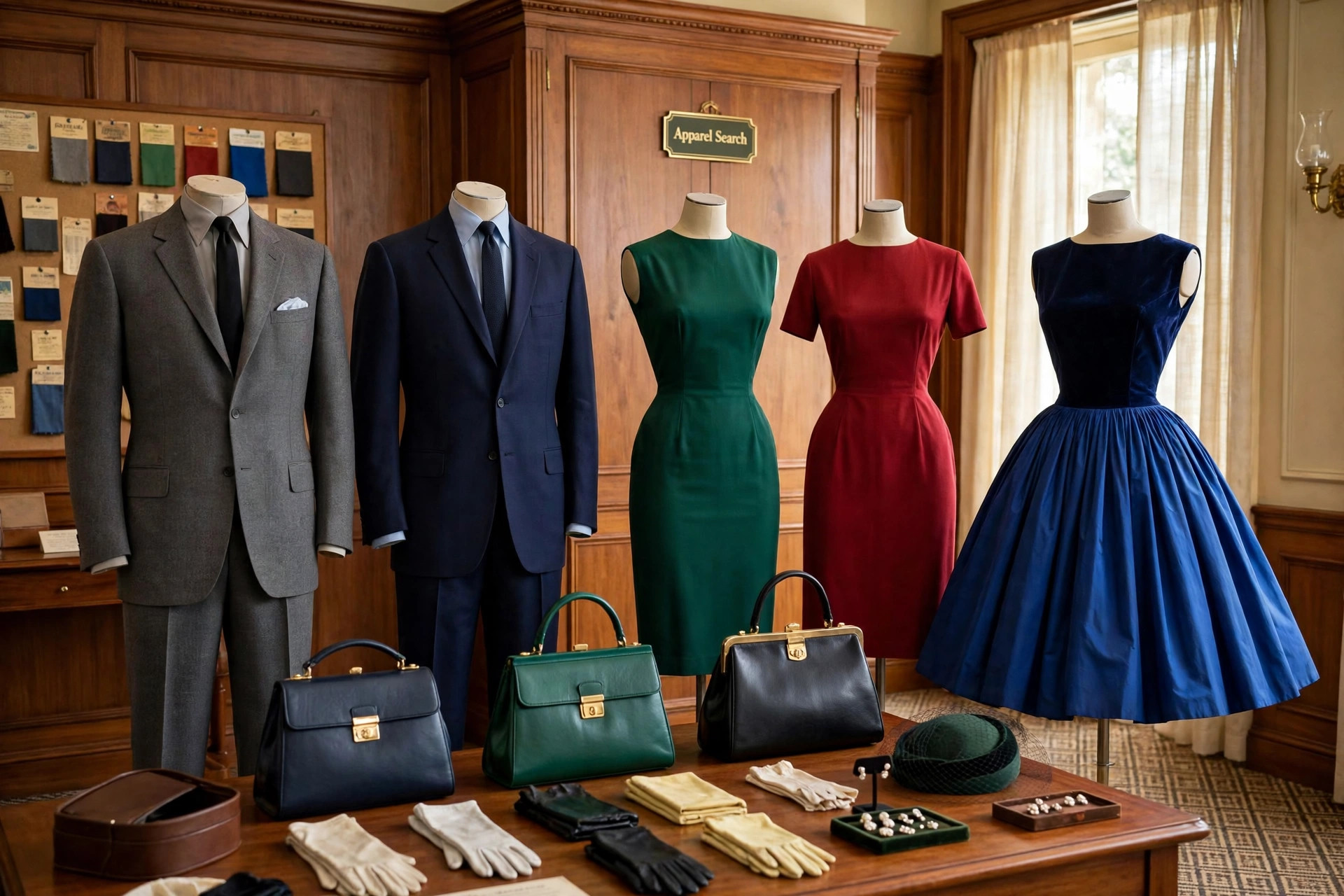
The suit. The foundation garment is the tailored suit, and its power is in its narrowness. Jackets sit close to the body, lapels stay slim, ties stay skinny, and the overall effect is a vertical, controlled line that photographs as authority. Shirts are crisp, hats and pocket squares finish the public version of a man, and the difference between a partner and a hopeful is often a matter of quality and confidence rather than a different category of clothing. Bryant uses that narrow range deliberately: when every man in a room is in a suit, the small differences — fit, fabric, grooming, ease — have to carry all the meaning, and they do.
The sheath and the shirtwaist. The women's office wardrobe runs on structure of a different kind: fitted sheath dresses that follow the body closely, shirtwaist dresses with defined waists, neat cardigans, gloves and structured handbags. These are working clothes for a working hierarchy, and their polish is a form of armour. A secretary's dress is not a lesser version of a client's dress; it is a different statement, made within tighter means, and the design keeps that distinction honest. Away from the office, the register widens — fuller skirts, cocktail dresses, evening fabrics — and the contrast between a woman's daytime discipline and her evening self becomes one of the show's quiet storytelling tools.
Colour as biography. The palette begins in the controlled neutrals and deep tones of the office — greys, navies, browns, burgundy, forest — and admits brighter, more saturated colour in domestic and evening scenes. Characters who are changing tend to change chromatically first: a bolder dress, a loosened tie, a print that would have been unthinkable two seasons earlier. Because the baseline is so disciplined, even a modest shift reads as an event, which is precisely the economy a long-running series needs. A costume department that spends its effects carefully can make a single new dress land like a plot twist.
Grooming and finish. Mad Men is a reminder that costume design includes everything the camera reads as dress: slicked and parted hair, clean-shaven faces in the early seasons, watches, cufflinks, polished shoes, cigarettes-era accessories and the exact way a coat is carried over an arm. None of these details is decorative. Together they produce the show's famous surface of order — a surface the drama then spends seven seasons cracking, while the clothes, poignantly, try to hold their line.
Character in Clothes
What the Clothes Say Before Anyone Speaks
Television costume earns its keep in the first seconds of a scene, and Mad Men is an unusually pure example. A man in a perfectly kept suit, arriving in an office where everyone else is in shirtsleeves, has announced his standards before he sits down. A woman whose dress is immaculate at the end of a chaotic day has told you how she survives. Bryant's wardrobe consistently does this preliminary work, sorting the room into the secure, the striving and the slipping, and it does so with period-correct tools rather than modern shorthand. There are no anachronistic shortcuts — no contemporary silhouettes smuggled in to make a character relatable. The relatability has to come through the period line itself.
In Mad Men, a suit is not interesting because it is unusual. It is interesting because it is exactly right.
The domestic wardrobe carries the other half of the argument. At home, the tailoring relaxes into sport shirts, knitwear and housecoats; wives' dresses move between polished daytime looks and more private, sometimes more fragile, registers. The gap between a character's public costume and private costume is where the series lives — it is a drama about people performing respectability — and the costume department is the one that builds both sides of that performance, garment by garment. When the performance fails, the clothes register it first: a loosened tie, a creased suit, a dress chosen for someone who is no longer there.
That is why the show's fashion influence, when it came, took the form it did. Viewers were not responding to individual spectacular outfits. They were responding to a complete, coherent system of dressing — one with rules they could actually adopt: fit your tailoring, narrow your palette, finish the details. A system can be sold in a shop. A spectacle can only be admired. The retail chapter that follows is the direct consequence of that difference.
The Making
One Designer, Seven Seasons
Long-running television rarely keeps a single costume author, and Mad Men did. Janie Bryant designed all seven seasons, a continuity the roster of credits supports without qualification, with Tiffany White Stanton sharing later Costume Designers Guild nomination credit — a detail worth noting because it reflects how senior costume departments actually work: a lead designer holding the creative line, supported by a team whose contribution the guild record recognises. For a guide reader, the practical lesson is to credit the system, not just the silhouette. Seven seasons of consistent period dressing is a departmental achievement — research, fitting, alteration, continuity tracking across episodes shot out of order — as much as an individual one.
The period itself is the other production challenge. The early 1960s sit close enough to the present that audiences have photographs of their own families in the same clothes, which makes errors unusually visible. A wrong lapel width or a modern shoe does not read as a small slip; it breaks the spell of a show that depends on the viewer believing, completely, in a sealed world. Bryant's solution was consistency as immersion: hold the line everywhere, in principals and background alike, so that no single frame gives the game away. It is unglamorous work, and it is the reason the glamorous moments land.
The Fashion Effect
The Cleanest Retail Case in Television
Most claims about a show's fashion influence rest on search data and sentiment. Mad Men's rests on sell-through, in the designer's own words. Bryant designed three Mad Men collections for Banana Republic, and, as she put it in a California Apparel News panel report, all of them sold out in two weeks. Read that plainly: a mainstream American retailer commissioned the costume designer of a cable drama to translate her screen wardrobe into shoppable clothes — not once, but three times — and the public bought each collection out within a fortnight. Alongside the Banana Republic work, Bryant also created a Brooks Brothers suit edition, taking the show's tailoring language to the most traditional address in American menswear. Between the two collaborations, the wardrobe's two poles were covered: the accessible high street and the heritage tailor.
Why did this wardrobe, of all wardrobes, convert so directly into retail? Because it was already a system of real clothes. The Banana Republic customer was not being asked to wear a costume; she and he were being offered the show's rules — the fitted sheath, the narrow suit, the finished details — in contemporary fabrics at contemporary prices. Our Fashion on Television overview calls this the translation effect, and Mad Men is its textbook case: the closer a screen wardrobe sits to a wearable system, the shorter the distance between watching it and buying it. Bryant's dual role — designer of the original and designer of the retail translation — removed the usual middleman, and the two-week sell-outs are what that removal looks like in numbers.
There is a second, quieter effect. The collections certified the costume designer as a commercial fashion designer in her own right — a credit line that, a generation earlier, would have been almost unthinkable for a television wardrobe department. Mad Men helped normalise the idea that the person dressing a hit series might also dress its audience, a path later shows and designers would follow as a matter of course.
Legacy
Why Mad Men Still Sets the Tailoring Standard
The legacy of Mad Men's costumes is not a single revived garment. It is a revived standard: the idea that fit is a form of storytelling, that restraint can be more distinctive than display, and that a television wardrobe can hold one coherent line for seven seasons and change how a mainstream audience dresses for work. In the years the show ran, its narrow suits and fitted dresses were credited across fashion coverage with sharpening contemporary office dressing; the documented, checkable core of that influence remains the Banana Republic and Brooks Brothers record described above, and this guide rests its claims there rather than on the wider commentary.
For the student of screen style, the show also completes a circuit in our Fashion on Television series. Patricia Field's New York wardrobes, covered elsewhere in this section, proved television could start trends by display. Bryant proved it could also start them by discipline — by showing an audience, week after week, what it looks like when clothes are worn with intention. Both lessons are now permanent parts of how costume designers, retailers and viewers understand each other. The suit, in Mad Men, was never just a suit. It was the argument the whole series was making, tailored to fit.
Common Questions
Questions & Answers
Who designed Mad Men's costumes?
Janie Bryant designed the costumes for all seven seasons of Mad Men on AMC, from 2007 to 2015. Tiffany White Stanton shared later Costume Designers Guild nomination credit, reflecting the senior team behind the wardrobe.
What is the signature Mad Men wardrobe?
The signature wardrobe is early-1960s tailoring worn with discipline: narrow suits with slim lapels and skinny ties for the men, and fitted sheath and shirtwaist dresses, structured handbags and gloves for the women. Fit, grooming and finish carry the meaning, so small differences in quality and ease signal rank and character.
Did Mad Men's costumes really sell in shops?
Yes, in the most directly documented way on this roster. Bryant designed three Mad Men collections for Banana Republic, and in her own quoted words all of them sold out in two weeks. She also created a Brooks Brothers suit edition, taking the show tailoring language to a heritage menswear house.
In This Series
The Fashion on Television hub this guide belongs to, the parent film section, and two companion guides to character-led television wardrobes.
Search Apparel Search