Fashion on Television · Screen Style Topics
The Marvelous Mrs. Maisel: Swing Coats, Hats and a Comedian Dressed for Battle
Donna Zakowska began The Marvelous Mrs. Maisel with a single garment — a pink coat that encoded her heroine's whole outlook on life — and sustained that colour-led argument across all five seasons of Amazon's late-1950s New York comedy. This guide follows the wardrobe piece by piece: the jewel-toned swing coats, the hats that are everything, the cinched dresses and the black-dress stage uniform — and traces an effect measured not in percentages, but in Bergdorf Goodman windows, a charity auction of the designer's coats, Vogue tutorials and two costumes acquired by the Smithsonian.
At a Glance
- Series
- The Marvelous Mrs. Maisel (Amazon, 2017–2023)
- Setting
- New York City in the late 1950s and early 1960s — the years Zakowska calls the height of women's clothing and couture
- Costume designers
- Donna Zakowska (all five seasons; Emmy winner for the series, 2019)
- Signature look
- Jewel-toned swing coats — pink first of all — cinched-waist dresses with full skirts, sculptural hats, gloves and finished accessories; a black dress and pearls as the stage uniform
- The fashion effect
- Exhibition, retail-event and fan-recreation: Bergdorf Goodman windows and a pop-up auctioning Zakowska's coats for the Fashion Manufacturing Initiative, two costumes acquired by the Smithsonian's National Museum of American History, and Vogue recreate-the-look tutorials
The Design Brief
New York at Its Best-Dressed Moment
The Marvelous Mrs. Maisel, Amazon's comedy-drama of 2017–2023, is set in the New York of the late 1950s and the very early 1960s — and its costume designer, Donna Zakowska, has been explicit about why that precise moment mattered to her. Researching the period through vintage photographs and the Vogue and Harper's Bazaar issues of those years, she concluded that the years from 1956 to 1960 were, in her words, absolutely the height of women's clothing and couture. The series therefore does not dress its heroine in a generic "fifties" of poodle skirts and nostalgia. It dresses her at the summit of a real fashion era, in the city that era called home, and it holds that standard across all five seasons of the show.
The heroine is Miriam "Midge" Maisel, a New York housewife whose marriage collapses and who discovers, in the wreckage, a ferocious talent for stand-up comedy — a career almost no woman of her world was permitted to want, let alone pursue. That collision is the wardrobe's whole brief. Midge must look, at every moment, like the most polished product of the Upper West Side domestic world she was raised for, while visibly becoming someone that world has no costume for. Zakowska's solution was not to dress the rebellion down. It was to dress it up: to make Midge's perfection itself the provocation, so that the better she looks, the more radical her presence in a late-night comedy club becomes.
Zakowska designed all five seasons of the series, and the continuity shows. This is a single designer's sustained argument about colour, hats and silhouette, developed over years rather than assembled season by season — and recognised as such by the industry, with an Emmy win for the series in 2019 among its honours. She has described herself as a storyteller through colour, still seduced by it, excited every time a new colour or fabric in the right tone appears. Watch any run of episodes with that sentence in mind and the series reorganises itself: Midge's life is told in colour decisions, and the wardrobe's famous joy is not decoration on top of the story. It is the story's native language.
The research discipline underneath the joy is worth underlining. Zakowska scoured hundreds of vintage fashion magazines, drew on her own New York roots and her background as an artist, and built the look from the period's own evidence — then heightened it, in her own phrase, by enhancing reality rather than copying it. The result is a wardrobe that scholars can exhibit and audiences can imitate, which is precisely what happened to it, as the fashion-effect section below describes.
The Wardrobe
The Maisel Wardrobe, Piece by Piece
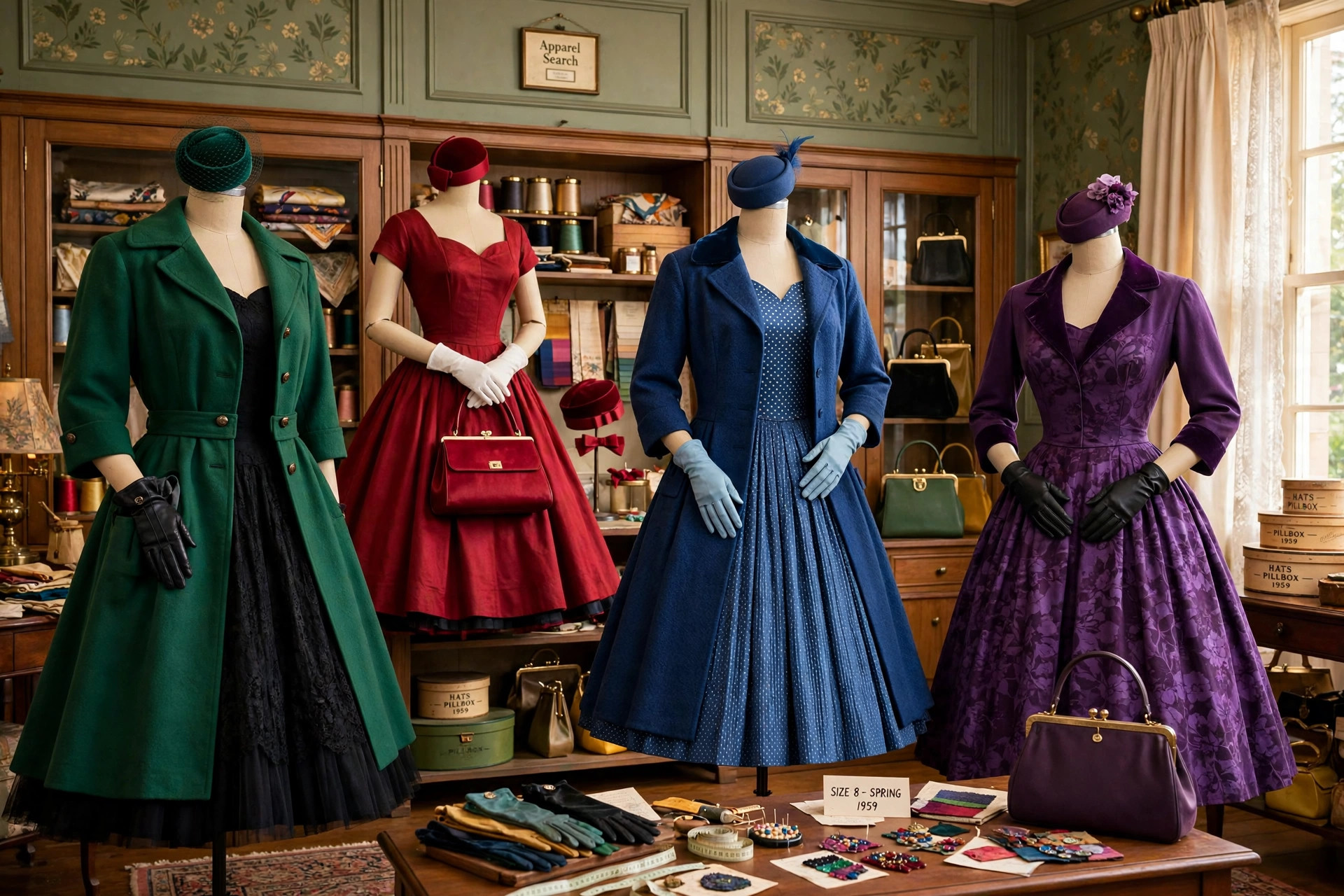
The swing coat, in jewel tones. The coat is this wardrobe's headline garment, and it arrives in the pilot itself: the first costume Zakowska designed for the show was Midge's pink coat, which became, in the designer's own explanation, her signature shade — pink, to Zakowska, referred to the rose-coloured glasses through which Midge sees the world. From that founding garment the coats multiply across the seasons in crimson, emerald, teal and a full jewel box of saturated tones, cut with the period's generous swing and almost always finished as a complete composition with hat, gloves and bag. Contemporary accounts of Zakowska's workshop describe racks of these coats alongside the dress forms displaying the show's highlights — a working wardrobe that looked, even off camera, like a confectionery of 1950s colour.
Hats, above all. "The hats are everything in the '50s," Zakowska told the Television Academy, and the series treats that sentence as law. Midge's millinery — sculptural, asymmetrical, saturated in tones like persimmon and emerald to match her wardrobe — is designed to express what the designer called Midge's perkiness and assertiveness. Zakowska grew up in a New York that still teemed with milliners, when women across income brackets ordered custom hats, and she brought that lived memory to the work, coordinating each hat with the hair department so the whole head worked as one design. A Maisel look without its hat is unfinished, and the series almost never leaves one unfinished.
The dress: cinched waist, full skirt. Under the coats stands the era's defining silhouette, executed at its height: dresses flawlessly cinched at the waist, skirts full over crinoline, cocktail frocks in printed silk, satin and crepe, day dresses in florals and polka dots. This is the late-1950s couture line — the legacy of Dior's post-war shaping — worn not as museum reconstruction but as a young woman's actual best clothes, chosen with intent and worn with appetite. The discipline of the silhouette is what allows the colour to sing: when every waist is placed and every skirt is engineered, a persimmon or a Tiffany blue reads as exuberance rather than chaos.
The black dress: a comedian's uniform. Against all that colour stands one deliberate exception. For her stand-up performances, Midge returns again and again to a basic formula established by the end of the first season: the black dress, with pearls. Zakowska kept that uniform recognisable across the run, adding more fanciful elements in later seasons — a deep red performance dress with loops of velvet and silk among them — without breaking its identity. The restraint is the point. On stage, stripped of the day's colour, Midge is not a lady amusing her friends; she is a professional at work, and the wardrobe insists the audience see the difference.
Accessories as finishing law. Gloves, structured handbags, a single chiffon bow, a slim ribbon belt, matched shoes: the Maisel wardrobe observes the late-1950s rule that an outfit is a total composition, completed before it leaves the house. It is one of the period details modern dressing has most thoroughly abandoned, and one of the ones the show's many imitators — guided by the tutorials discussed below — most enjoyed reviving.
Character in Colour
Pink First: Colour as Biography
Return to that first pink coat, because Zakowska's own account of it is the key to the whole wardrobe. Pink was not chosen because it photographed prettily, though it does, or because it suited the actor, though it does. It was chosen as psychology: the rose-coloured glasses through which Midge sees the world. Midge's defining trait is a refusal — comic, brave and sometimes costly — to see her life as diminished. Her husband leaves; she becomes a comedian. Doors close; she dresses as if they were about to open. A designer who begins from that trait, and encodes it in the heroine's signature colour, has done the deepest work costume design can do: she has made the audience feel a character's inner weather before a single joke lands.
"The first costume I designed for the show was Midge's pink coat. It became her signature shade because, to me, it referred to the rose-coloured glasses through which Midge sees the world." — Donna Zakowska
Colour storytelling of this kind runs through the whole cast's dressing, but its most charming evidence is generational. Midge's mother, Rose Weissman, is dressed as the source code of Midge's own polish — the older woman's elegance is the curriculum from which the younger woman learned — and the production's makeup and costume departments worked in parallel to keep that mother-daughter rhyme visible. When Rose's own story expands, her wardrobe is given colours dyed and constructed with the same seriousness as her daughter's: in one celebrated case, a single patterned cloth dyed in three different colourways — orange, blue and mustard among them — was engineered around a corseted bodice and matched to hat and shoes. The Maisel women do not simply wear beautiful clothes. They inherit, adapt and occasionally weaponise a family language of dress.
And then there is the sheer scale of the joy. For the fourth season alone, accounts of the production record Zakowska sketching more than fifty looks for Midge, while also dressing the show's thousands of extras and its full ensemble from her operation. A wardrobe that size, held to a single designer's colour intelligence across five seasons, is why the series' fashion feels authored rather than accumulated — and why, when institutions came to honour it, they honoured it as one body of work.
The Making
One Designer, Five Seasons
Donna Zakowska costumed all five seasons of The Marvelous Mrs. Maisel, from its 2017 beginning to its 2023 conclusion, and won the Emmy for the series in 2019 — an award that sits within a longer honours record for the show's costumes across its run. Longevity of that kind changes what a wardrobe can attempt. A designer who knows she will dress a character for years can plant a signature in a pilot — a pink coat — and trust the audience to carry its meaning through dozens of hours of television, deepening it each time the colour returns. She can establish a performance uniform in a first season and still be refining its variations in a fourth. The Maisel wardrobe's coherence is not an accident of taste; it is the compound interest of a single designer given time.
The workshop reality behind the polish was formidable: a New York-based operation at Steiner Studios in Brooklyn, walls papered with sketches, mood boards layered with vintage magazine clippings and fabric swatches, shelves of fashion history, and the logistics of dressing a principal cast in couture-standard period dress alongside crowds of extras numbered in the thousands. Zakowska also wrote the wardrobe down for the record, publishing her own book on the series' costumes in 2021 — a designer's archive of her own work, and one more sign that this production understood, while it was still running, that it was making something fashion history would want to keep.
The Fashion Effect
Windows, Auctions and a Museum: The Maisel Effect
The Marvelous Mrs. Maisel's fashion effect is documented richly — but in a different currency from search spikes, and this guide will not pretend otherwise. No search or sales percentage for this series appears in the research behind this page, and none is invented here. What the record shows instead is arguably more prestigious: the fashion establishment, the retail establishment and the national museum each, in turn, treating Zakowska's wardrobe as a cultural artefact worth staging in the real world.
Start on Fifth Avenue. Bergdorf Goodman, New York's temple of luxury retail, installed Midge Maisel-themed windows and an accompanying pop-up store, auctioning some of Zakowska's coats to benefit the Fashion Manufacturing Initiative. Consider what that means as a fashion-effect document: the city's most exacting department store judged that this television wardrobe belonged in its windows, and that the designer's actual coats were objects its customers would bid on for charity. Then consider the Smithsonian. The National Museum of American History selected two of Zakowska's costumes for its collection — the United States' national history museum deciding that dresses designed for a streaming comedy are part of the country's material story. Television costumes have been exhibited before; acquisition into that collection is a rarer and more permanent honour.
The third strand is the audience itself. Vogue analysed the show's looks and offered tutorials in recreating them — the fashion press functioning, in effect, as the wardrobe's pattern book, teaching readers how to assemble Midge's polish from their own closets and the current rails. That tutorial culture is the Maisel effect at street level: not a single garment spiking in the data, but a complete grammar of dressing — coat, hat, gloves, cinched dress, finished accessories — being relearned by viewers who had never been taught it. Our Fashion on Television overview sets this series alongside the sales-spike cases precisely to make the point that there is more than one way for a screen wardrobe to change how people dress. Maisel changed it the slow, institutional way: by being exhibited, auctioned, acquired and copied, all at once.
Legacy
What Mrs. Maisel Leaves Behind
The series ended in 2023, and its wardrobe's legacy is already secured in the most literal way a wardrobe's legacy can be: two of its costumes are in the Smithsonian's National Museum of American History, and its designer has published the definitive book on its making. Future students of late-1950s style will encounter Midge Maisel's pink coat and her jewel-toned swing coats not as stills from a cancelled fashion moment but as catalogued artefacts of American dress — which is a remarkable destination for a comedy about a housewife who was told, in every way her world could phrase it, to stay home.
Within television, Maisel's legacy is a standard of finish. It demonstrated, across five seasons, that a period wardrobe could be researched from the era's own magazines, built to couture discipline, organised by a rigorous colour intelligence — and still be funny, fast and warm, because the clothes were carrying character rather than competing with it. It also restored the hat to the centre of a modern heroine's silhouette, a restoration no one who has seen the series can quite un-see: after Mrs. Maisel, a bare head on a dressed-up character looks, faintly, like a sentence missing its punctuation. Designers of period series since have worked in its shadow whether they cite it or not; the bar for "height of the era, enhanced" dressing is now set where Zakowska set it.
And within the wider story this section tells — the story gathered on our Fashion on Television hub — Maisel stands as the exhibition case: the series whose effect is measured not in percentages but in windows on Fifth Avenue, bids at a charity auction, tutorials in Vogue and a place in the national collection. That is not a lesser kind of fashion effect. In the long run, it may prove the most durable kind of all, because institutions keep what clicks forget. Midge Maisel dressed as if the world were about to open for her. The fashion world's institutions, in the end, agreed to open — and to keep the coats.
Common Questions
Questions & Answers
Who designed The Marvelous Mrs. Maisel's costumes?
Donna Zakowska designed the costumes for all five seasons of the Amazon series (2017–2023), and won the Emmy for the series in 2019. The wardrobe's continuity — its colour storytelling, swing coats and hats — is the work of that single sustained authorship.
What is Midge Maisel's signature look?
Jewel-toned swing coats over cinched-waist dresses with full skirts, almost always completed by a sculptural hat, gloves and a structured bag. The founding garment was the pink coat Zakowska designed first for the pilot, which became Midge's signature shade — pink, the designer said, for the rose-coloured glasses through which Midge sees the world. On stage, Midge wears a contrasting uniform of a black dress with pearls.
What was The Marvelous Mrs. Maisel's fashion impact?
Its impact is documented through exhibition, retail events and fan recreation rather than a sales percentage. Bergdorf Goodman installed Midge Maisel-themed windows and a pop-up store auctioning Zakowska's coats for the Fashion Manufacturing Initiative; the Smithsonian's National Museum of American History acquired two of her costumes; and Vogue ran tutorials on recreating the looks.
In This Series
The Fashion on Television hub this guide belongs to, the parent film section, and two neighbouring mid-century wardrobes in the same series.
Search Apparel Search