Fashion on Television · Screen Style Topics
The Queen's Gambit: Chessboard Checks and a Wardrobe That Thinks Ahead
A limited series about chess had no business becoming a fashion event — until Gabriele Binder dressed its heroine's mind in checks, coats and colour, and built roughly 80 percent of the wardrobe by hand to do it. This guide traces Beth Harmon's arc from orphanage uniform to the white queen of Moscow, piece by piece, and follows the measured audience response: checkered coats clicked nearly 384 percent more often in the month after the debut, and a museum exhibition within the release season.
At a Glance
- Series
- The Queen's Gambit (Netflix, 2020), a limited series adapted from Walter Tevis's novel
- Setting
- The late 1950s and 1960s — Kentucky, American tournament cities, Paris and Moscow
- Costume designers
- Gabriele Binder
- Signature look
- Chessboard checks and black-and-white pattern, sculptural coats, turtleneck sweaters and a colour arc that ends in the white of the queen
- The fashion effect
- Stylight research: clicks for checkered coats rose nearly 384 percent after the debut versus the prior month; white wool coats and turtleneck sweaters rose at least 56 percent; the costumes were featured in a Brooklyn Museum virtual exhibition
The Design Brief
A Chess Prodigy, Dressed Move by Move
The Queen's Gambit is a limited series, released by Netflix in 2020 and adapted from Walter Tevis's novel, and its brevity is part of its costume design's power. There is no second season in which to correct a look or grow into one: the whole of Beth Harmon's life in clothes — from orphaned child to international chess champion — had to be designed, built and resolved inside a single, closed arc. The story is set in the late 1950s and the 1960s, moving from Kentucky through tournaments in the United States and abroad to a final confrontation in Moscow, and it follows a fictional chess prodigy whose growing sophistication and self-assurance, as the Brooklyn Museum put it when it exhibited these costumes, are written directly into what she wears.
Costume designer Gabriele Binder took that arc as a literal design brief. Beth begins the story in an orphanage uniform — a dull jumper dress over a collared shirt, the clothes of a child to whom clothing happens. The turning point, in wardrobe terms, comes when the teenage Beth wins prize money and buys clothes for herself for the first time: from that moment, dress becomes one of the ways she thinks. Binder and the production talked constantly, by the designer's own account in interviews around the series, about where Beth is in the story at each stage — more and more glamorous as she rises, sometimes trying to be other people, until at the end she is finally comfortable in the world of chess and, not coincidentally, in her clothes. Costume here is not illustrating the plot. It is keeping score of it.
The scale of the making deserves emphasis, because it overturns an easy assumption about a glossy period series: that its clothes were found, borrowed or bought from vintage stock. Roughly 80 percent of the costumes in The Queen's Gambit were handmade by Binder's team. That figure explains the wardrobe's unusual coherence. When a department builds most of what appears on screen, it controls colour, pattern scale, fit and finish to a degree that assembled vintage can rarely match — and control mattered enormously on this production, because the wardrobe's patterns were being asked to rhyme with the most famous patterned object in the world: the chessboard.
Binder drew, for Beth, on the fashion revolution of the 1960s itself. She has named Cristóbal Balenciaga as a favourite and a particular inspiration — his pure, sculptural 1960s work — and the series' wardrobe moves through the decade's changing silhouettes as Beth moves through the chess world: conservative late-1950s shapes first, then the cleaner, bolder, more geometric dressing of the sixties, inflected by place. New York sharpens her; Paris makes her more French in spirit; Moscow, at the climax, dresses her as something close to royalty. The geography is in the garments, but the constant is the game.
The Wardrobe
The Queen's Gambit Wardrobe, Piece by Piece
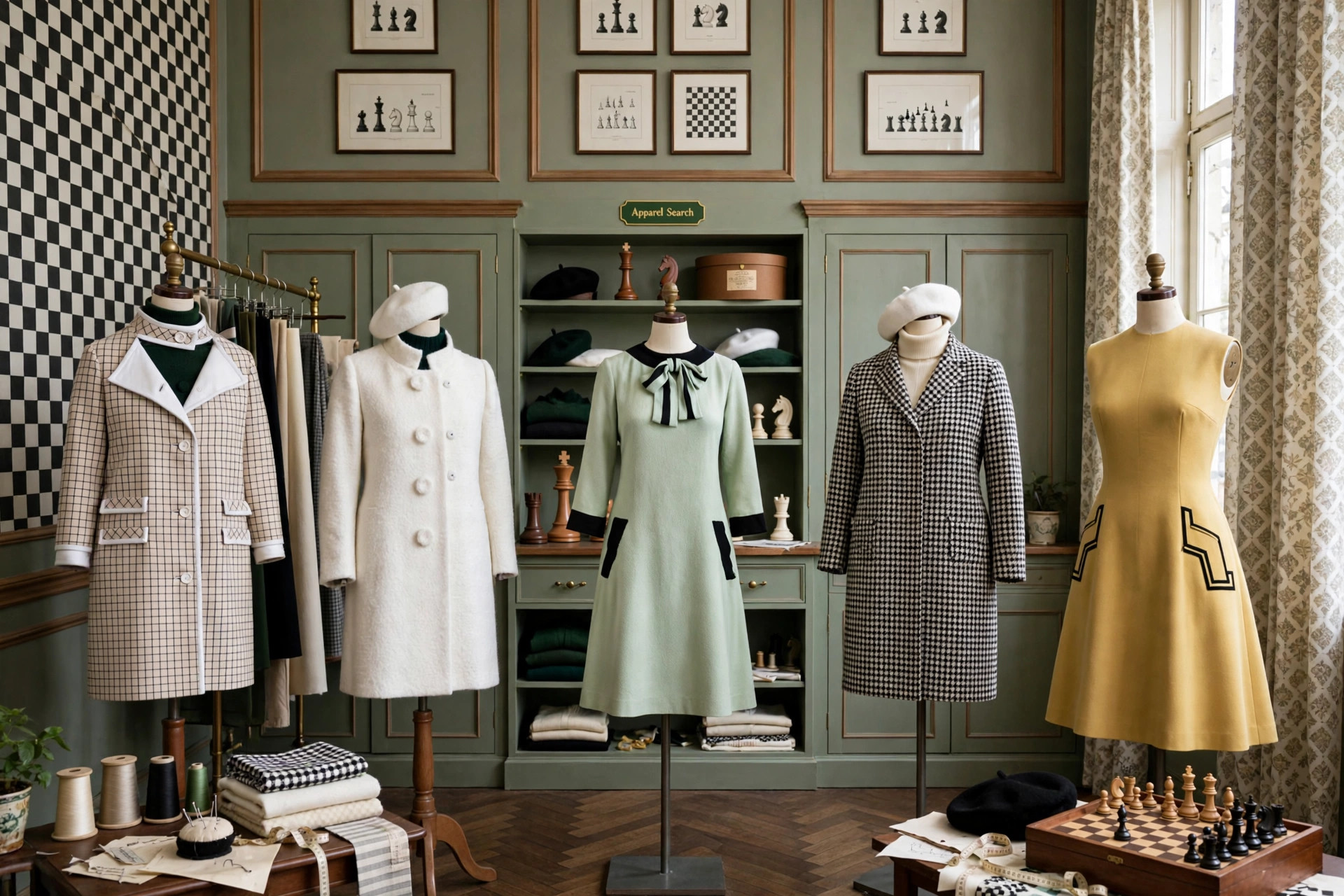
Checks, plaids and the board itself. The signature device of this wardrobe is pattern used as biography. Checks, plaids and geometric prints recur on Beth from her first self-bought clothes onward — a plaid pinafore bought with early winnings is an early landmark — and they intensify as her chess identity strengthens. Binder explained the logic directly: Beth should have felt more confident in a checkered outfit, and the contrast of the check mirrors the nature of the game itself — decisive, win or lose. Black-and-white patterning does double work throughout the series, reading simultaneously as authentic 1960s op-art-inflected fashion and as the board carried into cloth. Background players are often patterned too, so that Beth's world seems tiled by the game she cannot stop seeing.
Coats as armour. If one category carried this wardrobe off the screen, it was coats — and the fashion-effect numbers below prove it, with checkered coats and white wool coats leading the audience response. Within the story, the coat is Beth's travelling armour: the garment of arrivals, departures and tournament halls, worn over everything and therefore the first thing every room sees. Binder gives her structured, sculptural coats in the Balenciaga-inflected spirit she admired, and reserves the most resonant of all for the end: in Moscow, Beth appears in a long white coat with a white hat, a combination the production itself recognised, in discussion, as making her look like the white queen. The entire series' costume argument lands in that single image — the player become the piece, on her own terms.
Turtlenecks and knits. The turtleneck sweater belongs to Beth's serious, interior register: the clothes of practice, study and concentration rather than performance. It is significant that turtlenecks were among the garments the audience reached for afterwards — viewers had understood, without being told, that this plain piece of knitwear was part of the character's intelligence, not just her style. Sleek, minimal and repeated, the turtleneck is the wardrobe's quietest garment and one of its most eloquent.
The Peter Pan collar and the gamine line. Beth's earlier and softer looks lean on details the period genuinely loved: Peter Pan collars, neat shirt-dresses, A-line shapes and shorter hemlines as the sixties progress. Binder uses these to keep the character's youth visible inside her growing glamour — Beth is formidable, but she is also young, and the wardrobe never lets the audience forget either fact for long. The collar in particular becomes a kind of punctuation, reappearing as a reminder of the girl inside the champion.
Colour: from drab to decisive. The series' colour story runs from the orphanage's dull greys and browns through the pastels and prints of Beth's self-invention to the strong, saturated statements of her championship years — and finally to that closing white. It is a disciplined arc, and its discipline is why individual pieces became so identifiable: in a wardrobe where every colour is earned by the story, a green dress, a red coat or a white finale registers as an event.
Character in Pattern
Dressing Like the Game
Most costume design uses clothes to say who a character is. Binder's wardrobe for The Queen's Gambit does something rarer: it shows how its character thinks. Beth Harmon experiences the world spatially and strategically — she famously visualises chess games whole, playing them out above her — and the wardrobe externalises that mind. Grids, checks and contrasting blocks turn her body into a board on which the audience can watch positions develop. When her life is controlled, the patterning is crisp and deliberate. When she is struggling — with loneliness, with addiction, with the costs of her gift, all of which the series treats seriously — the polish of the dressing becomes part of the tension: the more immaculate the surface, the more the audience is invited to wonder what it is costing to maintain.
"Beth should have felt more confident in a checkered outfit" — the contrast of the check, Binder said, mirrors the game itself: decisive, win or lose.
The wardrobe also tracks a subtler journey, from imitation to authorship. The young Beth dresses by absorbing the women and the cities around her — her adoptive mother's world first, then the sharper styles she encounters as she travels, each place lending her a version of herself to try. Binder has described those stages openly: a New York influenced by the Factory Girl moment, a Paris that turns her toward a French soubrette spirit in the lineage of a young Catherine Deneuve or Françoise Hardy, a Moscow look that mixes competitive killer instinct with deliberate femininity. The point of the sequence is its ending. By the final episode, Beth is no longer dressed as anyone else. The white queen of the Moscow scenes is not an imitation of a style icon; she is the style, arrived at last at a self she does not need to borrow.
That is why this limited series, with no continuing wardrobe to maintain, rewards close reading more than almost any other in this section. Every garment was placed inside a finished story, by a department that built most of them by hand, under a designer who treated pattern as psychology. The chess was always the subject. The clothes are how the series thinks about it out loud.
The Making
Handmade: Inside Binder's Department
The figure that defines this production's craft is the one already quoted: roughly 80 percent of the costumes were handmade by Gabriele Binder's team. Sit with that for a moment. A period series spanning two decades of fashion, several countries and a large cast of players, officials and onlookers, built four-fifths of its clothing from scratch rather than sourcing it. Handmaking on that scale is not nostalgia; it is strategy. It lets a designer fix the exact scale of a check so it reads correctly on camera, repeat a silhouette in graduated colours across a character's development, and fit garments to the precise sculptural line — Balenciaga's ghost again — that the story's visual argument requires.
The industry noticed. Binder's work on the series was honoured by her peers in the costume profession's own awards, and the costumes were then given the treatment usually reserved for historic dress: exhibition. The Brooklyn Museum presented the wardrobe in a virtual exhibition, "The Queen and the Crown," created with Netflix, offering digitally rendered, interactive 360-degree views of costumes from The Queen's Gambit alongside those from The Crown, set within a rendering of the museum's Beaux-Arts Court, with a virtual panel discussion involving Binder herself. A wardrobe designed for a streaming series, examined by a major museum's fashion curator as material culture — that is the making story's real ending, and it arrived within the series' own release season.
The Fashion Effect
384 Percent: A Trend Measured in Clicks
Television fashion effects are often asserted in the language of vibes. The Queen's Gambit's was measured in clicks, and the numbers remain some of the cleanest in this entire field. Research by Stylight, reported by Footwear News and by Chess.com, compared audience behaviour after the series' debut with the month before its release. Clicks for checkered coats — a garment Beth wears memorably — rose nearly 384 percent. White wool coats and turtleneck sweaters, two other pillars of Beth's wardrobe, each rose by at least 56 percent. The pattern in the data is the pattern in the wardrobe: the audience did not respond to "1960s style" in the abstract. It responded to specific, named, repeatable garments it had watched a character think in.
The mechanism is worth spelling out, because our Fashion on Television overview returns to it across many series. A limited series concentrates attention the way a film does, but at television length: viewers lived inside Beth's wardrobe for hours, watched it evolve, and finished the story with its key pieces fixed in memory as a complete, purchasable system — a checkered coat, a white coat, a turtleneck, a neat collar. Retail did not need to invent the translation. The wardrobe itself was already modular, wearable and priced, in its high-street echoes, within reach. The chessboard checks that signified a mind at work on screen signified, on the street, that the wearer had been paying attention.
There is a further, quieter point in the Stylight figures: two of the three surging categories are coats, the most considered purchase in most wardrobes. Costume-driven trends usually peak in accessories — the cheap, low-risk souvenir of a look. The Queen's Gambit moved coats, which suggests its audience was not buying a novelty but adopting a silhouette. Binder's sculptural, handmade, Balenciaga-inflected outerwear had communicated its quality through the screen, and viewers went looking for the real thing in the only way the data can record: one click at a time, nearly four times as often as the month before.
Legacy
The White Queen Endures
The Queen's Gambit's legacy begins with a proof. Before 2020, the fashion industry's working assumption was that a costume-driven retail surge required either a long-running series, with seasons of repetition, or a film with a major marketing machine. A seven-part limited series about chess — a subject with no existing fashion constituency — disproved both halves of that assumption in a single release window. What it had instead was total design coherence: one designer, one closed story, one wardrobe built mostly by hand to a single visual argument, and an audience that finished the story wanting to wear its conclusion. The Stylight numbers and the Brooklyn Museum exhibition, arriving together, mark the moment a streaming limited series was treated simultaneously as a retail event and as museum-worthy design.
Its influence on costume practice is just as concrete. Binder's method — pattern as psychology, colour as biography, a final look that resolves the wardrobe's whole argument in one image — has become a reference point for how to dress a character whose interior life is the real subject. The white queen finale is now the standard example: a costume that a viewer who had somehow missed every line of dialogue could still read perfectly. Within the wider story told by our Fashion on Television hub, The Queen's Gambit is the case that proves depth can beat duration — that a wardrobe does not need years to enter fashion's memory, if every piece in it means something.
And the garments themselves have settled into the modern wardrobe's permanent vocabulary. The checkered coat, the white wool coat and the black turtleneck were classics before Beth Harmon wore them; classics, however, need periodic re-authorisation, a reminder to a new generation that these pieces still work and still signify. The Queen's Gambit gave that reminder with unusual precision, attaching each revived garment to intelligence, discipline and self-possession. People did not just want to look like Beth. They wanted to look like someone who had already seen the whole board — and thanks to Gabriele Binder, they knew exactly what that looked like.
Common Questions
Questions & Answers
Who designed The Queen's Gambit's costumes?
Gabriele Binder designed the costumes for the Netflix limited series (2020). Roughly 80 percent of the costumes were handmade by Binder's team, a scale of in-house making that gave the wardrobe its unusual coherence of colour, pattern and fit.
Why does Beth Harmon wear so many checks?
Binder used the chessboard itself as the wardrobe's pattern source. She explained that Beth should have felt more confident in a checkered outfit, and that the contrast of the check mirrors the game itself — decisive, win or lose. Checks, plaids and black-and-white patterning therefore track Beth's growing chess identity throughout the series.
What was The Queen's Gambit's fashion impact?
Stylight research found clicks for checkered coats rose nearly 384 percent after the debut compared with the prior month, while white wool coats and turtleneck sweaters rose at least 56 percent. The costumes were also featured in a Brooklyn Museum virtual exhibition, The Queen and the Crown, presented with Netflix.
In This Series
The Fashion on Television hub this guide belongs to, the parent film section, and two neighbouring wardrobes — one maximalist, one in jewel-toned 1950s polish.
Search Apparel Search