Fashion on Television · Screen Style Topics
Euphoria: The Wardrobe That Dressed a Generation
Most television costumes are admired. Euphoria's were adopted — copied the same week, searched for the same night, and worn to real parties by an audience that treated a fictional high school's hallways as a lookbook. This guide tells the design story behind that wardrobe: how Heidi Bivens built a contemporary dress code out of vintage racks, current labels and custom pieces across two seasons, how the fashion industry answered with a runway collection of its own, and how Natasha Newman-Thomas dressed the same characters five years on for the third season.
At a Glance
- Series
- Euphoria (HBO, 2019– ), created by Sam Levinson
- Setting
- The fictional East Highland, California — a suburban high school and, in season three, the same characters five years later
- Costume designers
- Heidi Bivens (seasons 1–2); Natasha Newman-Thomas (season 3)
- Signature look
- Contemporary party dressing as character language: cut-out dresses, glitter and rhinestones, vintage denim, cargo pants — and Rue's maroon hoodie
- The fashion effect
- Searches for black cut-out dresses up 890 percent after the season two premiere; Coperni's Fall 2022 collection documented as directly inspired by the show
The Design Brief
Dressed Like Real Life, Only More So: Bivens's Method
Heidi Bivens came to Euphoria with an unusual double fluency: a career that moved between fashion styling and film costume design, on productions where clothes had to read as both character and genuine contemporary style. That fluency became the show's founding decision. The teenagers of East Highland would not be dressed the way television usually dresses teenagers — in neutral, repeatable outfits chosen to disappear. They would be dressed the way style-conscious young people actually dress: deliberately, expressively, and as a form of self-invention, with each character's closet researched as an individual wardrobe rather than a costume rack.
The method was sourcing as much as designing. Bivens and her department mixed current designer and high-street labels with deep vintage hunting and custom-made pieces, so a single episode could move from a thrifted T-shirt to a runway dress without breaking the show's reality. The clothes were contemporary — the series is set in the present day — but the eye behind them was editorial: silhouettes were chosen for how they would land in a screenshot, a GIF, a social post. In the streaming era, a costume's second life is as an image, and Euphoria's wardrobe was built by someone who understood that from the first fitting.
The proof of the method's importance is the artifact it produced. When the show's production partner A24 published Euphoria Fashion, Bivens's book documenting the first two seasons' wardrobes, it treated a television costume department's work the way publishers treat a designer's archive — character by character, look by look. Television costume designers rarely get a monograph. Bivens got one because her department had not merely dressed a hit series; it had published, in effect, a working guide to how a generation wanted to look.
Season two sharpened the approach rather than softening it. The party scenes grew more formal, the silhouettes bolder, the vintage deeper — and the audience response, measured in the fashion-effect section below, grew with it. First, the wardrobe itself, piece by piece.
The Wardrobe
The Euphoria Wardrobe, Piece by Piece
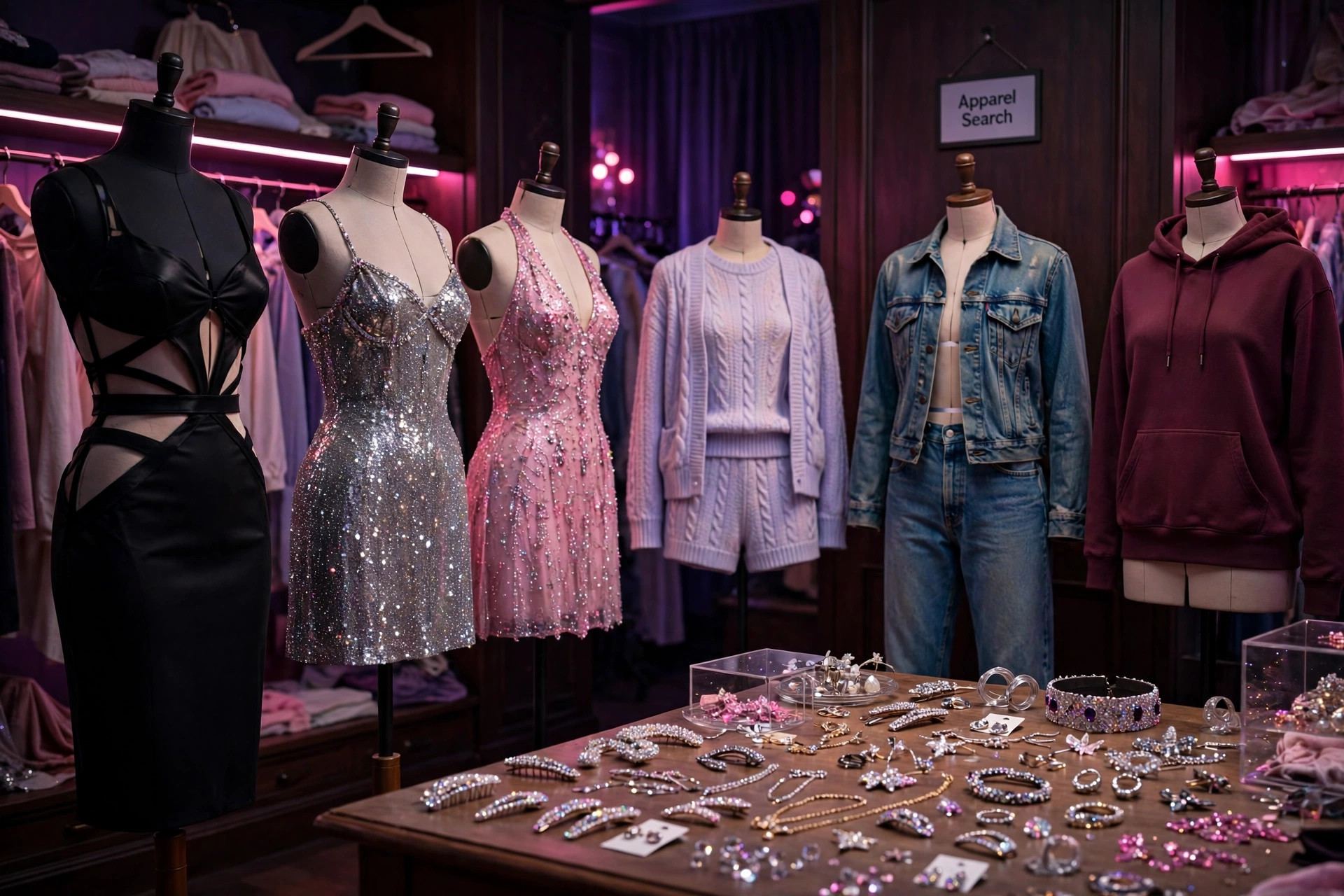
The cut-out dress. The signature garment of the Bivens era is a party dress engineered around absence: straps, cut-outs at the waist and hip, a silhouette that reads as both dress and diagram. Its defining moment came in the season two premiere, when Maddy Perez's black cut-out dress turned a New Year's Eve party scene into the show's most consequential fashion image — consequential in the literal, measurable sense detailed below. The cut-out dress condensed the whole Bivens philosophy into one garment: contemporary, body-conscious, unapologetically attention-seeking, and — crucially — findable. A viewer did not need a costume shop to join in; she needed a search bar.
Glitter, rhinestones and the party uniform. Around the cut-out dress sits the show's wider party vocabulary: sequinned and rhinestoned mini dresses, sheer layers, corset tops, platform shoes and going-out sets in saturated color. Euphoria treated teenage party dressing with the seriousness fashion gives a runway — every entrance an occasion, every outfit a thesis about the wearer. That seriousness is why the looks travelled: they were already styled to editorial standard before the audience ever screenshotted them.
The maroon hoodie. At the opposite pole stands the most emotionally loaded garment in the series: Rue Bennett's oversized maroon hoodie, her late father's, worn as armor through the first two seasons. It is the anti-costume inside a famous-for-costumes show — shapeless, repeated, unglamorous — and its power is precisely that repetition. In a wardrobe of transformations, the hoodie is the constant, and its absence in season three, as the later section of this guide describes, was itself a design statement about a character unmoored.
Denim, cargos and the everyday base. Beneath the party layer, the show's daily uniform runs on baggy denim, cargo pants, oversized tees, flannel and sneakers — the thrifted, borrowed, lived-in base that made the glamour believable. Bivens's vintage sourcing showed most quietly here: clothes that looked found rather than issued, because many of them were.
Beauty as part of the costume. No account of the wardrobe is complete without the glitter tears and graphic liner that framed it. The makeup and the clothes were designed as one image — rhinestones answering rhinestones — and together they made the show's stills instantly identifiable at thumbnail size, the scale at which modern fashion fame actually happens.
Character in Clothes
Five Closets, Five Arguments
Euphoria's costume design does its storytelling by closet. Each principal's wardrobe is a coherent argument about who that person is trying to be, and the arguments are legible at a glance — the skill that separates costume design from mere styling.
In Euphoria, getting dressed is never neutral: every character's closet is a claim about who they intend to be that day.
Maddy dresses as a declaration of control — vintage designer pieces, sharp party silhouettes, jewellery with presence. Her clothes say she has already decided how the room will see her. Cassie, by contrast, dresses in pursuit: softer, more romantic, more imitative, her wardrobe visibly reaching toward an ideal assembled from images — a contrast the third season would push to its limit. Jules is the wardrobe's experimentalist, mixing vintage, art-school eclecticism and daring pieces that treat identity itself as the material. Lexi, the observer, dresses in a quieter, retro-inflected register — the closet of someone watching the party as much as attending it. And Rue dresses to disappear into comfort: menswear-inflected, oversized, anchored by the hoodie.
The system matters because it is teachable. Viewers did not just copy outfits; they identified which closet was theirs and shopped the argument, not the item. That is a deeper kind of fashion influence than a single trending dress — it is a set of style identities, distributed by a television series, and it explains why the show's effect outlasted any one episode's numbers.
The Handover
Five Years Later: Newman-Thomas Takes the Helm
The third season posed the hardest brief in the show's life: the same characters, five years after high school, in adult lives their teenage closets could not have predicted. It also brought a new designer. Heidi Bivens stepped back after two seasons, and costume design passed to Natasha Newman-Thomas, who had previously worked with creator Sam Levinson on The Idol. "Those are big shoes to fill," Newman-Thomas told The FADER. "Heidi did such a phenomenal job in the first two seasons." Her task was expansion, not erasure: to grow the universe Bivens built into adulthood.
Her method leaned even harder into vintage and sourcing as storytelling. Working from the Warner Brothers costume house, Los Angeles vintage shops and resale platforms, she built each character a five-year biography in clothes. Maddy, now adjacent to Hollywood power as a talent manager's assistant, dresses in vintage designer finds — Gucci, Alaïa, McQueen, Moschino — power expressed through access and taste. Lexi, a writer's assistant who rejected fast fashion at liberal-arts college, wears primarily vintage, including seventies suits and shirts, with contemporary accessories mixed in. Rue, living nomadically, collects clothes from wherever she lands — Newman-Thomas describes her as a chameleon whose wardrobe reflects her surroundings — and the famous maroon hoodie, her father's, is gone: the security blanket has been lost with the life that held it.
The season's set pieces show the range. Cassie's bridal look was a custom collaboration between Newman-Thomas and designer Jackson Wiederhoeft, built in multiple iterations so the character could command the room in every phase of her wedding. Nate, performing success he has not secured, is dressed in Bottega Veneta — what Newman-Thomas calls performative workwear, luxury doing the talking for a character faking establishment. And in a first for the series, the costume department made the influence official: Newman-Thomas partnered with resale platform Depop on a weekly Euphoria edit dropping alongside each episode, curating pieces and styling cues from that week's characters — the show selling its own language back to its audience, in the open.
The Fashion Effect
An 890% Dress: The Effect, Measured
Television fashion effects are usually asserted. Euphoria's was measured, twice over. After the season two premiere in January 2022, Vogue Business trends editor Lucy Maguire reported the figure that has since become the show's fashion shorthand: searches for black cut-out dresses rose 890 percent, following Maddy's dress. One garment, one episode, a near nine-fold search spike — the cleanest single data point in modern television costuming, and the reason this series anchors any serious account of screen-driven fashion.
The industry's answer came from the runway. WWD documented Coperni's Fall 2022 collection as directly inspired by the show — the direction of influence reversed, a Paris label taking its cue from a high-school drama's costume department. That reversal is the Euphoria story in miniature: Bivens had dressed fiction in real fashion so fluently that real fashion began dressing itself in the fiction.
The mechanism matters, and our Fashion on Television overview names it: identification plus availability. The audience was the characters' own age, the clothes were contemporary and shoppable at every price level, and each episode functioned as a weekly drop. Where a period drama sends viewers to admire, Euphoria sent them to search — and the search data, the resale edits and the runway citation are the receipts.
The Legacy
What Euphoria Changed
Euphoria's legacy in costume design is a change of job description. Before it, a contemporary-set series dressed its cast well or badly, but the wardrobe was rarely the story. After it, the costume department of a youth-skewing series is understood — by networks, by brands, by the designers themselves — as a fashion actor in its own right: capable of moving search volume in a weekend, of earning its designer a publisher's monograph, of pulling a Paris runway into its orbit.
The handover to season three completes the lesson. Bivens built the language; Newman-Thomas proved it could survive its author, translating the same five closets into adult lives without breaking their grammar — Maddy still commanding rooms, Cassie still reaching, Lexi still vintage, Rue still armored, now in found clothes instead of a father's hoodie. A wardrobe that can be inherited is a wardrobe that was designed as a system, not a series of looks. That, more than any single dress, is what the next generation of television costume designers learned from East Highland — and why this guide's series, our Fashion on Television hub, treats Euphoria as the contemporary era's defining case.
Common Questions
Questions & Answers
Who designed Euphoria's costumes?
Heidi Bivens designed the first two seasons (2019–2022) and documented them in A24's book Euphoria Fashion. For the third season, set five years after the high-school years, costume design passed to Natasha Newman-Thomas, who had previously worked with series creator Sam Levinson on The Idol.
What is Maddy's black cut-out dress, and why does it matter?
The black cut-out dress Maddy Perez wears in the season two premiere became the show's single most measured fashion moment: Vogue Business trends editor Lucy Maguire reported that searches for black cut-out dresses rose 890 percent after the premiere. The dress condensed the Bivens method — a bold, body-conscious party silhouette, sourced and styled like real contemporary fashion rather than built like a traditional costume.
How did Euphoria's approach differ from normal television costuming?
Bivens dressed the cast the way people actually shop: a deliberate mix of contemporary labels, vintage finds and custom pieces, researched from real youth style rather than invented in a costume shop. The effect was that viewers could — and did — buy the same language of clothes the morning after an episode aired, which is why the show's fashion impact shows up in search and retail data rather than only in praise.
In This Series
The Fashion on Television hub this guide belongs to, the parent film section, and two companion guides — a goth school uniform and a chessboard of sixties tailoring.
Search Apparel Search