Fashion on Television · Screen Style Topics
Wednesday: The Goth Uniform That Went Mainstream
A school uniform in black and white, a heroine allergic to color, and a dance in a ruffled black dress: Wednesday took the most restricted palette on television and turned it into the season's loudest fashion signal, carrying goth and dark-academia style from the subculture shelf to the high street. This guide tells the design story behind that wardrobe — how Colleen Atwood, brought on by Tim Burton, and co-costume designer Mark Sutherland built a complete monochrome world at Nevermore Academy, and how the data platforms measured what happened when the audience started dressing in it.
At a Glance
- Series
- Wednesday (Netflix, 2022– ), the Addams Family series developed with Tim Burton as director and executive producer
- Setting
- Nevermore Academy, a boarding school for outcasts in Jericho, Vermont — and the colorful "normie" town beyond its gates
- Costume designers
- Colleen Atwood (lead) with Mark Sutherland as co-costume designer
- Signature look
- Monochrome goth: the black dress with a white collar, the striped Nevermore uniform, braids, and black tailoring — color reserved for everyone else
- The fashion effect
- The show helped mainstream goth and dark-academia style; Lyst data in trend coverage put Rick Owens searches up 200 percent, chokers up 81 percent and black items up 169 percent
The Design Brief
A Heroine in Black and White: Atwood's Restriction
Every great costume system begins with a rule, and Wednesday's is the strictest on modern television: the heroine does not wear color. Colleen Atwood — one of the most decorated costume designers in film history and Tim Burton's longtime collaborator, brought onto the series by Burton himself — built the show's wardrobe on that single refusal. Wednesday Addams exists in black and white: black dresses, white collars, striped knits, black tailoring, braided hair. The world around her is allowed the full spectrum, and the contrast is the character. She does not need dialogue to announce that she is not of this place; the palette announces it in every frame.
The restriction sounds simple and is anything but. A monochrome heroine must remain visually rich across whole seasons without the designer's easiest tool — color — to vary her. Atwood and co-costume designer Mark Sutherland answered with texture, silhouette and pattern: stripes against solids, lace against tailoring, the soft ruffle against the severe collar, so that black is never one note but a full scale. The discipline was recognised by their peers: Atwood and Sutherland share the Costume Designers Guild win for the first season, and the pair returned as the credited designers for season two — the monochrome system, like the character, does not bend.
The setting sharpens the design problem beautifully. Nevermore Academy is a school for outcasts — werewolves, vampires, sirens, gorgons — each faction with its own visual identity, all of it orbiting a heroine who out-outcasts them all in a school uniform. Around her, the town of Jericho dresses in cheerful small-town color. The wardrobe's geography is therefore a map of belonging, drawn in clothes — and the heroine belongs nowhere, in black and white, by design. First, the wardrobe itself.
The Wardrobe
The Monochrome Wardrobe, Piece by Piece
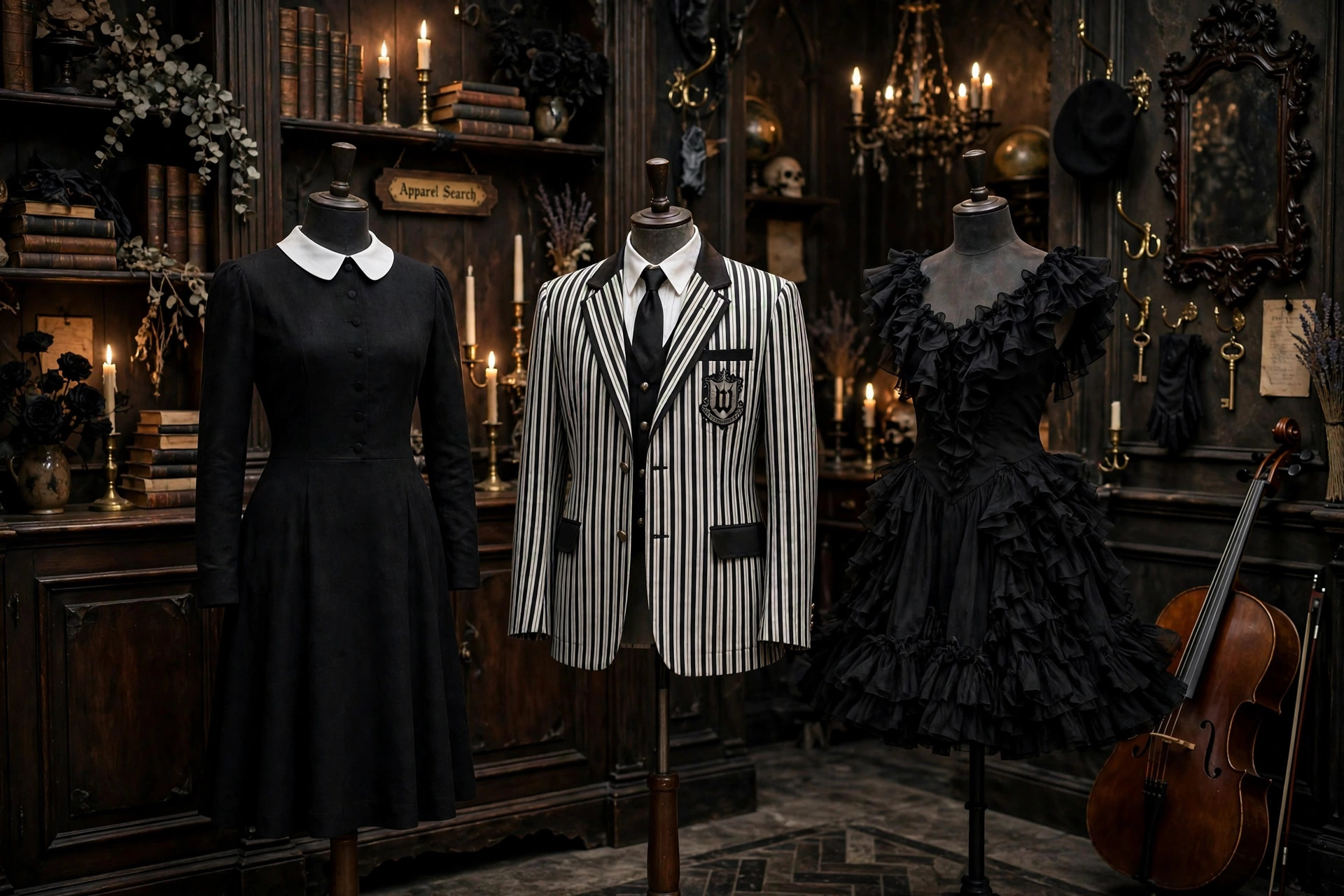
The black dress with the white collar. The signature garment updates the character's historic silhouette — the black dress with its crisp white collar has been Wednesday Addams's emblem since the character's earliest incarnations — into a contemporary, wearable key piece. In the series it functions as her civilian uniform: severe, neat, faintly funereal, and instantly the most copied item in the show. A collar is a small thing; placed in white against an all-black wardrobe, it became a logo the audience could sew, buy or thrift in an afternoon.
The Nevermore uniform. The school uniform — striped blazer, skirt, shirt and tie in the academy's colors — performs the classic uniform trick in reverse. Uniforms usually erase individuality; Wednesday's is customised by its wearer into another expression of it, worn with a precision and deadpan that make the regulation garment read as a personal statement. Around her, the same uniform on other students becomes a study in how one garment carries many characters — the faction scarves, badges and styling choices of Nevermore's tribes all register against the shared base.
The dance dress. The first season's most famous single costume is the black ruffled dress Wednesday wears to the school dance — layered, dramatic, unmistakably a gown and unmistakably hers, worn for a dance sequence that, as the fashion-effect section below records, spawned endless recreations. The dress matters to the design story because it proves the system's range: inside a strict monochrome rule, the department could still produce a showpiece — proof that restriction, handled well, is a generator rather than a limit.
Tailoring, knits and the everyday black. Between the emblem pieces, the wardrobe runs on black tailoring, striped knitwear, oversized dark layers and practical boots — a complete, wearable grammar of goth dressing drawn from real subculture staples and finished to screen standard. The cello, her constant companion, completes the silhouette so consistently that it functions almost as an accessory: black dress, braids, cello case — a pictogram the audience learned in one episode.
Color, used against her. The system's final piece is everyone else. Her roommate Enid's rainbow-bright wardrobe — color as personality, worn with pride — is the monochrome rule's necessary opposite, and their shared dorm room, split visually down the middle, became one of the show's defining images. Costume design rarely gets so clean a thesis statement: two closets, two worldviews, one window between them.
Character in Color — and Its Absence
A Whole School, Dressed Against One Girl
Wednesday's costume design does its storytelling by contrast at every scale. At the scale of a room, it is Wednesday's black against Enid's color. At the scale of the school, it is the heroine's severity against the factions' flamboyance — each outcast tribe at Nevermore given its own textures and signals, so the academy reads as a wardrobe of subcultures with one monochrome still point at its center. At the scale of the town, it is Nevermore's gothic register against Jericho's bright normality.
Wednesday wears no color so that the audience can see everyone else's: the wardrobe makes a whole world out of one refusal.
The Addams family itself anchors the system historically. The parents' looks honour the family's established iconography — Morticia's column of black, Gomez's pinstriped suiting — while translating it into the series' contemporary register, so the heroine's palette reads as inheritance rather than costume-party reference. Wednesday is not dressing up as an Addams; the wardrobe insists she simply is one, and that the black was always a birthright before it was a style.
What elevates the design beyond a strong central idea is its consistency under pressure. Comedy, horror, mystery and romance all pass through this wardrobe, and the rule holds in each register — the same black that is funny at breakfast is eerie at midnight and, in the dance sequence, suddenly joyful. Holding one palette across every tone a series can strike is the quiet virtuosity for which the Costume Designers Guild honoured the first season.
The Craft
Texture Is the New Color: Working in Black
Designers who work in black tell a consistent truth: it is the hardest palette to photograph and the easiest to flatten. Black swallows detail; two black garments that differ beautifully in the fitting room can merge into one silhouette on screen. The Wednesday department's answer — visible in every episode — is a discipline of surfaces. Matte against sheen, lace against smooth tailoring, knit against leather, ruffle against line: the wardrobe is composed the way a still life is, in textures that catch light differently, so the monochrome image stays deep and readable.
Pattern does the second half of the work. Stripes — in the uniform blazer, in knits, in the heroine's own signature pieces — give the camera geometry to hold, and give the audience the show's most reproducible motif after the collar. A stripe can be bought in any shop on earth; a stripe in black and white is Wednesday. That reproducibility was not an accident of the design but its genius: like the white collar, the wardrobe's key elements sit within reach of a fan with a high-street budget and a free afternoon, which is precisely how a screen style becomes a street style — the journey the next section measures.
The Fashion Effect
Goth, Mainstreamed: The Effect, Measured
Wednesday's fashion effect was documented in the trend coverage of its first season: the series helped bring goth-adjacent, dark-academia style to the mainstream — two aesthetics with deep subculture roots, suddenly visible everywhere from high-street windows to school corridors. The data platform Lyst's figures, reported in that coverage, give the wave its shape: searches for Rick Owens — the designer whose name is shorthand for high-fashion goth — rose 200 percent; searches for chokers rose 81 percent; and searches for black items rose 169 percent in the show's wake. A heroine who wears one color moved the market for that color.
The dance scene supplied the wave's participatory engine. Wednesday's dance — in the ruffled black dress, to a soundtrack the audience adopted as its own — spawned endless recreations, each one a costume event: to recreate the dance was to dress for it, in black, with the collar, the braids and the deadpan. Few television fashion moments convert viewers into wearers so directly; the recreation is the receipt.
The mechanism matters, and our Fashion on Television overview names it: a complete, copyable system. Euphoria offered its audience a wardrobe per character; Wednesday offered something even simpler — a palette, two motifs and a silhouette, each element cheap to find and impossible to mistake. Goth had been waiting decades for a mainstream carrier with that clarity. It arrived, fittingly, as a schoolgirl who would have hated the attention.
The Legacy
What Wednesday Changed
Wednesday's legacy is a proof about restriction. In an era of maximal television wardrobes — thousands of pieces, rainbow palettes, a new look per scene — the most imitated wardrobe of its season was built from black, white, stripes and a collar. Atwood and Sutherland demonstrated that a costume system with a memorable rule travels further than a wardrobe with endless variety, because a rule can be learned, recognised and reproduced by anyone. The show also returned a genuine subculture style to the mainstream with its grammar intact: the goth and dark-academia wave that followed was not a watered-down quotation but the real vocabulary — chokers, black tailoring, lace, the school-uniform silhouette — carried by a character who treats it as identity rather than fashion.
The second season kept the credited team and the rule, extending the system rather than replacing it — the correct instinct, since the palette had by then become the series' signature in the fullest sense. Within our Fashion on Television series, Wednesday stands as the monochrome pole of modern screen style: the guide to keep beside Euphoria's rainbow and Succession's whisper, as proof that television costume design can move fashion at any volume — including, and perhaps especially, at deadpan.
Common Questions
Questions & Answers
Who designed Wednesday's costumes?
Colleen Atwood, the multiple Academy Award-winning designer and longtime Tim Burton collaborator, leads the costume design; Burton brought her onto the series. Mark Sutherland is her co-costume designer — the pair share the Costume Designers Guild win for season one and are the credited designers for season two.
Why does Wednesday almost never wear color?
The monochrome wardrobe is the character made visible: Wednesday Addams dresses in black and white — the black dress with its white collar, the striped Nevermore uniform, black tailoring — as a refusal of the colorful world around her. Costume designers Colleen Atwood and Mark Sutherland hold that restriction across the series so that color itself becomes storytelling, marking everyone who is not Wednesday.
Did Wednesday really bring goth style back?
The effect was documented in trend coverage of the show's first season, which credited it with helping bring goth-adjacent, dark-academia style to the mainstream. Lyst data reported in that coverage put searches for Rick Owens up 200 percent, chokers up 81 percent and black items up 169 percent in the show's wake, and the season's dance scene spawned endless recreations.
In This Series
The Fashion on Television hub this guide belongs to, the parent film section, and two companion guides — a rainbow party wardrobe, and the Upper East Side dressed for war.
Search Apparel Search