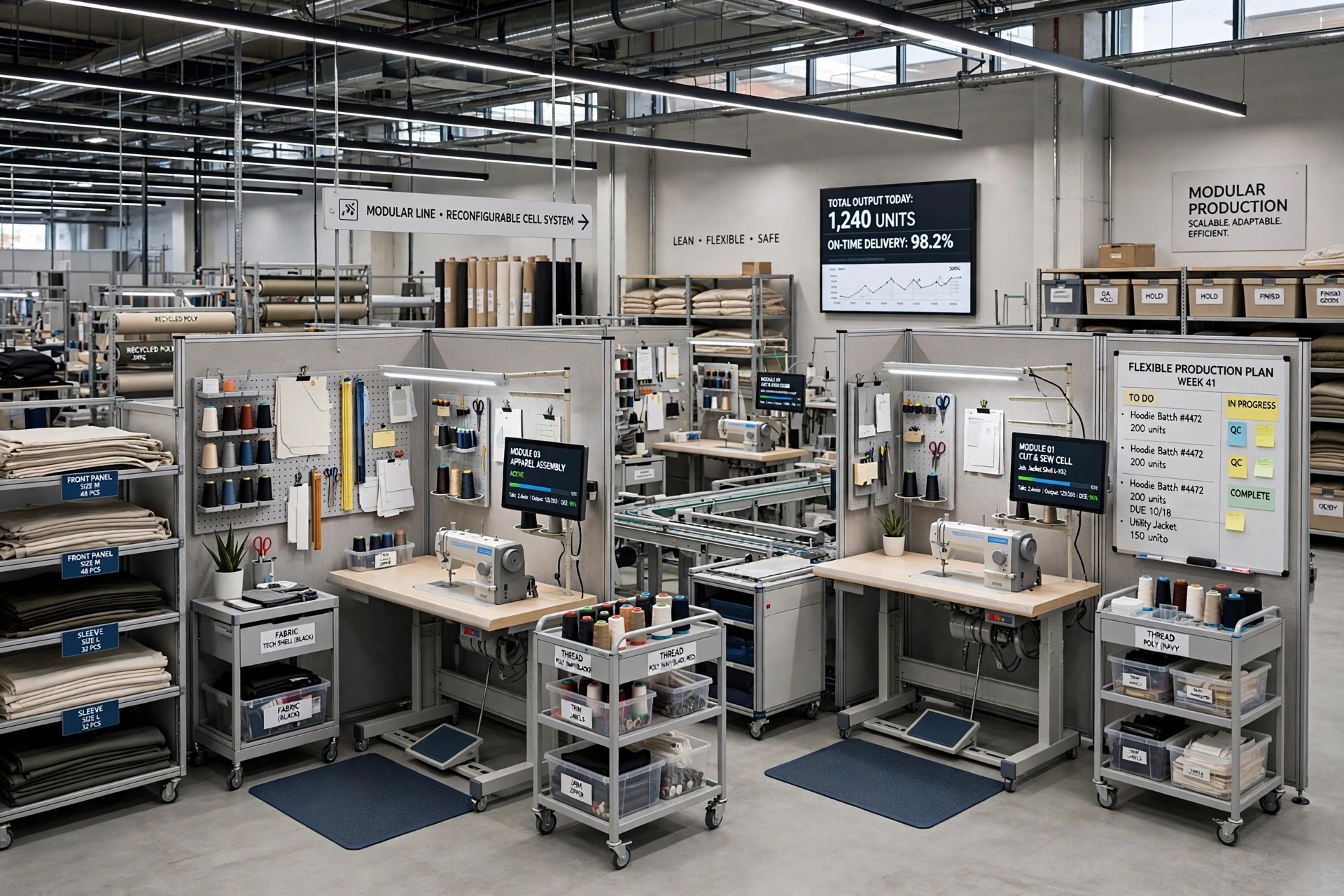
Flexible manufacturing is a production approach that lets garment factories switch quickly between styles, sizes, and order volumes without costly downtime. Instead of running one product for weeks, flexible lines handle variety — exactly what modern fashion brands need to test, reorder, and react.
What Makes Manufacturing Flexible?
Flexibility comes from modular workstations that can be rearranged for different garments, multi-skilled operators who handle several operations, quick-change tooling and fixtures, and planning systems built for small lots. The goal: change a line over to a new style in hours, not days.
Why Fashion Needs Flexibility
Shorter fashion cycles, test-and-reorder buying, and wide size curves all punish rigid mass-production lines. Flexible manufacturing lets brands launch in small quantities, read sell-through, and reorder winners — cutting markdowns and dead inventory, which is where most fashion profit actually leaks away.
Costs and Trade-offs
Flexibility isn't free: changeovers consume time, and per-unit costs run higher than dedicated high-volume lines. It pays off when your styles change often, your volumes are uncertain, or speed to market beats unit cost. Stable basics in huge volumes still belong on dedicated lines.
FAQs
- What is the difference between flexible and lean manufacturing?
- Lean eliminates waste; flexibility handles variety. They complement each other — a lean flexible line changes over fast with minimal wasted motion and material.
- What order sizes suit flexible manufacturing?
- Typically 100 to a few thousand units per style. Below that, artisan or sample-room setups work better; far above it, dedicated lines win on cost.
- Can a small factory be flexible?
- Often more easily than a large one. Small factories with cross-trained teams and general-purpose machines adapt naturally — flexibility is as much culture as equipment.
- Does flexibility hurt quality?
- Not if changeovers are standardized. Documented setup procedures, first-piece inspections after each changeover, and operator training keep quality steady across product switches.
Apparel Search: explore more production & sourcing resources for the fashion industry.