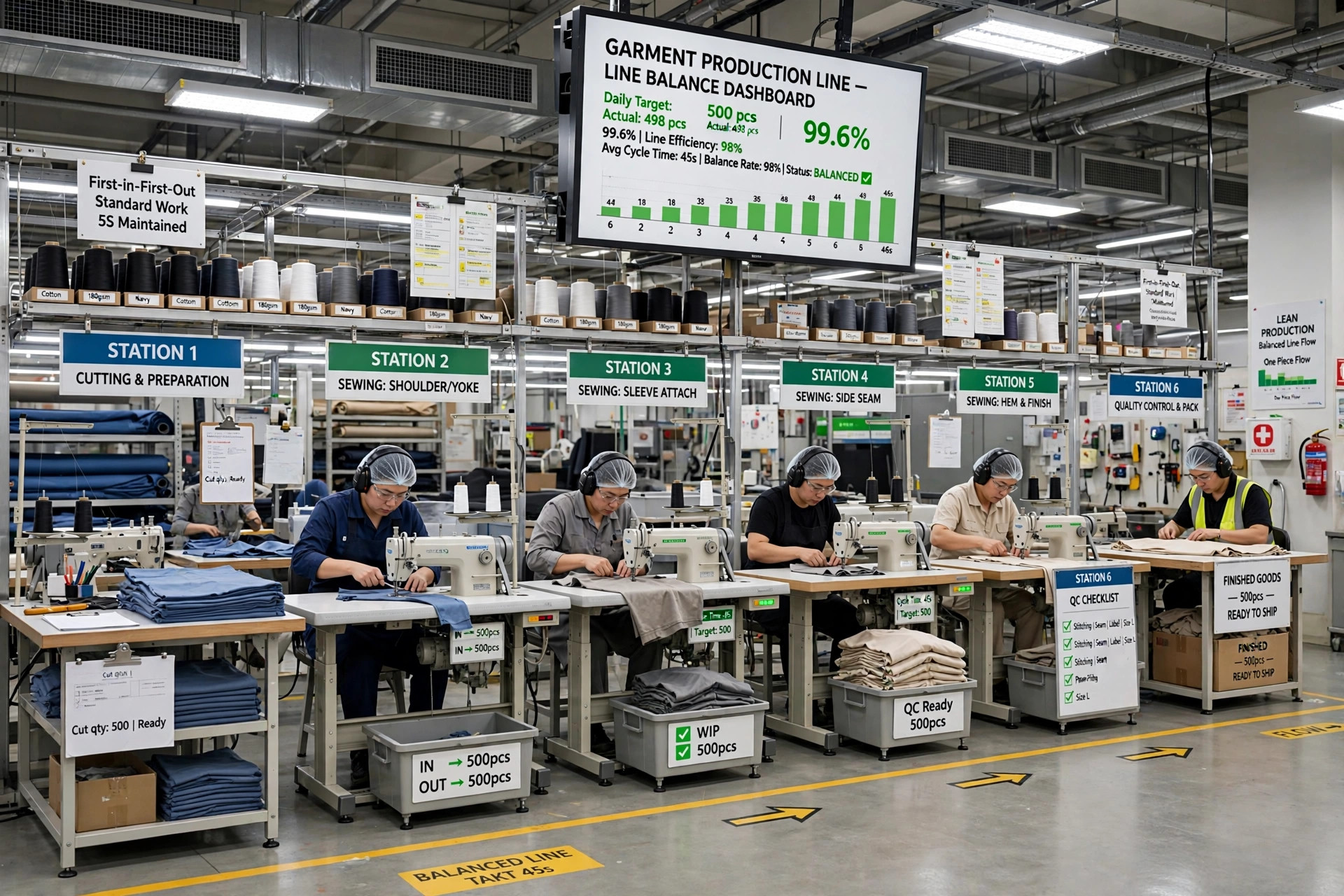
Manufacturing efficiency measures how well a garment factory converts labor hours into finished pieces. Small gains compound fast — a 5% efficiency improvement across a 500-worker factory is like adding 25 workers for free. Here's how professionals measure it and move it.
How Efficiency Is Measured
The standard metric is line efficiency: actual output versus theoretical output at 100%. It derives from SMV (standard minute value) — the time a garment should take — compared against actual minutes consumed. Related KPIs include pieces per operator-hour, defect rates, and on-time delivery.
Line Balancing
An unbalanced line starves some operators while burying others; the slowest operation sets the pace for everyone. Industrial engineers balance lines by splitting bottleneck operations across multiple workers and combining quick ones. Progressive bundle, unit production, and modular systems are the three classic line architectures, each suited to different volumes.
Lean Tools That Work in Sewing
5S workplace organization cuts the constant searching that bleeds minutes. Kaizen — small continuous improvements from operators themselves — outperforms grand redesigns. And reducing work-in-progress between stations exposes problems fast instead of hiding them in piles of bundles.
FAQs
- What is a good line efficiency for a garment factory?
- 60–70% is typical; well-run factories sustain 75%+. Below 50% signals serious balancing or methods problems worth investigating.
- What is SMV in garment manufacturing?
- Standard Minute Value — the time needed to make one garment including allowances for fatigue and machine delays. It underpins costing, planning, and incentive pay.
- How do you find bottlenecks?
- Watch where bundles pile up. Work accumulates before the slowest operation — that's your bottleneck, and the first place to add capacity or simplify the method.
- Does efficiency pressure hurt quality?
- Only when it's just speed-up. True efficiency work — better methods, balanced lines, good ergonomics — usually improves quality because rushed, awkward work causes defects.
Apparel Search: explore more production & sourcing resources for the fashion industry.