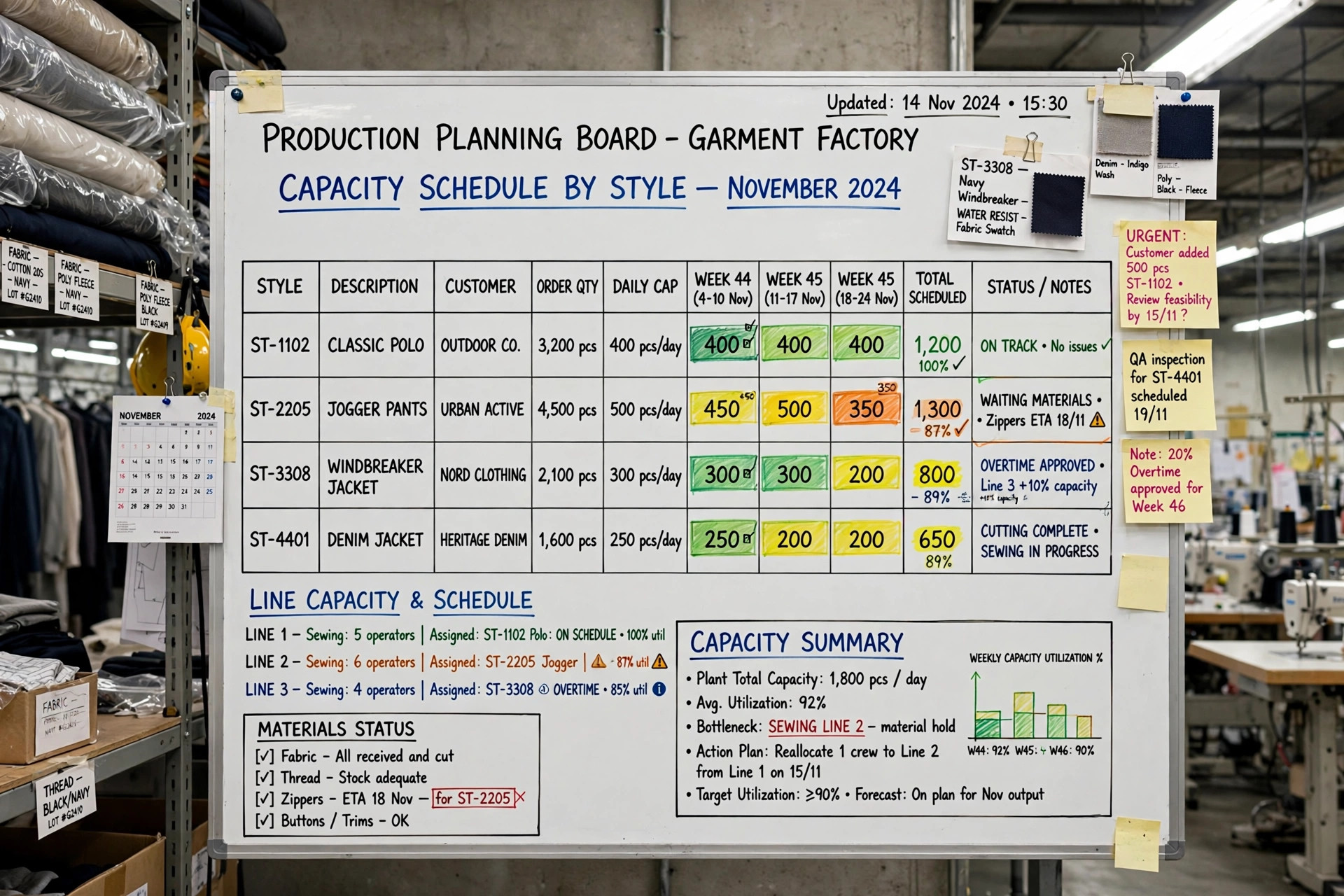
Capacity planning makes sure enough factory time, labor, and machines exist to produce your orders on schedule. Skip it and you get late deliveries, overtime premiums — or factories quietly subcontracting your work to shops you never vetted.
How Capacity Is Calculated
Capacity math starts with available minutes: operators × working minutes per day × efficiency. Divide by the garment's SMV (standard minute value) to get daily output per line. A 30-operator line at 65% efficiency running 480 minutes has about 9,360 productive minutes — enough for roughly 780 units of a 12-SMV t-shirt.
Booking Factory Time
Good factories sell their capacity months ahead, especially before peak seasons. Share your forecasts early — even rough ones — so the factory can reserve line time. Formalize it: confirm production slots in writing with start dates, daily output commitments, and penalties or remedies for slippage.
What Goes Wrong
Common failures: overbooking (factories saying yes to everyone), style changeovers eating planned capacity, and fabric arriving late so lines sit idle then rush. Build 10–15% buffer into every plan, and never let a single factory hold 100% of a critical program.
FAQs
- How far ahead should I book factory capacity?
- For offshore production, 3–6 months ahead of bulk start is normal; peak seasons (pre-holiday) need more. Domestic shops may work on 4–8 week horizons.
- What is the difference between capacity and output?
- Capacity is what a factory could produce; output is what it does produce. The gap comes from changeovers, absenteeism, material delays, and inefficiency.
- Should I ask a factory for its capacity?
- Yes — and verify it. Ask for demonstrated output on similar products, not theoretical maximums. A factory claiming double its proven output is planning to subcontract.
- How do I plan capacity across multiple factories?
- Allocate by capability and risk: core volume with your best partner, overflow with a qualified second source. Keep tech packs identical so either factory can run any style.
Apparel Search: explore more production & sourcing resources for the fashion industry.