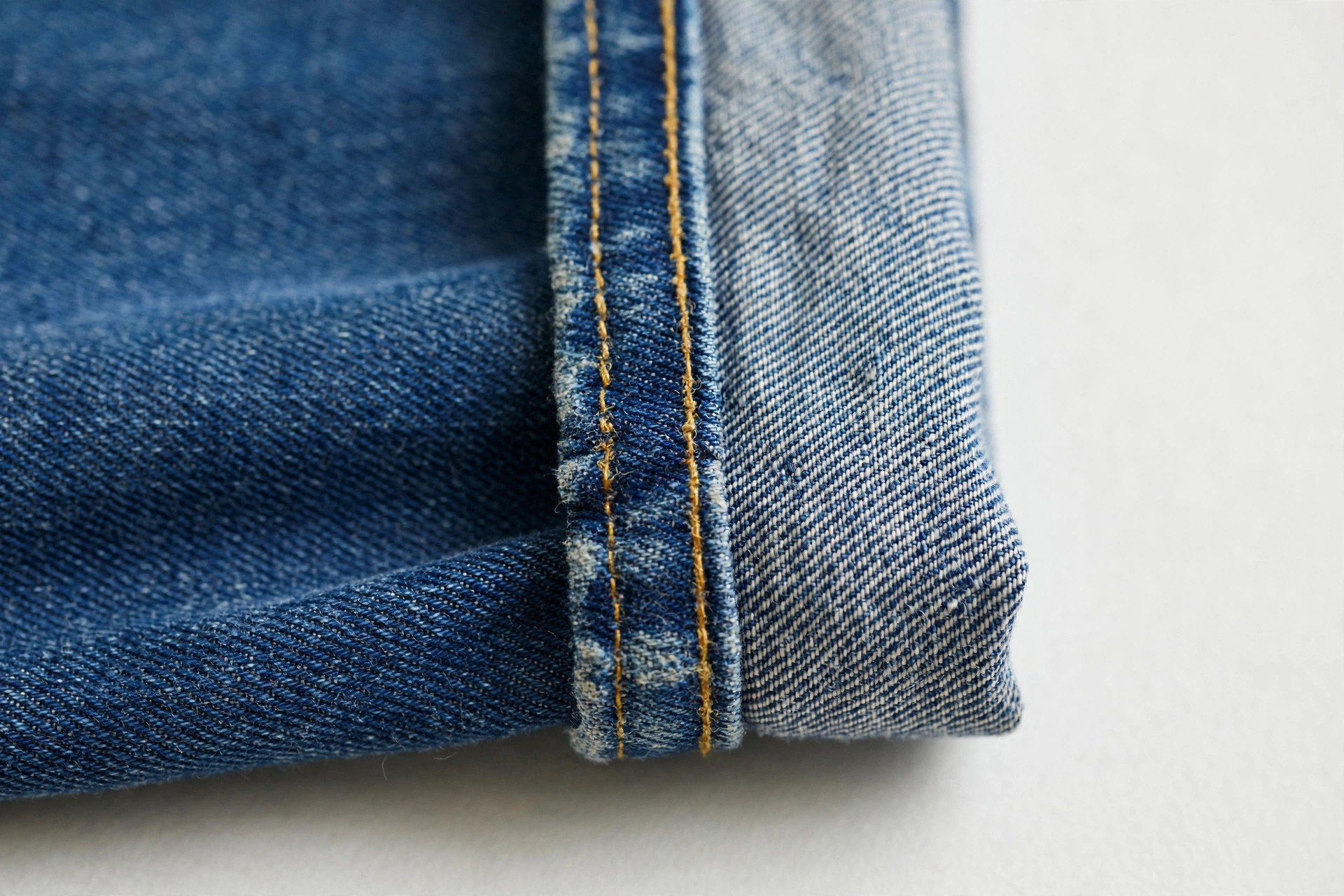
A flat-felled seam (also spelled flat-fell seam) joins two pieces of fabric so the seam lies completely flat, with the raw edges folded under and enclosed, and two parallel rows of stitching visible on the outside. It is the seam running down the inside leg of your jeans and along the side of a classic work shirt — one of the strongest and most hard-wearing seams in clothing.
Built for Hard Wear
A flat-felled seam encloses its raw edges just as a French seam does, but instead of hiding inside the garment it is pressed flat against it and stitched down. That spreads stress across two rows of stitching and a wide folded base, so the seam resists the pulling, abrasion, and repeated laundering that destroy lesser seams. Denim jeans, chambray work shirts, uniforms, sportswear, and children's clothes all rely on it.
The visible twin rows of stitching — often in a contrasting thread on jeans — are not decoration first; they are the structure, and the style followed the strength.
How It Is Made
- Sew the seam, then press both allowances to one side.
- Trim the under allowance narrower, and fold the wider allowance over it to enclose it.
- Edge-stitch through all layers, then add the second row of stitching through the fold.
FAQs
- What is the difference between a French seam and a flat-felled seam?
- Both enclose raw edges. A French seam hides inside as a small ridge and suits fine fabrics; a flat-felled seam is pressed flat, stitched down with two visible rows, and suits medium to heavy fabrics.
- Why do jeans use flat-felled seams?
- Because the inseam takes constant friction and strain. The flat-felled construction is the most durable option and lies flat enough not to chafe.
- Is a flat-felled seam the same as a lapped seam?
- A flat-felled seam is a type of lapped construction — one allowance laps over the other — but properly felling includes folding under and enclosing the raw edge.
Detailed Guides: see Flat-Felled Seam in the glossary A–Z listing of the Apparel Search fashion glossary for related terms.