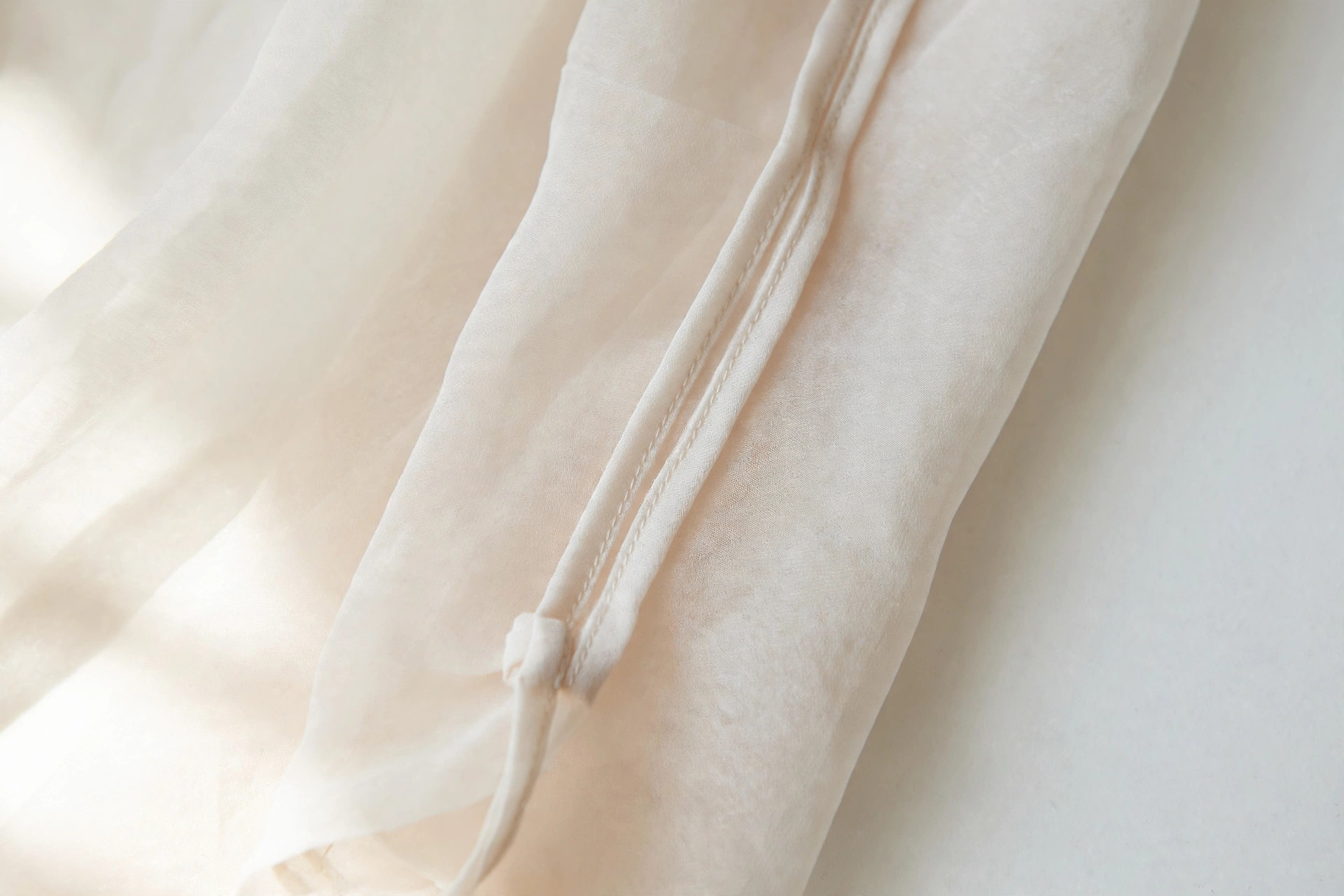
A French seam is a seam sewn in two passes so that the raw edges of the fabric are completely enclosed inside a tiny folded channel. First the layers are stitched wrong sides together close to the edge; then the seam is turned, pressed, and stitched again with right sides together, trapping every raw edge inside. Nothing can fray, and the inside of the garment looks as neat as the outside.
When a French Seam Is the Right Choice
French seams belong to fine and sheer fabrics — silk blouses, chiffon, organza, voile, fine cotton lawn — where an ordinary raw-edged seam would show through the cloth or fray away. They are also a hallmark of quality in unlined garments, heirloom sewing, and pillowcases, where the inside is on display.
They are not for heavy or bulky fabrics: the doubled fold of a French seam adds thickness that will not sit flat in denim or coating, and it is difficult around tight curves.
Sewing a French Seam
- Place the fabrics wrong sides together and stitch a narrow seam; trim close to the stitching.
- Turn the work so the right sides face, enclosing the trimmed edges, and press.
- Stitch again, far enough in to swallow the raw edges completely, and press the finished seam to one side.
FAQs
- Why is it called a French seam?
- The name is associated with French haute couture finishing, where enclosing raw edges by hand and machine was a standard of fine dressmaking.
- Is a French seam stronger than a normal seam?
- It is durable and fray-proof, and the double stitching adds security, though very heavy strain is better handled by a flat-felled seam as used on jeans.
- Can you sew a French seam on a curve?
- On gentle curves, yes, with careful trimming. On tight curves the enclosed fold resists shaping, and a narrow plain seam with a bound finish works better.
Detailed Guides: see French Seam in the glossary A–Z listing of the Apparel Search fashion glossary for related terms.