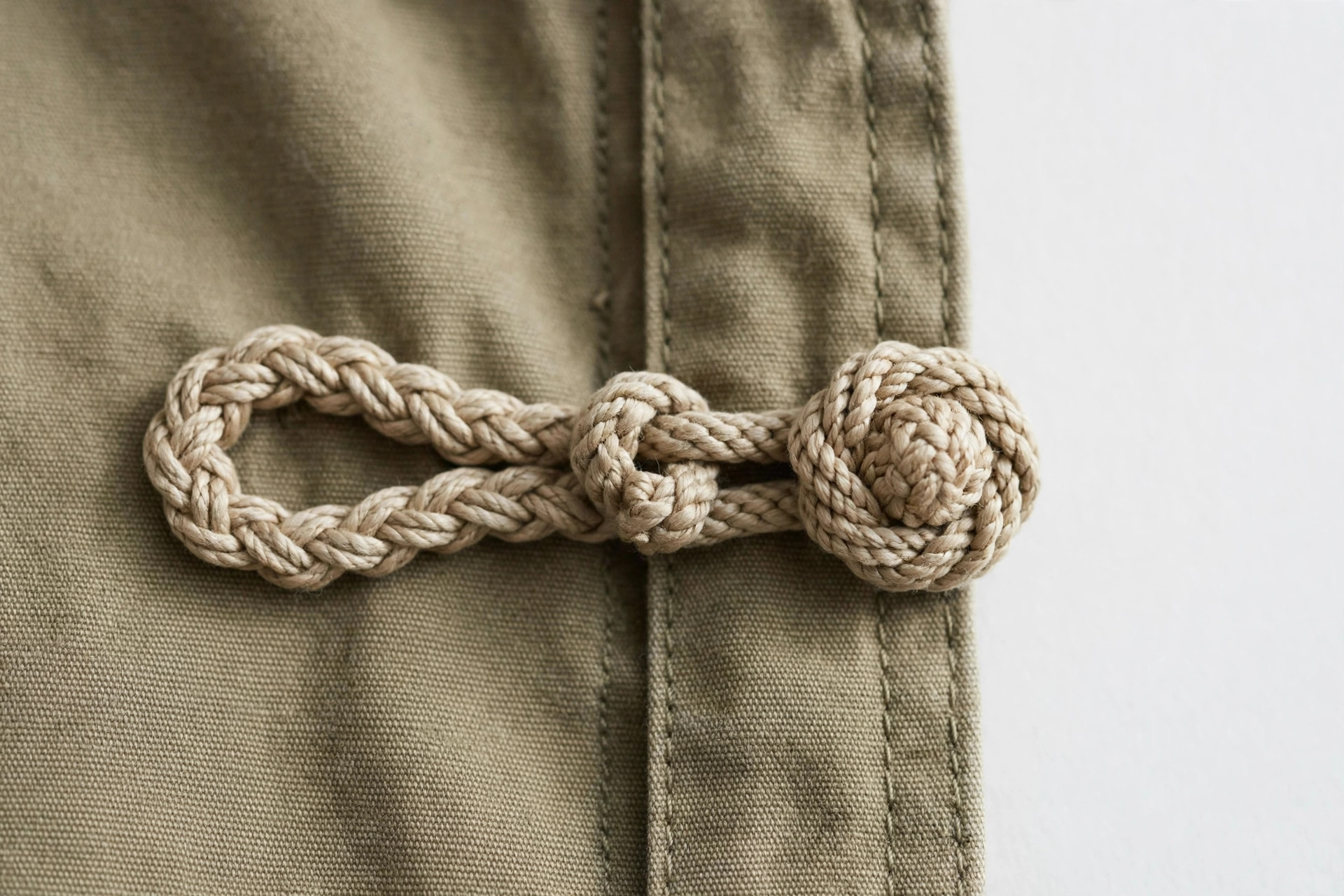
A frog closure is a decorative fastening made of two parts: a loop of braided or corded material on one side of an opening, and a knot button, ball, or toggle on the other that passes through the loop to close it. 'Frogging' — rows of ornamental braiding — takes its name from these closures, which appear on everything from hussar military jackets to the cheongsam and the duffle coat.
Three Traditions, One Fastening
Military tailoring made frogging famous: the chest of a hussar's jacket carries parallel rows of braid ending in toggles (oliviers), a display that began as a practical way to close a jacket without buttonholes in heavy braid-covered cloth. Chinese dress uses the pankou — a hand-knotted button and loop of the garment's own fabric — as the standard closure of the cheongsam (qipao) and the tang jacket, often as the garment's chief ornament. And the duffle coat's horn toggles and rope loops are a working frog closure scaled up for gloved hands.
In every tradition the principle is identical: the loop-and-toggle tolerates thickness and movement better than a button in a buttonhole, and it decorates while it works.
Construction and Use Today
- Frog closures are applied to the surface — stitched or sewn down over the finished opening — so they can be added to garments with no buttonhole work.
- Fashion uses range from a single frog at the neck of a cape or cardigan to full frogged fronts on jackets and coats.
- Handmade pankou frogs are sold in matched pairs and are a craft in themselves.
FAQs
- Why is it called a frog?
- The origin is uncertain; the term is recorded from the eighteenth century for the braided fastenings on military coats, possibly from the way the loops sit like a frog, or via the French word for braid ornament.
- Is a toggle the same as a frog closure?
- A toggle-and-loop is a form of frog closure — the duffle coat's fastening is the best-known example. 'Frog' usually implies the decorative braided form.
- Can frog closures be used instead of buttons?
- Yes — they close garments fully and are often used where fabric is too thick, delicate, or decorative for buttonholes.
Detailed Guides: see Frog Closure in the glossary A–Z listing of the Apparel Search fashion glossary for related terms.