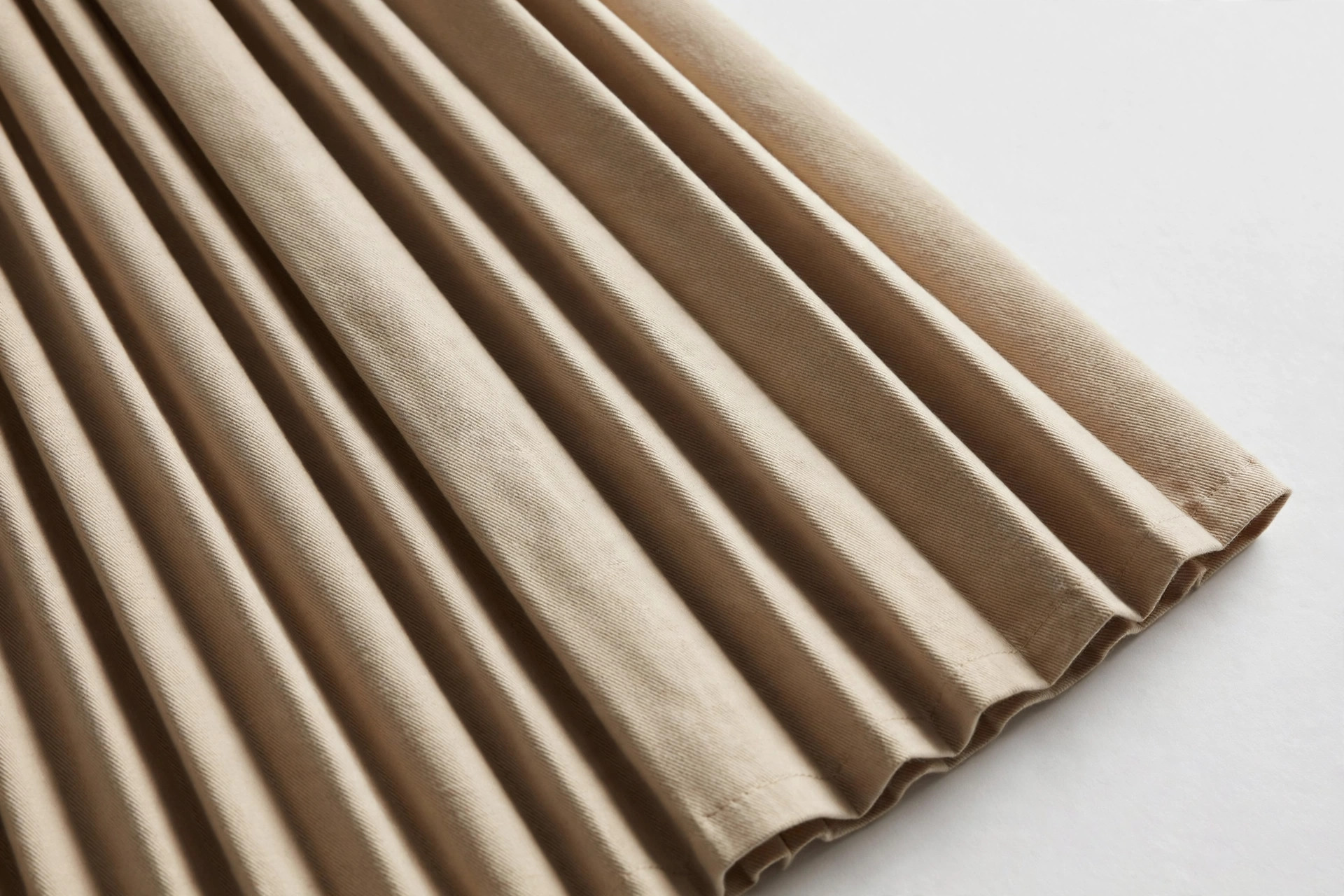
A knife pleat is a pleat in a series where every fold is pressed flat in the same direction, like the blades of a fan laid over one another. Knife pleats are narrow and evenly spaced, giving fabric a ribbed, swirling movement. They are the pleat of the kilt, the school uniform skirt, and countless pleated dresses and skirts.
How Knife Pleats Behave
Each knife pleat folds the fabric back on itself in one direction only, so a pleated section typically consumes about three times its finished width in cloth. Stitched down through the hip and released below — the classic skirt construction — knife pleats lie flat where the body needs smoothness and swing open in motion where it does not.
Because all the folds run one way, a row of knife pleats wraps around the body in a continuous spiral, which is why a pleated skirt twirls so evenly.
Knife Pleats vs. Other Pleats
- Knife pleat — all folds face one direction; sharp, directional movement.
- Box pleat — two knife pleats facing away from each other, forming a flat-topped fold.
- Inverted pleat — two knife pleats facing each other, hiding the fullness inside.
For the general technique, see our pleat guide.
FAQs
- How much fabric do knife pleats need?
- Roughly three times the finished width for full-depth pleats — one part shows, two parts are folded underneath.
- Do knife pleats suit every fabric?
- They suit fabrics that hold a crease, or synthetics that can be heat-set. Soft, spongy fabrics relax out of knife pleats quickly unless the pleats are stitched down.
- Are knife pleats used on kilts?
- Yes — the kilt's pleats are knife pleats, stitched through the hip and pressed so the tartan sett aligns in regimental or sett patterns depending on tradition.
Detailed Guides: see Knife Pleat in the glossary A–Z listing of the Apparel Search fashion glossary for related terms.