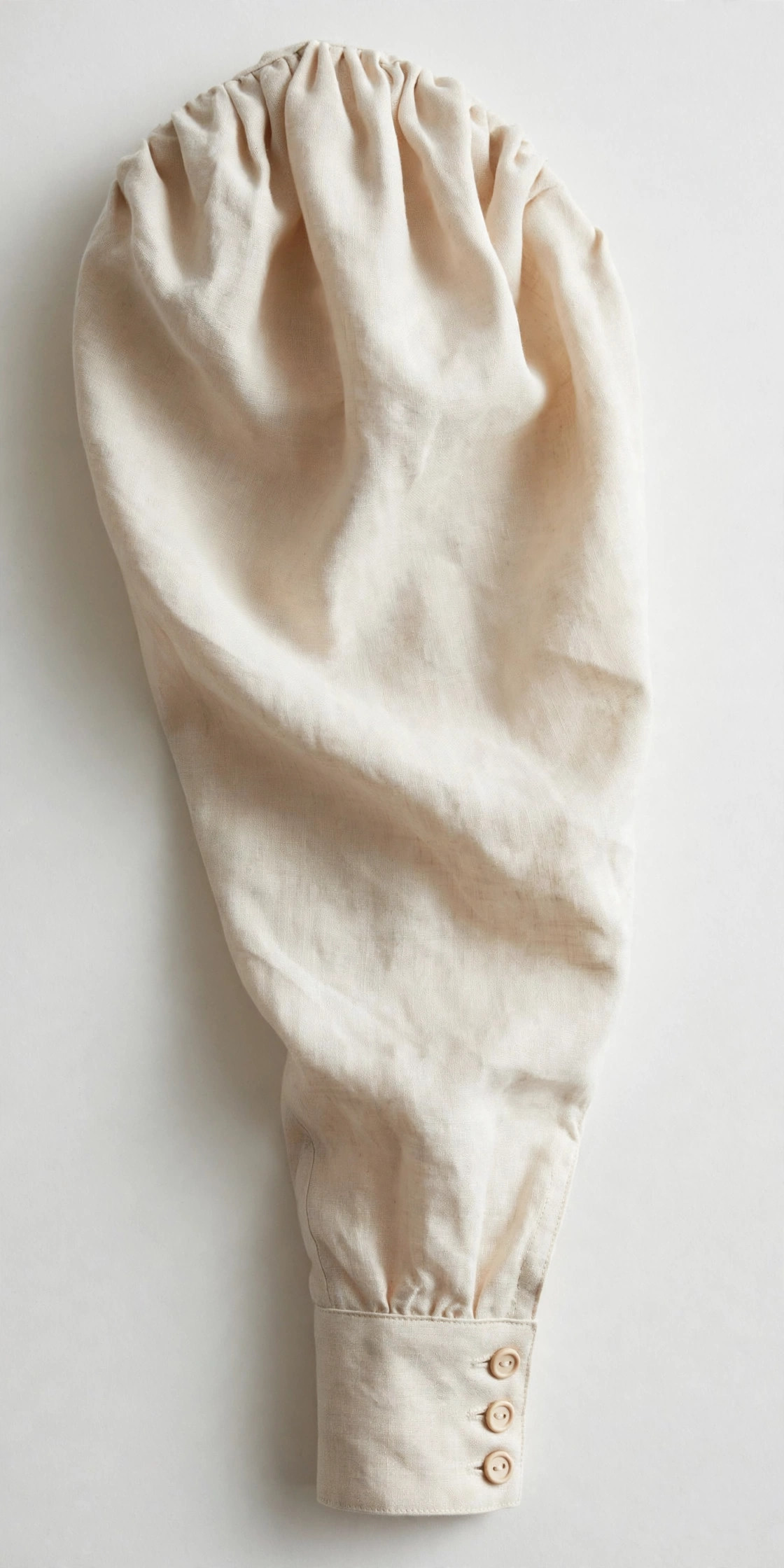
A leg-of-mutton sleeve, also called a gigot sleeve, is a sleeve that is enormously full at the shoulder and upper arm and then tapers down to fit the forearm and wrist closely. The shape — fat at the top, narrow at the bottom — resembles a leg of mutton (gigot in French), which gives it both its names. It is the signature sleeve of the 1890s, and fashion revives it whenever shoulders become the story again.
Rise, Fall, and Revival
The gigot sleeve first swelled in the 1830s, shrank, and then returned in the 1890s bigger than ever — sleeves so large they needed stiffening, padding, and feather-light supports to hold their shape, and so wide that wearers turned sideways through doors in caricatures of the day. By 1897 the fashion collapsed almost overnight, back to a slim sleeve.
Modern designers quote it at a wearable scale: a gathered, puffed shoulder head that melts into a normal fitted sleeve below the elbow. The historical construction — fullness pleated or gathered into the armhole, sleeve cut close from elbow to wrist — is unchanged.
Recognizing a True Leg-of-Mutton
- Maximum volume sits at the very top of the arm, not distributed down it.
- The sleeve is smooth and fitted from the elbow down.
- The transition between the two zones is abrupt, which is exactly what makes the silhouette so striking.
FAQs
- What does 'gigot' mean?
- Gigot is French for a leg of mutton — the shape the sleeve imitates: broad and rounded at the top, narrow at the end.
- How is a leg-of-mutton sleeve different from a balloon sleeve?
- A balloon sleeve is full along its whole length and gathers at the wrist. A leg-of-mutton is full only at the top and is fitted, not gathered, through the forearm.
- How were the huge 1890s sleeves supported?
- With stiff interlinings, gathered linings, and sometimes lightweight frames or down-filled pads sewn into the sleeve head.
Detailed Guides: see Leg-of-Mutton Sleeve in the glossary A–Z listing of the Apparel Search fashion glossary for related terms.