Apparel Search Consumer Guides
How to Shop Across Departments
The practical translation manual: convert by measurement rather than label, start from the correspondences that roughly hold, and run the fitting-room checks that separate a find from a return.
People shop across departments for fit reasons, and the reasons are unglamorous: a straighter cut, a longer torso, broader shoulders, no waist shaping where they do not want it, shaping where they do, a sturdier fabric, or a style that is simply only sold on the other side of the store. Departments are a merchandising arrangement; patterns are physics. There is nothing to get right or wrong about the choice itself — the only real skill involved is sizing, because the two departments speak different sizing dialects and a label that says "your size" in one can be two sizes off in the other. This page is the translation manual, written to sit beside our gender-neutral fashion guide, which covers how shared unisex ranges are cut; this page is about ordinary department clothing bought across the line.
Start With Measurements, Not Letters
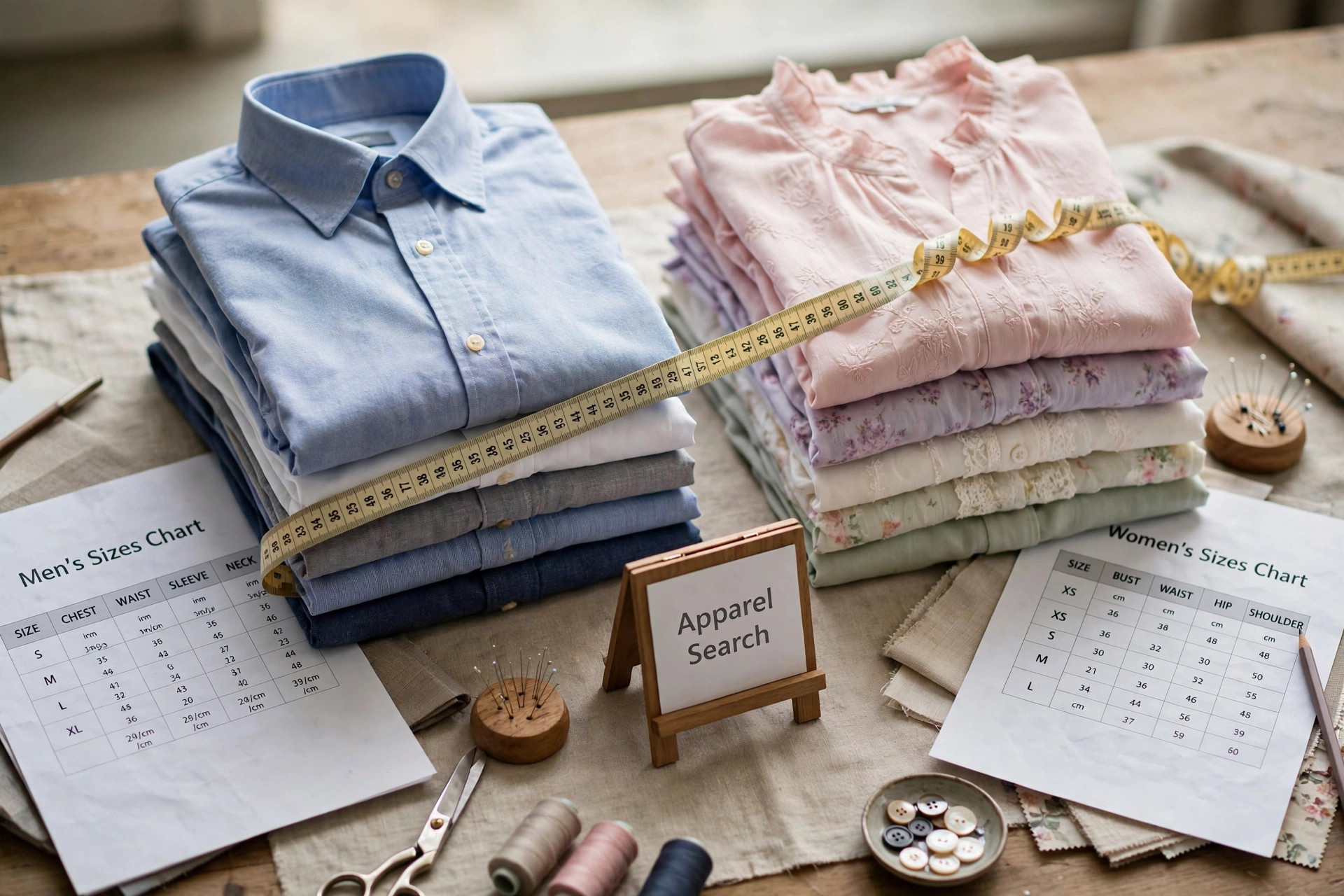
Every conversion problem in this page dissolves if you shop by measurement, so make that the habit. Know four numbers — chest, waist, hip, and your height as a rough guide to length — in inches or centimeters, taken the way our education guide to how to measure sets out. Then read the brand's own size chart for the garment you are buying and match measurements, not labels. The reason this matters more across departments than within them is that the two dialects fail differently: men's trouser waists are honest inches, so a 34 is a 34-inch waist from most makers; women's numeric sizes are codes that have drifted over the decades and differ from brand to brand, so a women's 10 is whatever that brand says it is this year. Letter sizes are vaguer still in both departments. A tape measure is the only common currency, and every decent size chart accepts it.
The Usual Correspondences — With Their Limits
With that warning posted, the rough correspondences that experienced cross-department shoppers start from are these. In tops, women's letter sizes tend to sit about one letter above the men's equivalent in chest terms: a women's medium starts around a men's small, a women's large around a men's medium. Expect the men's version to run longer in body and sleeve and wider at the shoulder at the "same" chest size. In bottoms, ignore the numbers entirely and convert at the waist: measure your waist, buy the men's size that states that waist, or read the women's size off the brand's chart by your waist and hip measurements. In US footwear, women's sizes run about one and a half above men's for the same foot length — a women's 9 is roughly a men's 7.5 — with the width caveat covered below. All of these are starting brackets: go to the fitting room, or the returns policy, expecting to try the sizes either side of the correspondence as well.
What Usually Translates Well
- Outerwear. Coats and jackets are cut with ease for layering, which absorbs block differences. A men's parka or a women's overcoat bought across departments mostly asks the shoulder check and a length check.
- Knitwear and fleece. Sweaters and fleeces drape and stretch rather than fitting at fixed points; a size either side of the correspondence is usually a styling choice, not a fit failure.
- T-shirts, hoodies and sweatshirts. Shoulder-hung knits with no shaping to begin with — the categories unisex ranges are built from, and just as easy bought from either department.
- Overshirts and flannel shirts. Worn open or layered, their straight cut makes the department they came from nearly irrelevant beyond shoulder and length.
- Relaxed and straight-leg bottoms. With the waist converted by measurement, a straight leg avoids most hip-curve mismatch; rises differ, so sit down in them before deciding.
- Hats, scarves and gloves. No translation at all beyond ordinary sizing — the simplest cross-department shopping there is.
- Sneakers. The length conversion is reliable and many are built on shared lasts; width is the remaining variable, covered in the callout below.
What Rarely Translates
- Tailored jackets and suits. A blazer is the block made visible: shoulder width, chest shaping, waist suppression and hip flare are all engineered per department. Cross-department tailoring is where fit goes to fail, and alteration costs approach the price of the garment.
- Formal dress shirts. Sold by neck size and drafted with department-specific shoulder and body proportions; the neck number alone does not carry the fit.
- Fitted dresses and shaped women's tailoring. Garments whose entire design is bust-waist-hip shaping have nothing to offer a differently proportioned frame, in either direction.
- Trousers where hip-to-waist ratio is the fit. Curved-waistband, shaped-hip styles are drafted around one ratio; if yours differs, the waistband gaps or the hip pulls, whatever the size.
- Dress shoes and formal footwear. Narrower lasts, different heel geometry and the width difference make formal shoes the least forgiving footwear conversion.
Fit-Check Points in the Fitting Room
- Shoulder seam position. The seam should sit at the edge of your shoulder bone. Drooping past it or pulling short of it ends the try-on: shoulders cannot be altered at any sensible price, and every other measurement keys off them.
- Close the front. Button or zip the garment fully. The closure should meet without pulling across the chest or stomach and without horizontal stress lines radiating from the buttons.
- Raise your arms. Lift both arms overhead, then reach forward. A garment that binds hard across the back or rides its whole body upward is short on room the size chart did not mention.
- Sit down. Waistbands and hips tell the truth seated. Sit, cross your legs, and check the waist for digging and the seat for strain — especially in cross-department trousers, where the rise was drafted for a different pelvis.
- Judge length against your proportions. Sleeve to the wrist bone, body to where you intend to wear it. Cross-department pieces typically run long (from the men's side) or short (from the women's); decide whether the length reads as intentional on you, because hemming fixes trousers and sleeves but not a jacket's body proportions.
- Find the waist. On any shaped garment, check where its waist seam or suppression falls against your natural waist. An inch off is styling; two inches off fights your body all day.
The Conversion Nobody Prints: Width
Shoe charts convert length and stop there, but the standard last width differs by department — a women's standard is a B width, a men's standard a D. A converted pair can match your foot's length exactly and still pinch a wider foot or swim on a narrower one. If a converted size feels wrong in a way length cannot explain, width is the explanation, and a wide or narrow fitting in the same length is the fix where the range offers one.
Common Questions
How do men's and women's letter sizes correspond?
Only loosely. In tops, a women's large often lands near a men's medium in the chest, and a women's medium near a men's small — but the men's garment will usually be longer in body and sleeve and broader in the shoulder, because the blocks differ, not just the scale. Treat any such correspondence as the middle of a three-size bracket to try rather than as a conversion, and trust a tape measure over the letter every time.
How do shoe sizes convert between men's and women's?
In US sizing, a women's size is roughly a men's size plus one and a half: a women's 9 is about a men's 7.5 in length. Length is only half the story, because the standard width differs — a B width for women against a D for men — so a converted pair can be the right length and still pinch or swim. The conversion works best in sneakers, which are more often built on shared lasts, and least reliably in formal footwear. Try before you commit where you can.
Why does my usual size fit differently in the other department?
Because the two departments draft from different pattern blocks, not from different scales of one block. A women's block builds in bust shaping, waist suppression and a hip curve on a shorter length scale; a men's block carries a broader, squarer shoulder, a straighter side seam and longer body and sleeve lengths. Moving departments changes the shape of the garment, not only its measurements — which is exactly why people do it for fit reasons, and why a straight size swap so often disappoints.
What should I check first when trying on a cross-department piece?
The shoulder seam. It should sit at the edge of your shoulder bone; if it droops well past it or stops short of it, walk away, because shoulders are the one part of a garment that cannot be altered economically. Next, closure: a buttoned front should close without pulling across the chest or gaping. Waist placement, body length and sleeve length can often be adjusted or styled around; shoulder and chest largely cannot.
Back to the Gender-Neutral Fashion Guide
How shared cuts are drafted, where the unisex label is honest, and the fit compromises one block for every body involves.