Protective Gloves
A factory directory for safety and protective gloves, from coated work gloves to cleanroom gloves.
Protective gloves are safety equipment first and clothing second: they are manufactured to guard hands against cuts, chemicals, heat, cold and contamination in workplaces from food plants to laboratories. This directory lists protective glove factories and explains how the products are made and specified, so safety buyers can talk to manufacturers in the right terms.
The category sits between two worlds. One end is industrial: knitted glove liners dipped in nitrile, latex or polyurethane coatings by the millions. The other is specialist: chemical-resistant gauntlets, cleanroom gloves and cut-resistant gloves made with high-performance fibers. The factories differ accordingly, and the listings and resources below reflect both.
Protective Glove Resources
An Educational Summary About Protective Gloves
It has been suggested that the origin of protective gloves dates back to prehistoric times, when early cavemen, prior to the Glacial Period (generally regarded as having commenced some 240,000 years ago), wore gloves fashioned from animal skins to protect their hands and arms from injury when they hunted. Much later, in classical times, gloves were used by the ancient Persians and Greeks to protect their hands against the cold and thorns, and in warfare and sport, not only for protection but also as weapons of offence.
In the early Middle Ages the wearing of gloves, other than for protective purposes, was largely confined to the nobility, clergy and military, for whom they were largely seen as status symbols. It was not until the 16th century that gloves came to be worn as a fashion item, by both sexes and increasingly across the social spectrum. The popularity of gloves as a fashion accessory continued to grow down the centuries, to the extent that by 1920 English glove manufacturers were producing 25 million pairs of fabric gloves per annum, thereby completely overshadowing the use of protective gloves. This summary is from the British Glove Association; readers who want to learn more about gloves can visit their site and join their association.
How Protective Gloves Are Manufactured
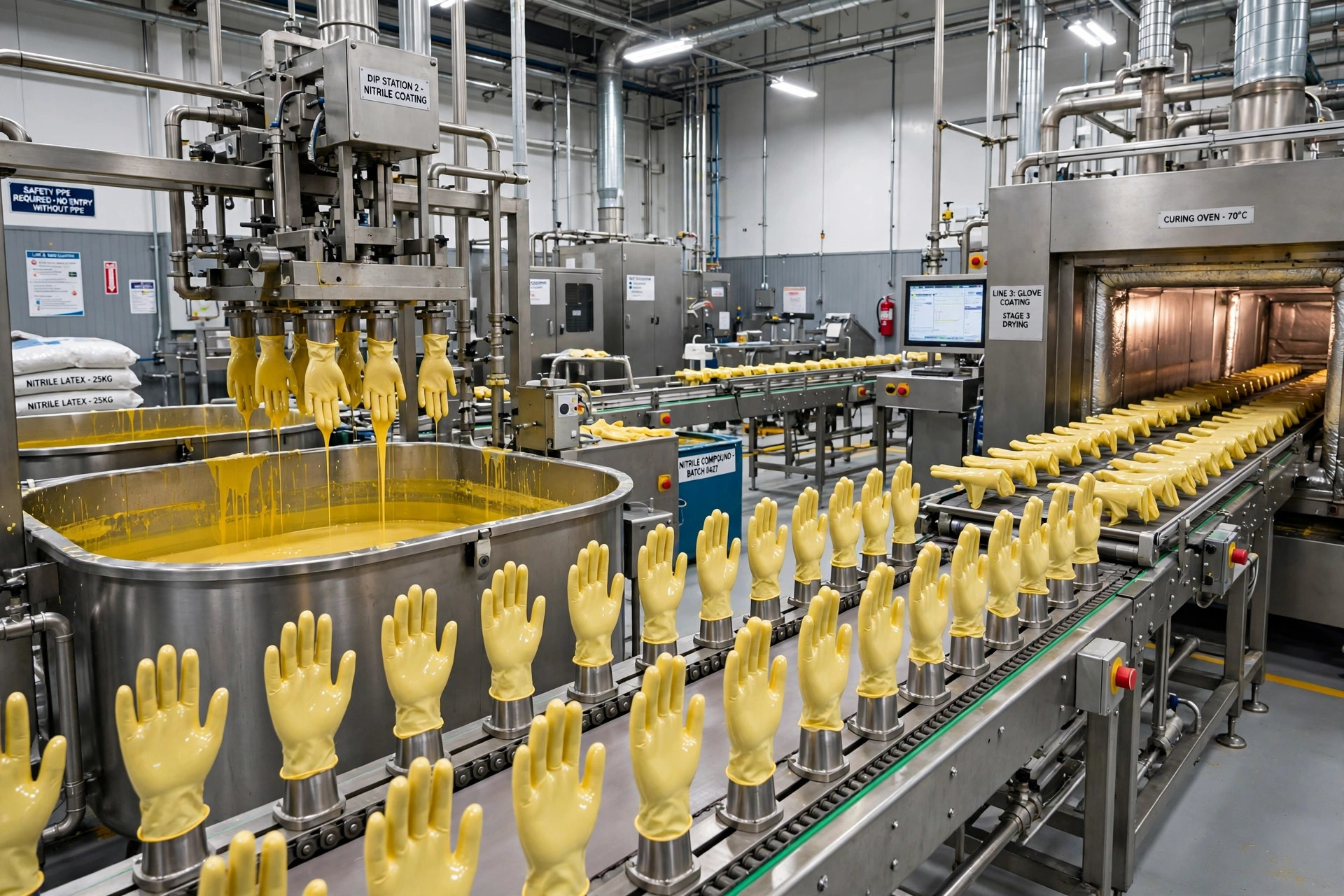
The dominant modern method starts with a seamless knitted liner, produced on automatic glove knitting machines in nylon, polyester, cotton or cut-resistant yarn blends. The liner is stretched over a hand-shaped former and dipped into a coating compound, nitrile for oil and abrasion resistance, latex for grip and flexibility, polyurethane for dexterity and touch sensitivity. Coating depth sets the product: palm-dipped gloves stay breathable at the back of the hand, while fully dipped gloves protect against liquids. After dipping, the gloves are cured, washed, dried, inspected and paired.
Other families are made differently. Chemical-resistant gloves are dipped repeatedly to build an unsupported glove of nitrile, neoprene or PVC. Leather protective gloves are cut and sewn like traditional work gloves. Disposable examination gloves are formed on continuous dipping lines and tested for pinholes, because a barrier glove with a hole is not a barrier.
Specifying Protective Gloves
Protective gloves are bought against standards. In Europe the EN 388 standard rates abrasion, cut, tear and puncture resistance; chemical gloves are rated under EN 374; in the United States, ANSI/ISEA 105 classifies cut, puncture and abrasion performance. A buyer should give a factory the hazard, the required rating, the coating and liner preference, and the size range. Fit is a safety feature in itself: a glove that is too loose catches in machinery, and one that is too tight is taken off, so factories offering many sizes, and consistent sizing between batches, are worth more than a marginal price difference.
Protective Glove Factory Listings
Kimberly-Clark Professional
Based in Roswell, Ga., Kimberly-Clark Professional is one of Kimberly-Clark Corporation’s four business segments. Known for innovative, quality solutions for away-from-home washrooms, DIY settings and “clean” and “industrial” manufacturing environments, Kimberly-Clark Professional manufactures and markets protective gloves, wipers, masks and apparel for the scientific and industrial segments under the global brands Kimtech, KleenGuard and WypAll.
Glove Guides
Common Questions
What is the difference between protective gloves and work gloves?
The terms overlap, but protective gloves are specified and tested against defined hazards and standards, such as cut resistance under EN 388 or chemical resistance under EN 374. Work gloves is the broader trade term covering general-purpose gloves for manual work, including leather and cotton styles.
How are coated protective gloves made?
A seamless knitted liner is stretched over a hand-shaped former and dipped into nitrile, latex or polyurethane. Palm-dipped gloves keep the back of the hand breathable; fully dipped gloves add liquid protection. The gloves are then cured, washed, dried and inspected before pairing.
What do EN 388 ratings on a glove mean?
EN 388 rates mechanical protection: abrasion, blade cut, tear and puncture resistance, each shown as a performance level on the glove’s pictogram marking. Buyers match the ratings to the hazards of the job rather than buying the highest numbers available.