Dyadic International History
Earlier company descriptions, brand line-ups, store counts and photographs from the history of Dyadic International, kept for historical reference.
← Back to the current Dyadic International profile
The Company Description of Its Time
Dyadic International, Inc. is filed in its Apparel Search profile as a global biotechnology company with, in its own phrase, the groundbreaking technology that brings nature to the marketplace. The company description, in substance: Dyadic is focused on the discovery, development and manufacturing of novel products derived from the DNA of complex living organisms - including humans - found in the earth's biodiversity; using its integrated technology platform, it develops biological products such as proteins, enzymes, polypeptides and small molecules for applications in the agricultural, industrial, bioenergy, chemical and biopharmaceutical industries. The identifying details as recorded are Dyadic International, 140 Intracoastal Pointe Drive, Suite 404, Jupiter, Florida 33477-5094, USA, phone 1-561-743-8333, and the information is dated May 2007 - a date kept attached, because a biotechnology company's platform claims belong to their moment.
Stonewashing: Pumice, Acid and Neutral Cellulase
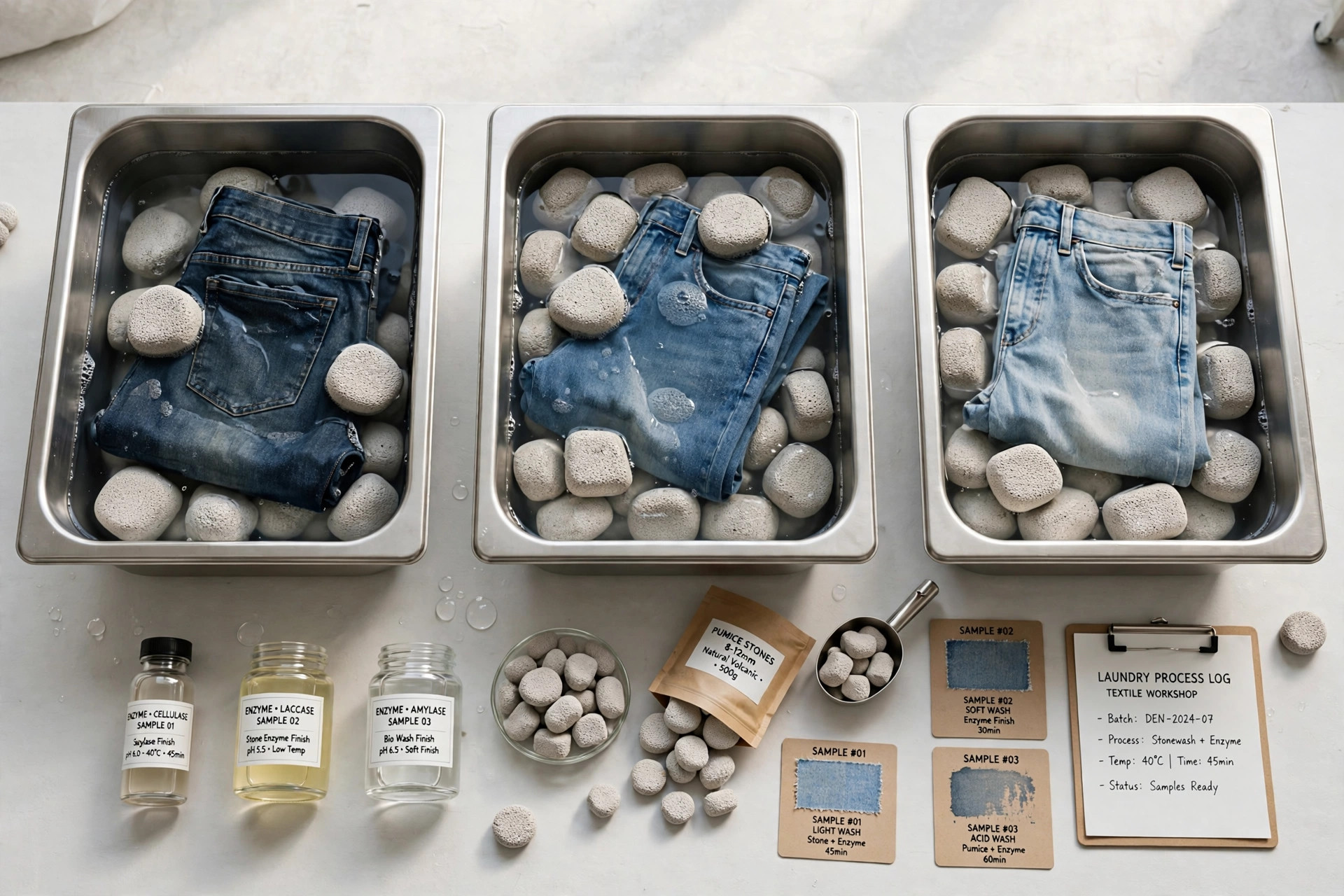
The process history is told plainly: stonewashing with pumice stones started out exactly as it sounds - fabric was washed with stones; before the development of cellulases, stonewashing involved a lot of pumice rock tumbling around in a washer with denim garments. Since the innovation of cellulase, the stonewashing cycle time has been cut in half when used in conjunction with pumice stones, as recommended by Dyadic; additionally, stonewashing with cellulase is superior to washing with pumice alone because it increases garment softness and results in higher levels of fabric abrasion. The enzyme choice is then a genuine trade-off, explained in the company(?:'|')s own terms: when originally developed, cellulase was an acid enzyme with a pH of about 5; acid cellulase is aggressive, and although it produces high levels of abrasion, it also reduces the fabric's tensile strength and results in a high amount of re-deposition, or backstaining.
Neutral cellulase, with a typical pH of 6.5, does not reduce the fabric's tensile strength or backstain as severely as acid cellulase does; however, neutral cellulase is not as aggressive as acid cellulase and typically commands a higher market price. Dyadic's proprietary neutral cellulase enzymes - US Patent #5,811,381 and US Patent #6,015,707, as recorded - are claimed to provide unique attributes, as well as brightness and contrast, to denim wash; those performance claims are the company(?:'|')s own, and a laundry evaluating enzymes should test them on its own production rather than take any directory's word. To meet the industry(?:'|')s demand for stonewashing, Dyadic is developing additional varieties of enzymes to improve existing finishing processes, a partial list including laccase, polyesterase and cold water biofinishing.
Amylase, Biofinishing and the Wider Enzyme Range
The second workhorse enzyme is amylase, described as the first enzyme innovated to remove the starch warp sizing from fabric. Warp sizing protects the warp yarn with a coating of starch that minimises yarn breakage during weaving; although useful in weaving, it leaves fabric stiff to the touch, and amylase - also known as amylose in the company(?:'|')s phrasing - is used to remove the starch, leaving fabric softer and ready for the consumer. Dyadic offers powdered amylase that is ready to mix into liquid for use. Cellulases are also used in biofinishing, for the removal of surface hairs from garments for increased comfort and fashion; the use of cellulase also provides a softer feel to the fabric, especially to man-made fabrics that can feel rough if not properly treated. The example is specific: TENCEL, a popular fabric produced from wood pulp, could not gain market share without biofinishing treatment because of its stiff fibers, which result in an uncomfortable effect.
The range closes with two more applications: catalases can be used to remove peroxide after bleaching to improve the dyeing process, and pectinase can be used as a bioscour - an environmentally friendly alternative to caustic scouring. With Dyadic(?:'|')s novel ability to screen for and produce new proteins, innovative uses for enzymes in the textiles industry are limitless. The Apparel Search routes lead to the textile enzymes page and the pumice page, the directory's own entries for the two product families this profile explains. Filed last in the D letter, Dyadic pairs with Dassault Systèmes as the letter's enabling-industry entries - one sells the software that designs garments, the other the biology that finishes them - and a completeness-minded directory keeps both, because a fashion industry guide that lists only brands cannot explain how a pair of jeans actually gets its wash.
More to Explore on Apparel Search
References & Further Reading
Looking for More Fashion Companies?
This profile is one filing in the Apparel Search company names directory. Browse the full A-to-Z listing on the Fashion Company Names directory, or shop by category in the Apparel Search shopping directory.