Women's Shoe Stores in Texas
How shoe shopping works in the Lone Star State — the four metro markets, a proper cowboy boot fitting, the San Marcos outlets, and live links to today's Texas shoe listings
Texas shoe shopping is organised around four very different metro areas — Houston, Dallas–Fort Worth, Austin and San Antonio — with two Texas specialities on top: a cowboy boot trade that treats fitting as a craft, and the San Marcos outlets, one of the biggest shoe-hunting grounds in the country. This guide — part of our Women's Shoe Stores by State directory — explains how shoe shopping works in each metro, how a boot fitting actually goes, and what Texas heat does to a shoe wardrobe. It deliberately carries no store listings of its own, because stores open, move and close too quickly for a printed list to stay honest. Instead, the live listings section at the foot of the page links you straight to current Texas shoe stores on Google Maps, Yelp, DSW and Nordstrom. For clothing and fashion retailers across the state more broadly, see our Retail Texas clothing and fashion retailer directory.
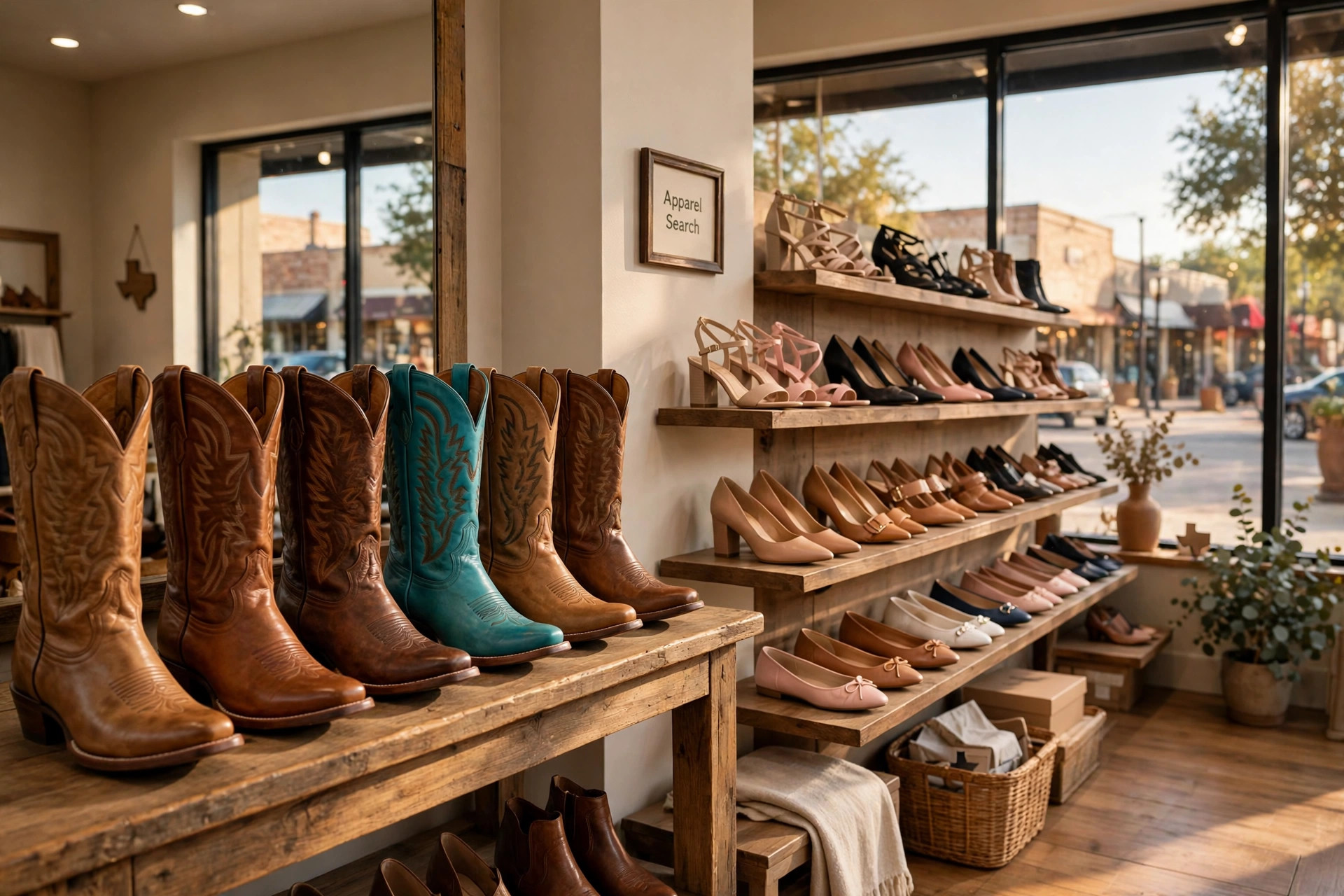
The Short Version
- Four metros, four shopping trips: Houston is the deepest market, Dallas–Fort Worth the luxury end, Austin the boutique end, San Antonio the value end — and most Texans can cover a search in one or two of them.
- Boots are a fitting, not a purchase: a cowboy boot has no laces, so the instep does the holding. Budget real time for a fitting, and expect a little heel slip in a new boot — it settles.
- San Marcos is the state's shoe day trip: two outlet centres side by side between Austin and San Antonio, with shoe stores by the dozen and prices the malls cannot match.
- Heat writes the wardrobe: feet swell across a hot day, Gulf humidity attacks leather in storage, and sudden rain bursts punish suede. Fit shoes late in the day and store them dry.
- Ranch-to-city is a real range: the same week can mean gravel and grass, office floors and a dance hall — block heels, wedges and boots earn their place.
- Use live listings for names and addresses: the links at the foot of this page open today's Texas shoe listings in a new window, so this guide stays open while you browse.
Four Metros, Four Different Shopping Days
Texas is too large for one shoe market — Houston and Dallas are roughly 240 miles apart, and few shoppers work all four metros. The practical approach is to pick the metro you can return to easily (a boot fitting or an exchange may mean a second trip) and work it thoroughly before widening the search.
Houston
Houston has the deepest bench of any Texas market, at every price. The Galleria and Uptown district concentrates the flagships — the big department stores with their full shoe floors, Nordstrom and Neiman Marcus among them — while Highland Village and the other in-town centres hold the boutique end. The suburbs are full-service territory in their own right: Katy, The Woodlands and Sugar Land each support their own malls, brand stores and off-price anchors, so a Houston shopper rarely has to cross the whole metro. One Houston-specific warning: Gulf humidity is a storage problem as much as a shopping one — leather shoes kept in a garage or a steamy closet will mildew, so whatever you buy needs a dry, air-conditioned home and a day of rest between wearings.
Dallas–Fort Worth
Dallas is the luxury end of Texas shoes. NorthPark Center runs one of the strongest shoe line-ups in the country across its department stores and designer boutiques; the downtown Neiman Marcus flagship is the classic Dallas shoe salon; and Galleria Dallas and the Highland Park Village boutiques fill in the top end. Fort Worth answers with the boot trade: the western stores around the Stockyards fit cowboy boots all day, every day, and carry the deep size and width runs the fashion stores skip. The two cities are about 35 miles apart, and the classic DFW strategy is a Dallas day for fashion shoes and a Fort Worth day for boots — shoppers based in Arlington or the Mid-Cities genuinely can do both, and the northern suburbs (Plano, Frisco, Southlake) have grown into a third pole of malls and brand stores.
Austin
Austin shops at boutique scale, with one famous exception: South Congress Avenue is boot country, anchored by the big western stores that fit tourists and locals side by side, and a boot fitting there is close to a civic ritual. The Domain, in north Austin, is the city's flagship district — department stores and brand flagships in an open-air setting — while the downtown and South Lamar boutiques cover the independent end, including comfort and European lines the malls pass over. Austin's calendar is driven by heat and festivals: sandal season runs most of the year, and the rodeo and festival weeks send a visible surge of shoppers into the boot stores. If your week includes Hill Country gravel, grass and limestone, tell the store — Austin shops dress feet for those surfaces every day.
San Antonio
San Antonio is the value end of the big four, built on established local retail: The Shops at La Cantera carries the upscale open-air line-up, Alamo Heights and Stone Oak hold the boutique and comfort-shoe cluster, and North Star Mall — marked by the giant pair of cowboy boots out front, among the largest boot sculptures in the world — covers the mainstream middle. Then there is the day trip: about fifty miles northeast on I-35, San Marcos holds two outlet centres side by side, San Marcos Premium Outlets and Tanger Outlets, together one of the largest outlet concentrations in the United States. Their shoe stores — athletic brands, designer labels, boot and family shoe outlets — make San Marcos the single best shoe-hunting ground in Texas for a shopper who knows her size and is willing to dig. Go on a weekday, wear slip-off shoes, and treat your size in a favourite style as buy-it-now.
Buying Cowboy Boots in Texas: A Fitting, Not a Purchase
A cowboy boot is held on by its instep, not by laces, which makes the fitting a different exercise from trying on a pump — and Texas is the best place in the country to have it done properly, because the state's boot stores and bootmakers fit boots as a speciality rather than a sideline.
A good fitting runs like this. The boot should feel snug across the instep — firm, like a handshake, not painful. When you stand, your heel will lift about a quarter of an inch with each step; that slip is correct in a new boot and settles as the leather sole flexes and the boot moulds to your foot, usually within a few weeks of wear. Your toes should not touch the end of the boot, and the ball of your foot should sit at the boot's widest point, where it is built to bend. Toe shape changes the fit as much as the look: a classic pointed toe needs more length in front of your toes than it appears to offer, a snip toe slightly less, and square and roper toes give the roomiest fit. On tall boots, measure your calf at its widest and compare it with the shaft — a beautiful boot that will not pull on over your calf is a short boot you have not admitted to yet. Use the pull straps, sit down, and take your time: a store that fits boots well will never rush this.
Leather choice sets price and care. Plain cowhide is the workhorse — durable, forgiving and the right first pair. Exotic leathers (ostrich is the Texas favourite, along with lizard and caiman) cost multiples of cowhide, feel different on the foot — ostrich is soft from the first wear — and need regular conditioning to keep from drying out in Texas heat. Construction matters too: a stitched welt sole can be resoled for years; a cemented sole is cheaper and lighter but is replaced, not repaired. Texas also keeps the custom end of the trade alive: El Paso has been a bootmaking city for over a century, and made-to-measure boots from a Texas bootmaker — your last, your leather, your stitch pattern — take months and cost accordingly, which is exactly why their owners wear them for decades.
Breaking in is short but real: wear new boots around the house and on short errands first, expect the instep to ease and the heel slip to fade, and condition the leather before the first long day, not after. In summer, rotate boots with your other shoes so each pair dries fully — a boot worn daily in August heat ages twice as fast.
The Kinds of Women's Shoe Stores Texas Offers
Every Texas metro mixes the same basic store types. Knowing which type you are walking into tells you how the fitting, the pricing and the size range will work.
- Department stores
- The comparison-shopping route: many brands under one roof, full shoe floors at the flagships, and the widest spread of price levels in a single stop. The Galleria in Houston, NorthPark in Dallas and La Cantera in San Antonio are the Texas examples of the form at its best.
- Brand stores
- A single label's own shops stock that label's full size and width range, including the narrow and wide fittings general stores skip. If you know a brand fits your foot, its own store is where the odd sizes live.
- Independent boutiques and comfort shoe stores
- Smaller, curated ranges — often European lines — with the most fitting advice per square foot. Texas's comfort shoe specialists, who fit widths and support features properly, sit in this group and are worth finding if standard fittings fail you.
- Off-price and warehouse shoe stores
- DSW is the giant of the form, with Texas stores in every metro and most mid-size cities: past-season and discounted brand shoes in a self-service warehouse, with patchy size availability that rewards regular visits and a store-locator check before you drive.
- Outlet stores
- The brands' own clearance channel, concentrated at San Marcos above all: genuine discounts, sizes limited to what was sent, and stock that turns over fast. Outlet shoe shopping is a skill — go knowing your size in each brand, because an outlet fitting room queue is no place to learn it.
- Western and boot stores
- The Texas speciality, from the Stockyards stores in Fort Worth and South Congress in Austin to boot departments in every small-city western shop: deep boot ranges, staff who fit boots daily, and repair and stretching services the fashion stores do not offer.
- Resale and consignment boutiques
- Once-worn designer shoes at a fraction of the original price, strongest in the big metros' boutique districts. Stock is one-of-one, so condition checks — soles, heel tips, insoles — are the whole game.
A Texas Shoe Wardrobe: Heat, Rain Bursts and Ranch-to-City
Texas weather writes the shoe brief more honestly than fashion does. Start with heat: feet swell across a hot day — up to half a size between a cool morning and a August afternoon — so a shoe fitted snug at 10 a.m. can be a shoe that hurts by 6 p.m. Breathable linings, leather uppers that give a little, canvas and knit for casual wear, and sandals for the long sandal season (in South Texas, most of the year) are the working answers. Unlined synthetics trap heat and rub; save them for short wears.
On the Gulf side, add humidity and rain. Houston's sudden downpours can soak a pair of shoes in the walk from a door to a car, and suede is the usual casualty — a protectant spray before the first wear is cheap insurance, and a spare pair kept at the office or in the car is a Gulf Coast habit, not an eccentricity. Leather that stays damp grows mildew: dry wet shoes slowly, away from direct heat, stuff them to hold their shape, and rotate pairs so each dries fully between wearings. Cedar shoe trees earn their keep in a Texas closet; a garage or attic, where summer temperatures soar, ruins leather faster than wear does.
The last Texas variable is surfaces. The same week can hold office floors, a gravel ranch road, grass at an outdoor wedding and a polished dance hall. Stilettos sink into grass and catch in gravel, so block heels, wedges and heel protectors are the practical order for outdoor events — and the honest Texas answer, the one locals actually wear, is a good pair of boots, which handles gravel, grass and a dance floor without changing. North Texas adds a brief opposite edge: a handful of genuinely cold weeks, the odd ice day, when lug soles and a warm boot stop being a style choice.
Fit Checks Before You Pay
Four checks catch most bad purchases, in Texas or anywhere. First, timing: try shoes late in the day, when your feet are at their largest — in summer, that difference is the whole fitting. Second, length: about a thumb's width, roughly a centimetre, beyond your longest toe — and the longest toe is the second toe for many women, not the big toe. Third, the widest part of your foot should sit at the widest part of the shoe, so its flex point matches yours; a shoe that creases across the toes is the wrong last, however right the size. Fourth, the heel test differs by shoe: a pump that slips when new will slip worse as it relaxes, so pumps should hold from the first step — while a cowboy boot is supposed to slip a little when new, as the fitting section above explains. Buy for the larger foot, use an insole in the smaller shoe, and walk on a hard floor before you decide: store carpet flatters every fit and hides every slip.
Find Live Women's Shoe Store Listings in Texas
Stores open, move and close faster than any printed list can track, so this guide carries no store listings of its own. For current names, addresses, hours, photographs and reviews, use the live sources below — each one is far better at up-to-the-minute listings than a directory page can be. Every link opens in a new window, so this guide stays open underneath while you browse.
Live Texas Shoe Store Listings
Google Maps — Women's Shoe Stores on the Map
- Women's Shoe Stores in Texas — Google Maps
- Women's Shoe Stores in Houston — Google Maps
- Women's Shoe Stores in Dallas — Google Maps
- Women's Shoe Stores in Austin — Google Maps
- Women's Shoe Stores in San Antonio — Google Maps
Yelp — Shoe Stores With Reviews
- Shoe Stores in Houston — Yelp
- Shoe Stores in Dallas — Yelp
- Shoe Stores in Austin — Yelp
- Shoe Stores in San Antonio — Yelp
Shoe Store Locators — Check a Chain's Texas Stores
Common Questions
Where is the best place in Texas to buy cowboy boots?
For range and fitting help, start where boots are the whole business: the western stores around the Fort Worth Stockyards and the dedicated boot stores in every big metro carry the deep size and width runs, and their staff fit boots all day. For heritage and custom work, El Paso is Texas's bootmaking capital — the trade has been there for over a century — and a made-to-measure pair from a Texas bootmaker takes months and costs accordingly. Wherever you go, a proper fitting matters more than the store's name.
How should new cowboy boots fit?
Snug across the instep — that, not the laces a boot does not have, is what holds it on. The heel should slip about a quarter of an inch when the boot is new; the slip settles as the leather sole flexes and moulds, usually within a few weeks of wear. Your toes should not touch the end, and the ball of your foot should sit at the boot's widest point. A boot that is painfully tight across the instep will not stretch enough to save it — try the next width instead.
Are the San Marcos outlets worth the trip for shoes?
For most Texas shoe shoppers, yes. The two outlet centres at San Marcos — Premium Outlets and Tanger Outlets, side by side between Austin and San Antonio — form one of the largest outlet concentrations in the United States, and their shoe stores cover everything from athletic brands to designer labels. Prices are genuinely lower than the malls, but sizes are whatever the brands sent, so go on a weekday if you can, wear shoes that slip off easily, and treat a favourite style in your size as buy-it-now — it will not be there next month.
What shoes hold up best in Texas heat?
Breathable ones. Leather-lined shoes, canvas and knit uppers, and sandals carry most of a Texas summer; unlined synthetics trap heat and rub. Feet swell in the heat — up to half a size across a hot day — so a shoe that is merely snug in an air-conditioned store in the morning can be tight by evening. On the Gulf Coast, humidity is the other enemy: rotate pairs so each dries fully between wearings, use cedar shoe trees, and never store leather shoes in a garage or attic.
Should I try shoes on in the morning or later in the day?
Later in the day. Feet are at their smallest first thing in the morning and swell with heat and walking, so a fitting done late in the afternoon tells the truth about how the shoe will feel at the end of a real day. Wear the socks or hosiery you plan to wear with the shoes, and walk on a hard floor rather than the store's carpet — carpet flatters every fit and hides heel slip.