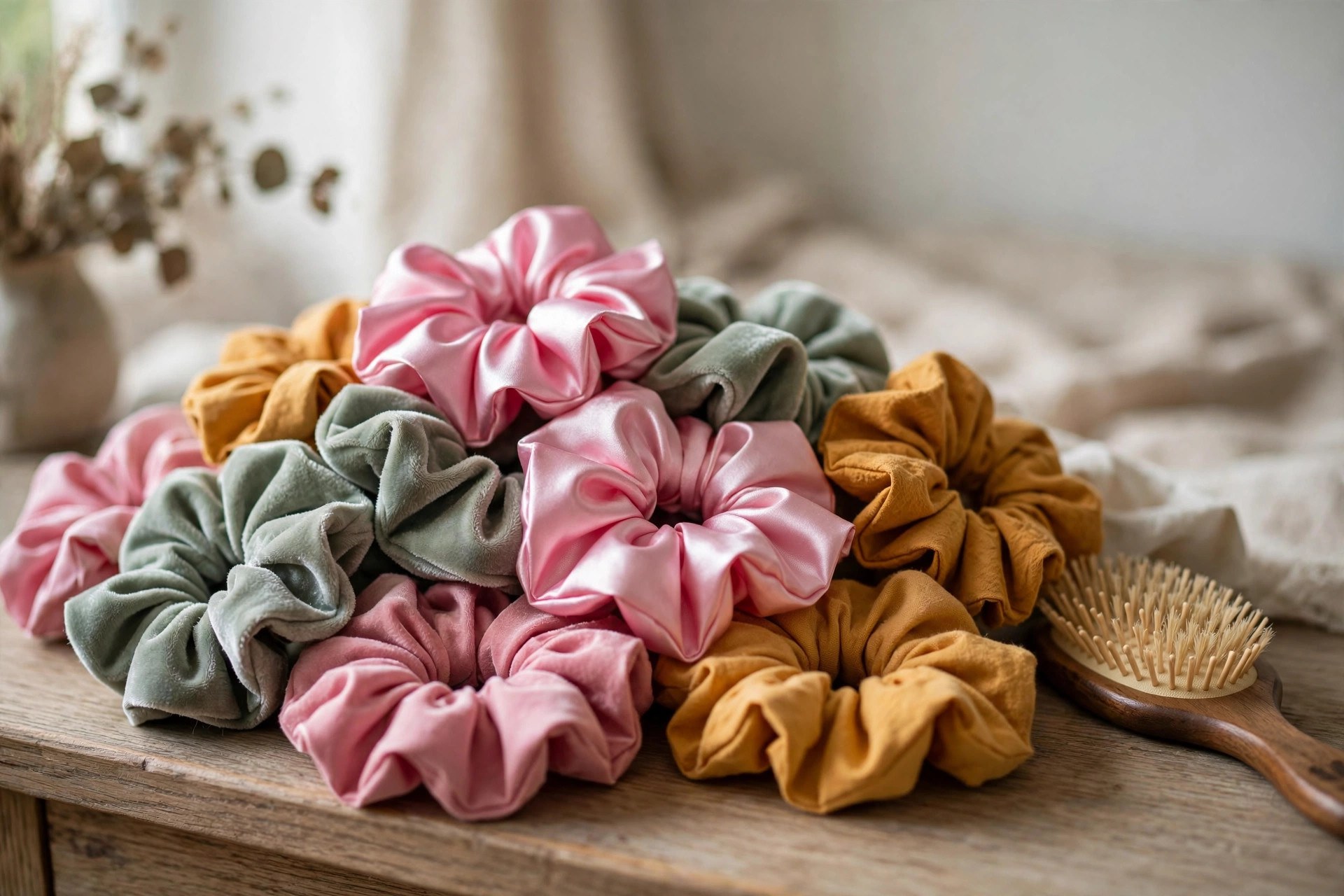
A scrunchie is a hair elastic completely covered in gathered fabric, so the stretchy band never touches your hair directly. That ruched fabric tube — in cotton, satin, silk, velvet or towelling — is the whole idea: it spreads the grip over a wide, cushioned surface instead of a thin rubber line. The result holds a ponytail with far less pulling, denting and breakage, and doubles as a visible accessory.
A Brief History: Invention, Peak, and Revival
The scrunchie was patented in the 1980s — Romy Revson's 1987 patent, originally called the Scunci, was inspired, the story goes, by the fabric waistband of her own pyjamas and named after her dog. Through the late 1980s and 1990s it became the default hair accessory of a generation: huge, bright, worn high, and matched to outfits with serious intent. In the 2000s it was abruptly declared unfashionable — a famous Sex and the City scene mocked the idea of a serious woman wearing one in public — and it retreated to gym bags and bathrooms.
The revival began in the late 2010s and had two engines. Hair health culture came first: as heat styling fell out of favour, silk and satin scrunchies were promoted as the gentlest way to tie hair up, especially overnight. Then came the VSCO-girl aesthetic of 2019, which made the scrunchie a Gen-Z wrist accessory and friendship token, stacks of them worn like bracelets. This time it has stayed, because the revival rests on a genuine functional case, not just nostalgia: for many hair types it simply is the better hair tie.
Fabrics: Satin, Silk, Velvet, Cotton and Towelling
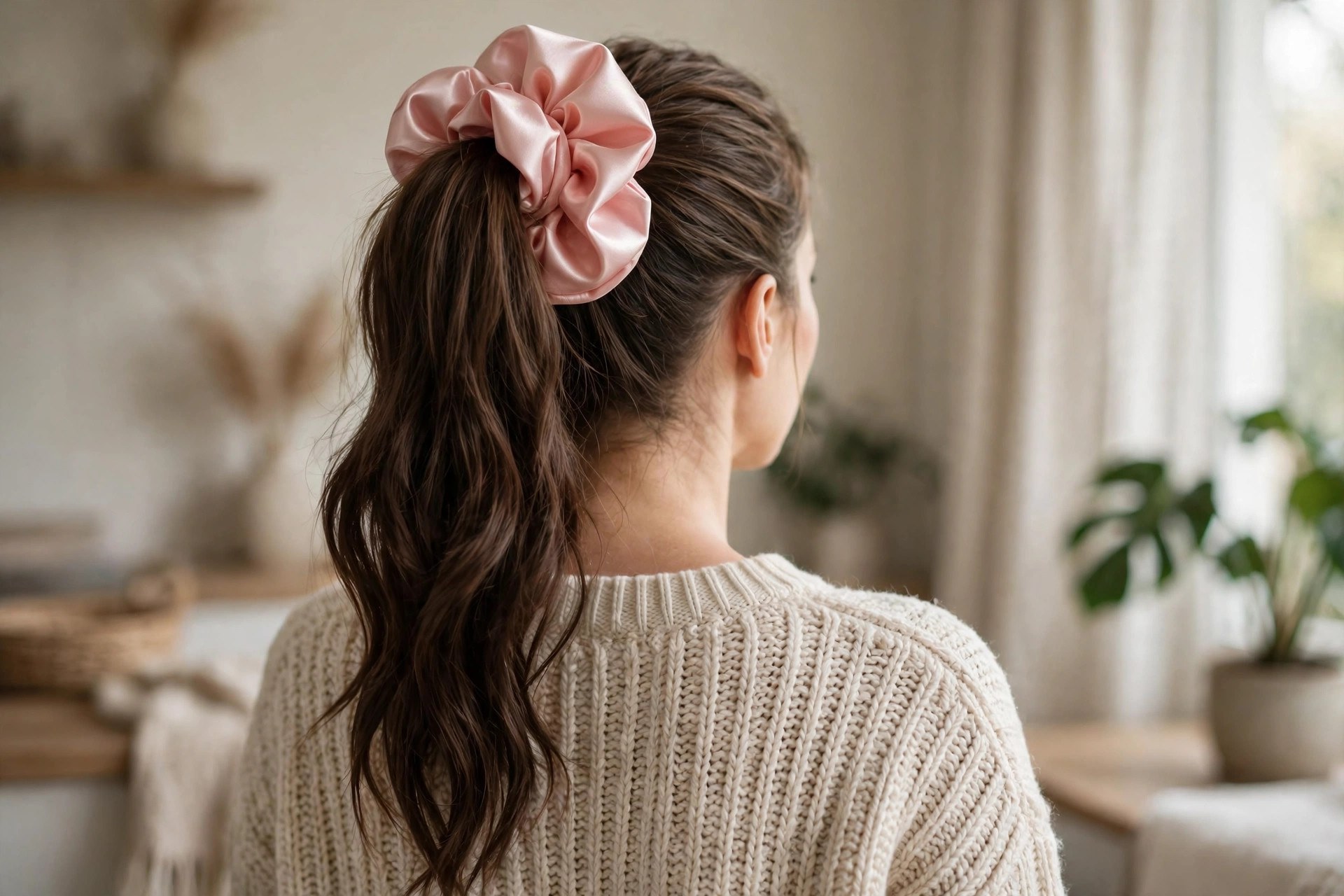
Satin and silk are the hair-health choices. Their smooth surfaces let hair glide rather than grip, reducing friction, frizz and the crease a ponytail normally leaves — the reason they are recommended for curly, fragile, bleached and overnight wear. Silk is the premium, breathable, natural option; polyester satin delivers most of the glide at a fraction of the price and is machine-washable. Velvet grips more, which fine, slippery hair often needs, and reads dressiest — the evening scrunchie. Cotton is breathable, cheap and absorbent, the everyday and workout staple, though it can dry hair slightly and leaves more of a dent.
Towelling and microfibre scrunchies are a small category of their own: worn after washing, they wick water from a bun or ponytail while you get ready, cutting drying time and heat use. Size matters alongside fabric. Standard scrunchies suit most hair; oversized versions make a statement and spread pressure further on very thick hair, while skinny scrunchies — a slim band with minimal fabric — give a subtle hold for fine hair and half-up styles. Inside all of them, elastic quality decides lifespan: when the elastic tires, the scrunchie is done, however good the fabric looks.
Benefits by Hair Type — Honestly Stated
For curly and coily hair, the case is strongest: a satin or silk scrunchie secures a pineapple (the loose, high overnight ponytail that protects curls) without crushing pattern or snagging on exposed elastic, and it comes out without dragging. For fine or thinning hair, the wide fabric surface lowers the tension at any single point, and a looser wrap holds surprisingly well. For thick, heavy hair, choose a strong elastic and a larger size, and accept that a scrunchie alone will not hold a high-intensity workout ponytail — few things do.
A balanced caveat belongs here. A scrunchie still ties hair up, and any tight, repeated, same-place ponytail can stress hair, whatever covers the elastic. The benefits are relative: less friction, less denting, less snagging than a bare elastic — not a licence to wear a tight ponytail daily. Rotate the position, vary the tightness, and let hair down when you can. Claims beyond that — that a scrunchie will make hair grow, for instance — are marketing, not fact.
How to Wear One — Beyond the Ponytail
The classics endure: a high ponytail, a low loose ponytail at the nape (the most elegant and the gentlest), a top knot or bun with the scrunchie wrapped at its base, and a half-up style on shorter hair. Plait wearers use one at the end of a braid, where it holds without the elastic crimp and adds a soft finish. Two space buns, a ponytail through a cap, and the wrist stack — a spare worn as a bracelet, ready when needed — complete the standard repertoire.
Styling is mostly colour and scale. Match or deliberately contrast with your outfit; a black satin scrunchie disappears into dark hair for formal settings, while an oversized patterned one can be the single accessory that makes jeans and a white shirt look planned. For work, keep to smooth fabrics in neutral colours and a low, neat placement. And wash them: scrunchies pick up hair oil and product quickly. Most cotton and satin versions machine-wash in a mesh bag on a gentle cycle; silk should be hand-washed. Replace them when the fabric looks tired or the elastic slackens — they are an inexpensive item doing daily work, much like the other small accessories in our women's accessories guide.
Common Questions
- Are scrunchies really better for your hair than hair ties?
- Generally yes. The fabric covering spreads pressure, removes the snagging contact of bare elastic, and — in satin or silk — reduces friction and ponytail creasing. They do not eliminate the stress of a very tight ponytail worn daily.
- Which scrunchie fabric is best for curly hair?
- Silk first, satin second. Their smooth surfaces protect curl pattern and reduce frizz, especially for overnight pineapple styling. Velvet grips too much for many curls; cotton can dry and dent them.
- Why do scrunchies not hold my hair?
- Either the elastic is worn out, the size is wrong for your hair volume, or the fabric is too slippery for your hair type. Try a larger size, a stronger elastic, or switch from satin to cotton or velvet for grip.
- How often should you wash a scrunchie?
- Every week or two with regular use. They absorb oil and styling product against your hair. Machine-wash cotton and satin in a mesh bag; hand-wash silk; air-dry all of them to protect the elastic.
- Can you sleep in a scrunchie?
- Yes — it is one of their best uses. A loose satin or silk scrunchie in a high, loose pineapple or a low bun protects hair overnight with far less friction than sleeping with hair loose on cotton bedding.