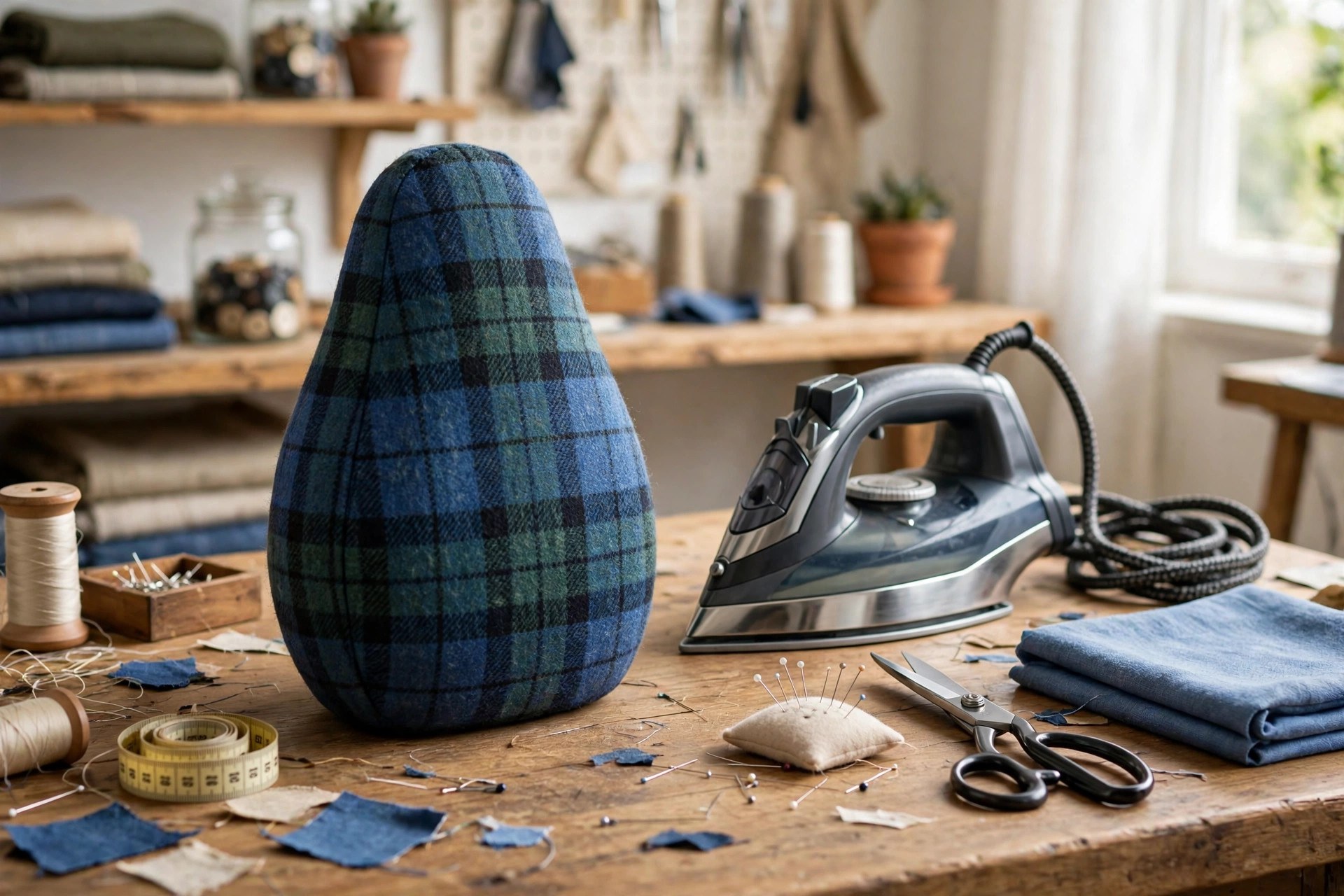
A tailor's ham is a firm, tightly stuffed, ham-shaped cushion used as a pressing surface for curved parts of a garment. A flat ironing board can only press flat things well; darts, curved seams, sleeve caps and collars are three-dimensional, and pressing them flat distorts them. The ham goes inside or under the curve so the iron can shape it instead of crushing it.
What a Tailor's Ham Is Made Of
Traditionally a ham is covered in wool on one side and cotton on the other. The wool side grips fabric, absorbs steam and suits woollens and higher heat; the smoother cotton side is for cottons and lower temperatures. Inside, the filling — historically sawdust, now often wood shavings, wool waste or dense synthetic stuffing — is packed hard enough that the ham barely gives when you press on it. That firmness is the point: a soft cushion would collapse under the iron and press nothing.
Hams come in a few sizes. A standard ham, roughly 20 by 13 cm, handles most darts, waist seams and collars. Larger hams suit coat work and long curved seams; small, narrow hams are made for children's clothes and tight curves. Colour matters a little: a plaid or checked cover, traditional on many hams, helps you see straight grain and keep seams aligned while you work.
How to Use a Ham: Curved Seams, Darts and Sleeves
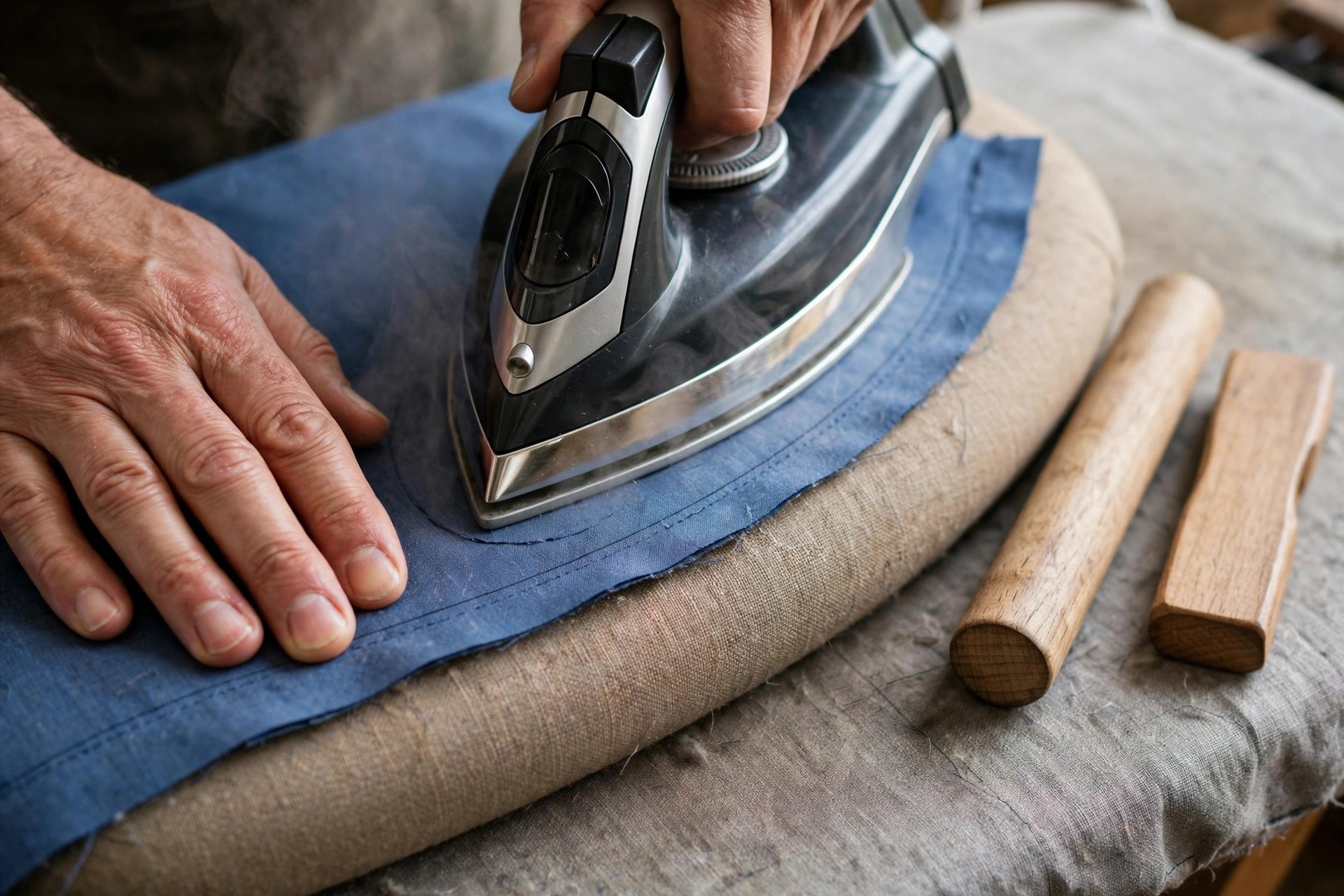
Press, do not iron. That single habit separates good pressing from most home pressing: lift the iron, set it down on the next spot, lift again, rather than sliding it back and forth, which stretches bias edges and shifts layers. Work on the wrong side of the garment where you can, use a press cloth over anything that might shine, and let each pressed section cool and dry before you move or hang the garment — the shape sets as it cools, not while it is steaming.
For a dart, place the ham under the dart so the fabric follows the body's curve, then press along the dart toward its point without pressing past the point, which creates a pucker. For curved seams — a princess seam, a hip seam, a waist seam on a shaped skirt — lay the seam over the ham's matching curve, open the seam allowances over the curve, and press in short sections. For a sleeve cap, ease the cap over the narrow end of the ham and press the ease in with steam and fingertips, shrinking out the fullness instead of pressing a crease into the armhole. Collars, lapels and rolled edges all benefit the same way: shape first over the ham, then a final light press.
The Rest of the Pressing Kit: Rolls, Clapper and Point Presser
A seam roll is the ham's long, thin cousin: a firm sausage-shaped cushion that goes inside a sleeve or trouser leg so you can press the seam without the iron marking a crease through to the other side. A sleeve roll is a smaller version for narrow sleeves and small openings. If you press only one seam in a narrow tube without a roll, you will usually press a shiny line into the opposite side; the roll prevents exactly that.
A clapper is a heavy, flat block of hardwood. Immediately after steaming a seam, lapel edge or trouser crease, you press the clapper down hard on the hot fabric and hold it for several seconds. The wood absorbs heat and moisture while its weight sets a flat, sharp, lasting finish — this is how tailors get edges that stay crisp. A point presser is a small, flat, pointed board, often combined with a clapper on the reverse side: slide the point inside a collar, cuff corner or facing, and you can press the seam open right into the point, then turn a sharp corner. Together, ham, roll, clapper and point presser cover almost every pressing problem a home or professional sewer meets. Our short glossary entry covers the same kit in brief: see the pressing tools glossary page.
Choosing, Care and Common Mistakes
When buying a ham, squeeze it hard: it should feel almost unyielding. Check the cover seams are tight, with no filling leaking, and choose wool-and-cotton covers over all-synthetic ones, which can melt or glaze under a hot iron. A ham lasts for decades; store it dry, because a damp sawdust filling can smell and eventually rot, and brush lint off the wool side so it does not transfer to pale fabrics.
The common mistakes are predictable. Pressing a curved seam flat on the board bakes in the wrong shape. Skipping the ham for speed, then trying to fix a flattened dart later, rarely works — reshape it with steam over the ham, patiently. Using a ham that is too soft, substituting a rolled towel for a sleeve roll on a final press, and moving a garment while it is still hot and damp all undo good work. Press each seam as you sew, not all at the end: pressing is half of sewing, and the ham is the tool that makes it three-dimensional.
Common Questions
- What is a tailor's ham used for?
- Pressing curved and shaped parts of a garment — darts, curved seams, sleeve caps, collars and lapels — over a firm curved surface, so the iron shapes them instead of flattening them against a flat board.
- Can I substitute a rolled towel for a tailor's ham?
- For a rough first press, sometimes, but a towel is far too soft and collapsible for a final press. A proper ham is packed almost solid, which is what lets the iron actually shape the fabric over it.
- Which side of the tailor's ham do I use?
- The wool side for woollens and higher heat — it grips and absorbs steam. The cotton side for cottons and fabrics needing lower temperatures. Check your ham: the two sides are usually visibly different fabrics.
- What does a clapper do that an iron cannot?
- It sets the press. Applied with firm pressure right after steaming, the heavy wood absorbs heat and moisture and holds the fabric flat while it cools, producing sharper, longer-lasting seams, edges and creases.
- Do beginners need a tailor's ham?
- If you sew garments with darts, set-in sleeves or curved seams, yes — it is one of the few tools that visibly improves results from the first use. Dressmakers who only sew straight seams can manage with a seam roll alone.
Not This Kind of Ham
One letter separates the sewing tool from a New Jersey breakfast. The pressing tool is a tailor’s ham, named for the profession. The sandwich filling is Taylor ham — a surname — created by John Taylor of Trenton in 1856 and sold as Taylor’s Prepared Ham; the 1906 Pure Food and Drug Act ruled it could not legally be called ham, so it became pork roll. North Jersey orders “Taylor ham, egg and cheese” on a hard roll or bagel, regarded as the state’s unofficial state sandwich, while South and Central Jersey say “pork roll” — dueling 2016 bills to make it official under each name both failed.