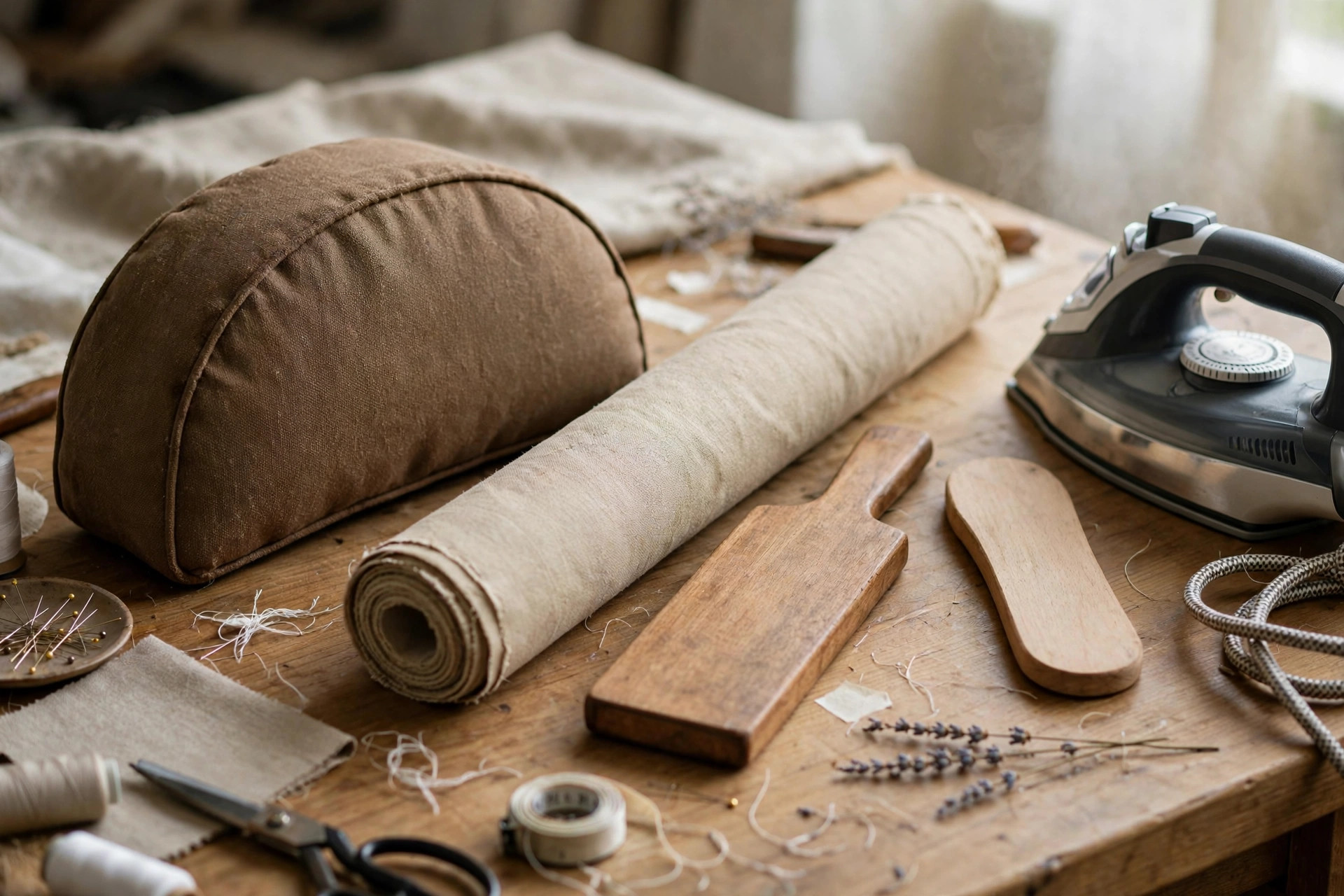
Pressing tools are the shaped surfaces and aids that let a maker press a garment into its intended three-dimensional form — because pressing in sewing is not ironing flat, it is moulding. The core kit: a tailor's ham (a firm, curved cushion for pressing darts and shaped seams), a seam roll (a long cushion that lets a seam be pressed open without imprinting the allowances), a clapper (a hardwood block that flattens seams and edges with pressure and steam absorption), a sleeve board (a narrow double-ended board for sleeves and small tubes) and a point presser (a pointed board for opening and pressing collar points, lapels and corners).
Each Tool's Job
- Sewing — the Apparel Search sewing section
- Tailor's ham — its curves stand in for the body's: bust darts, hip seams, sleeve caps and curved collars are pressed over it so they keep their shape instead of being flattened. One side is wool (for wool, low heat), the other cotton (for high heat).
- Seam roll — slipped inside a sleeve or trouser leg, it supports only the seam, so the iron presses the allowances open without creasing the garment around them.
- Clapper — after a shot of steam, the clapper is pressed (or lightly pounded) onto a seam, edge or pleat and held: the wood absorbs steam and the weight sets a flat, crisp result — the secret of sharp trouser creases and flat lapels.
- Sleeve board — a padded mini ironing board sized for sleeves, children's clothes and other narrow parts that a full board would crease.
- Point presser — its pointed end opens out collar points, cuffs and lapel corners so they can be pressed perfectly flat, often combined with a clapper surface.
Pressing as You Sew
Professionals press every seam as it is sewn — flat, then open (or to one side), then from the right side over the correct tool — and a garment pressed at each stage needs almost no final pressing. Heat, steam, pressure and cooling in place are the four variables; the tools exist to deliver them to curved, narrow and layered places an iron alone cannot reach. Tailoring structures such as hair canvas fronts are literally shaped by this pressing work.
FAQs
- What is the difference between pressing and ironing?
- Ironing slides the iron to remove wrinkles from flat cloth. Pressing lifts and sets the iron down with pressure, moulding seams and curves into shape — and always cooling in place before moving the work.
- If I buy only two pressing tools, which two?
- A tailor's ham and a clapper. The ham covers curves and darts; the clapper transforms seams, edges and creases. Add a seam roll next if you sew sleeves or trousers.
- Why is a clapper made of wood?
- Dense hardwood absorbs steam, holds heat out of the seam and adds weight — the combination sets a flatter, crisper seam than the iron alone can achieve.
Detailed Guides: see Pressing Tools in the glossary A–Z listing of the Apparel Search fashion glossary for related terms.