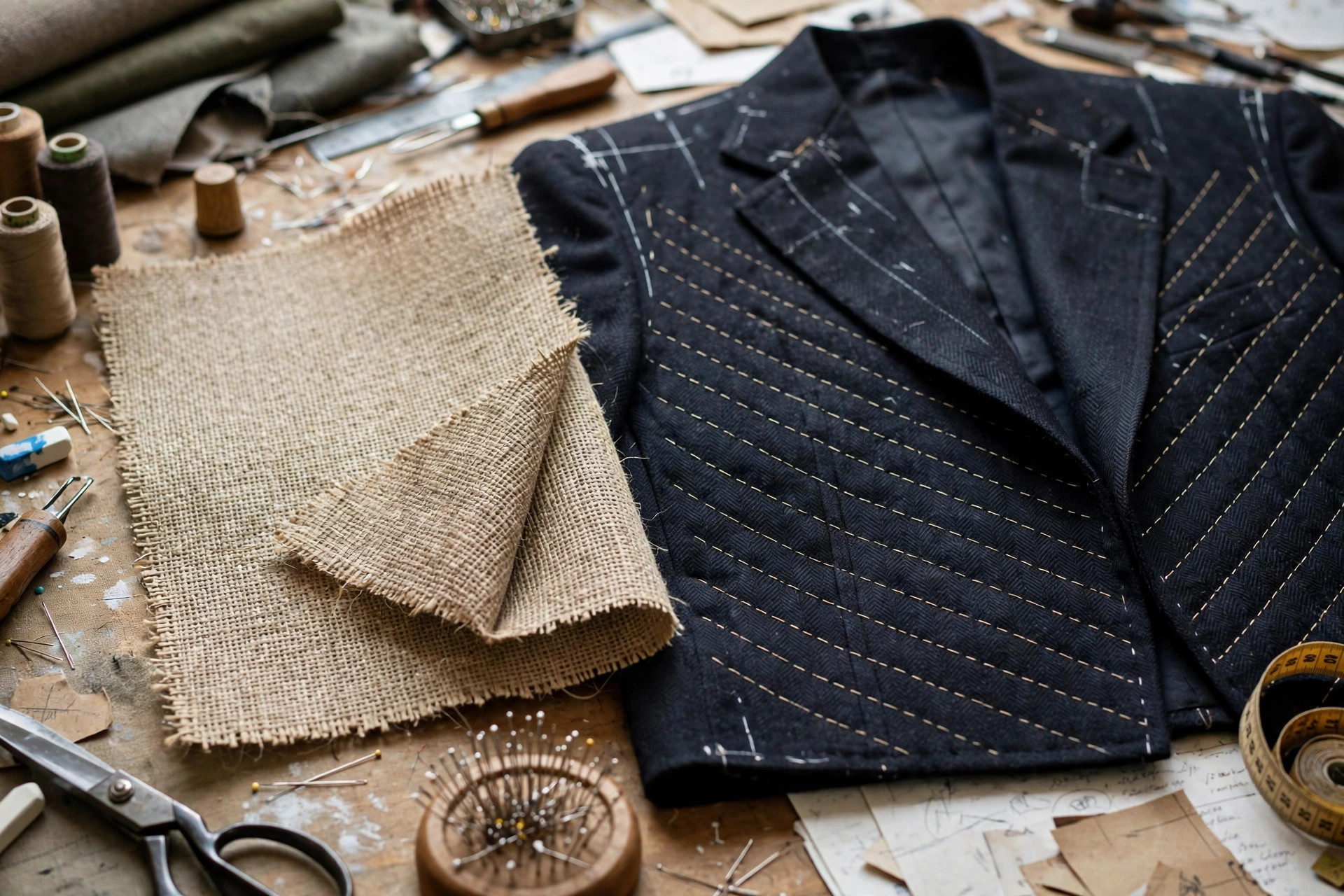
Hair canvas is a woven interfacing traditionally made from wool and cotton strengthened with horsehair (today often goat hair or a synthetic substitute) in the weft. It is the structural heart of a traditionally tailored jacket: a shaped canvas piece is pad-stitched by hand to the jacket front, where its springy, resilient weave holds the chest's curve, supports the lapel's roll and keeps the front from collapsing for the life of the garment. Unlike fusible interfacing, hair canvas is sewn in — it floats with the cloth rather than being glued to it.
Why Tailors Choose It
Hair canvas is alive in a way fusible cannot be: it moulds to the wearer's chest with wear, breathes, and never bubbles, peels or stiffens the cloth it supports. Grades range from heavy canvas for overcoats to fine, soft hair canvas for women's tailoring. The canvas is cut on the bias at the chest, darted and shaped with the iron, then attached with pad stitches worked in rows — the diagonal hand stitches that build the lapel's gentle roll into the structure itself.
- Sewing — the Apparel Search sewing section
- Full canvas — canvas runs the whole jacket front; half canvas — canvas through the chest and lapel only, with fusible below. Both out-shape and out-last a fully fused front.
Hair Canvas and Its Alternatives
Fusible interfacing made jackets cheaper and faster, and for soft, unstructured styles it is the right tool. But where a lapel must roll rather than fold, a chest must hold a sculpted curve, or a coat must serve for decades, hair canvas remains the standard — as it has been since horsehair cloth first stiffened 19th-century tailoring. It is sold by weight and hair content; genuine hair weft gives the springiest, most durable result.
Care matters with hair canvas: it is pre-shrunk before cutting (tailors soak or steam it, because a canvas that shrinks after pad stitching would pucker the whole front), cut with the hair weft running horizontally for maximum spring across the chest, and stored rolled, never folded, so its resilience is not creased out of it. A finished canvas front can be lifted out of a worn-out jacket and, in traditional bespoke practice, the client's measurements and canvas shaping are kept on file — the quiet archive behind tailoring that fits the same way for thirty years.
FAQs
- Is hair canvas made of real horsehair?
- Traditionally yes — horsehair (now more often goat hair) forms the weft that gives the canvas its spring. Modern versions may use synthetic fibres blended to imitate it.
- What is the difference between hair canvas and fusible interfacing?
- Hair canvas is sewn in and shapes the garment with resilient structure that moulds to the body. Fusible interfacing is glued on: faster, flatter, and prone to bubbling over time.
- Can hair canvas be used in women's tailoring?
- Yes — lighter, softer grades are made for it, and bespoke women's jackets and coats use the same pad-stitched canvas construction as men's.
Detailed Guides: see Hair Canvas in the glossary A–Z listing of the Apparel Search fashion glossary for related terms.