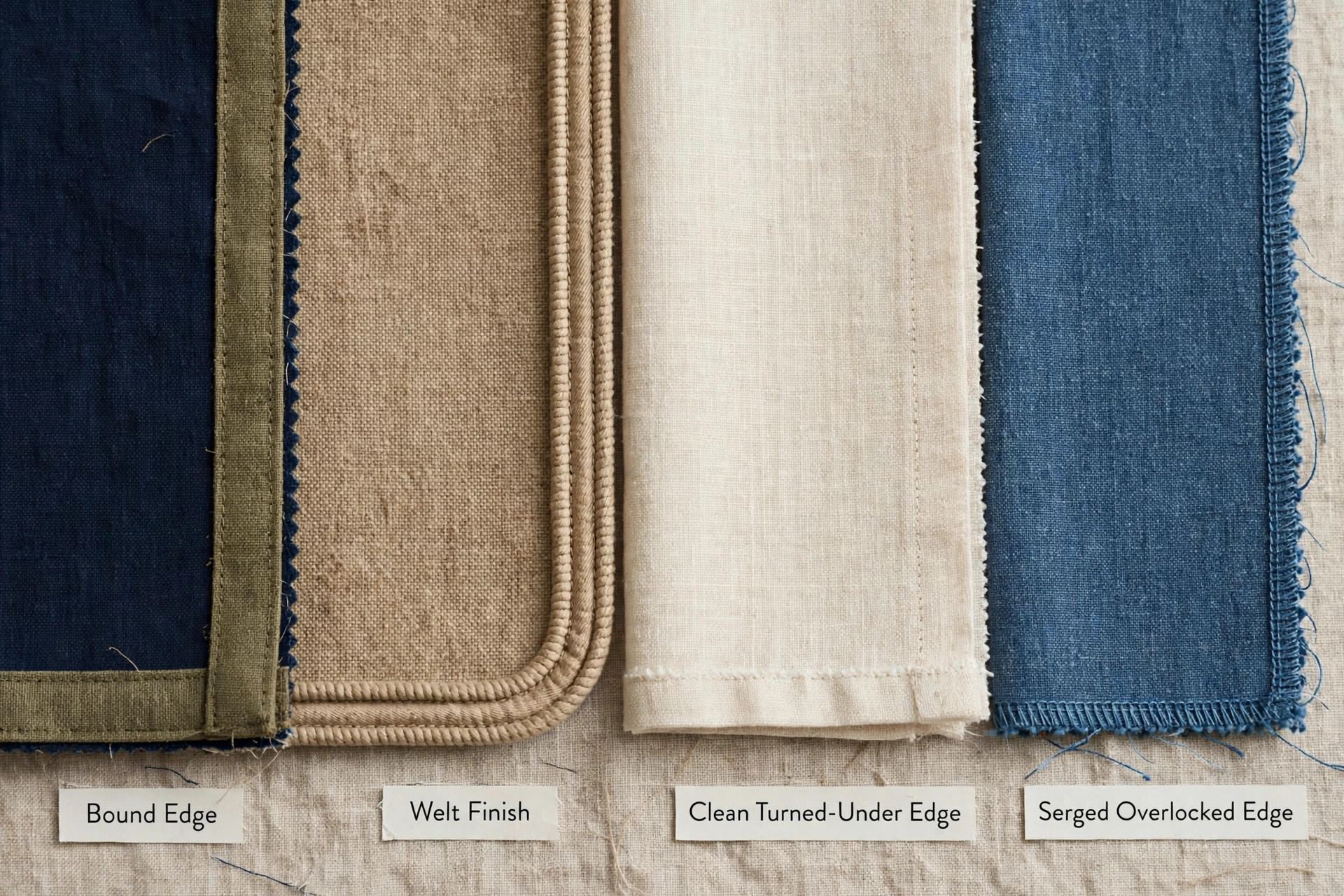
Seam finishes are the treatments applied to the raw edges of seam allowances so a garment survives wear and washing without fraying, and so its inside looks as considered as its outside. The main families are bound finishes (edges wrapped in a strip, including the Hong Kong finish), welt finishes (one wide allowance folded over the other), clean finishes (each edge turned under and stitched), self-bound finishes (the garment's own allowance or an attached facing does the wrapping) and serged finishes (edges overlocked by machine). The right choice balances fabric, garment quality, bulk and time.
The Main Finishes
- Sewing — the Apparel Search sewing section
- Bound finish — a separate bias or straight strip encloses the raw edge(s). Enclosing both allowances together suits straight seams on medium fabrics; binding each allowance separately and pressing open is the Hong Kong finish, best for unlined jackets and curved seams.
- Welt finish — one seam allowance is trimmed, the other folded over it and stitched down, enclosing the raw edges in a flat, sturdy package used on unlined trousers, skirts and workwear.
- Clean finish — each raw edge is turned under about 1/4 inch (6 mm) and edge-stitched. Simple, flat and bulk-free; the classic finish inside better dresses and blouses on fabrics that hold a crease.
- Self-bound finish — the allowance itself, extended or folded, wraps the edge, or a self-fabric strip is used; common on sheer and reversible garments where a foreign fabric would show.
- Serged (overlocked) finish — a serger trims and wraps the edge with thread in one pass. Fast, stretchy and the industry standard for knits and most ready-to-wear; edges can be serged together or separately and pressed open.
Choosing a Finish
Match the finish to the fabric's fraying habit and the garment's life: a fraying silk needs enclosure, a stable cotton is happy turned under, a knit needs the stretch of a serged or zigzag edge. Consider bulk at crossings, whether the inside will show (unlined garments deserve bound or clean finishes), and laundering — a finish that survives fifty washes is worth more than a pretty one that frays by the fifth.
One more everyday option deserves mention: pinking — cutting the allowance edge with pinking shears — which slows fraying on firm fabrics and served for generations before sergers were common; it remains useful inside lined garments and on leather and felt, which do not fray at all. Whatever the finish, allowances should be finished before construction seams cross them wherever possible: finishing a flat, open piece is faster and neater than wrestling a finished edge through a completed garment, and pressing each finish as it is made is what separates a garment that looks homemade from one that looks handmade.
FAQs
- What is the fastest seam finish?
- Serging: one pass trims and encloses the edge. Without a serger, a zigzag or overcast machine stitch is the quick equivalent, though less neat.
- Which finish is best for unlined jackets?
- The Hong Kong (bound) finish: each allowance is bound and pressed open, so the inside looks finished from every angle and curved seams stay smooth.
- Do seams inside a lined garment need finishing?
- Less elaborately — the lining protects them — but fraying fabrics still benefit from serging or pinking so loose threads do not work into the lining.
Detailed Guides: see Seam Finishes in the glossary A–Z listing of the Apparel Search fashion glossary for related terms.