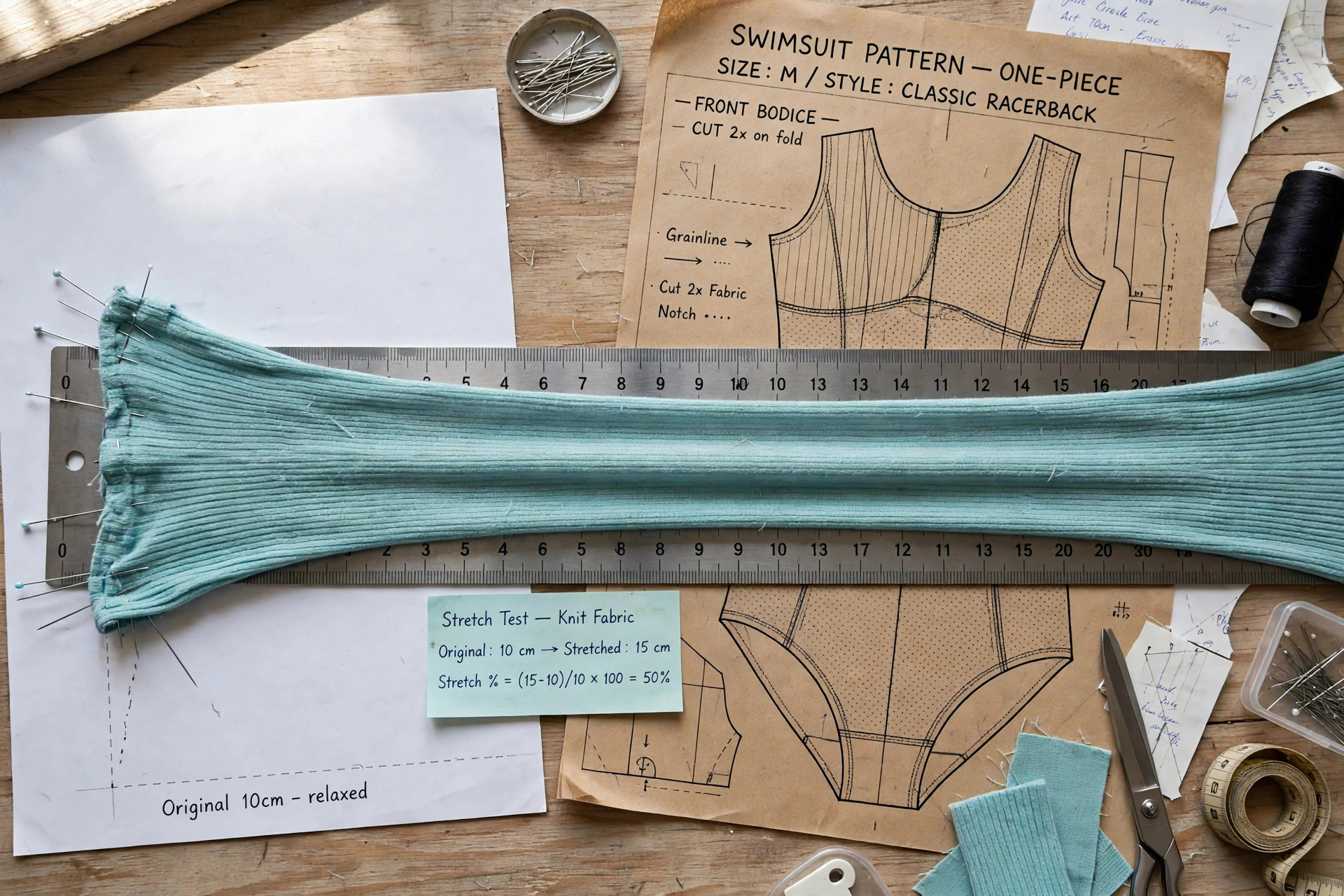
Negative ease means a garment is made smaller than the body it fits: the pattern's measurements are less than the wearer's, and the garment fits because its fabric stretches. It is the foundation of swimwear, leggings, leotards, fitted knit tops and much activewear. The amount is chosen from the fabric's stretch percentage — a bathing suit may be drafted at 10–20% less than the body around the torso — so that on the body the fabric is under even, comfortable tension, hugging without digging or sagging.
Sizing the Stretch
Negative ease is calculated, not guessed. The maker measures the fabric's stretch (how far a 4-inch/10 cm section stretches comfortably, and how well it recovers), then reduces the pattern by a matching proportion — less reduction where the body moves most, and often less (or none) in length if the fabric stretches mainly across its width. A stretch-and-recovery test on the actual fabric is essential: two jerseys with the same look can need very different patterns.
- Sewing — the Apparel Search sewing section
- Moderate stretch (jersey) — small reductions, often 1–2 in (2.5–5 cm) at the bust for a close top.
- High stretch (spandex blends) — swimsuit and dancewear reductions of 10–20% of the body measurement.
Negative Ease Versus Too Small
A garment with correct negative ease feels like a second skin: smooth, supportive, moving with the body. Too much reduction strains seams, distorts prints into pale stretched ghosts, and rides out of place; too little wrinkles and bags, especially when wet — swimwear is checked in water, where fabric relaxes. Negative ease is a property of the pattern-plus-fabric system, which is why knit patterns specify the stretch their sizing assumes.
Negative ease also explains swimwear's odd sizing feel: a suit that looks impossibly small on the hanger is engineered, not mislabelled, and trying it on dry is only half the test, since elastane relaxes a few percent in water. The same principle scales down to a watch strap's knit cuff or a sock's leg — anywhere a garment must stay in place without fastenings, controlled tension replaces closures. Designers speak of the fabric and pattern as one system: change the fabric's stretch by five percent and the pattern must be rebalanced to match.
FAQs
- Which garments use negative ease?
- Anything designed to cling by stretch: swimsuits, leggings, leotards, fitted T-shirts and knit dresses, sports bras and compression wear.
- How do I work out how much negative ease to use?
- Measure your fabric's comfortable stretch and recovery, then reduce the pattern by a proportion of it — commonly using about half to three quarters of the available stretch for a close fit.
- Can woven fabrics have negative ease?
- Effectively no. Without stretch the body cannot get into a smaller garment or move in it. A tiny amount exists in very soft bias cuts, but true negative ease belongs to knits and stretch wovens.
Detailed Guides: see Negative Ease in the glossary A–Z listing of the Apparel Search fashion glossary for related terms.