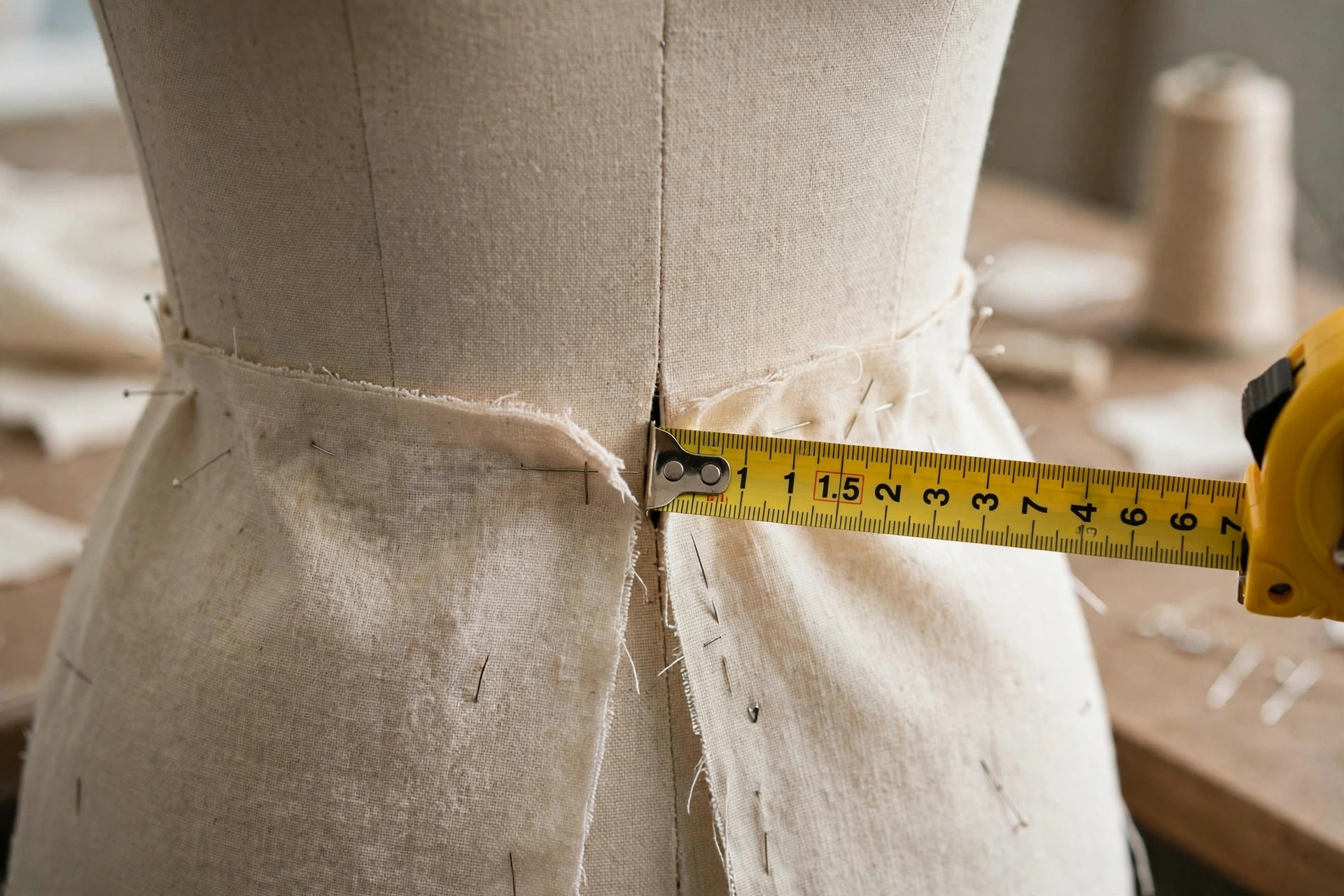
Wearing ease (also called fitting ease or comfort ease) is the amount added to a pattern beyond the body's own measurements so the wearer can breathe, bend, sit, raise their arms and simply get the garment on and off. It is a functional minimum, not a style choice: a woven bodice typically carries about 2–3 inches (5–7.5 cm) of wearing ease around the bust, less at the waist, and trousers need enough through the hip and crotch to sit down. Too little and seams strain and movement is restricted; the amount beyond wearing ease is design ease.
Typical Amounts
- Sewing — the Apparel Search sewing section
- Bust/chest — about 2–3 in (5–7.5 cm) in a close woven fit; more for jackets worn over layers.
- Waist — about 1 in (2.5 cm) on a fitted garment, since the waist expands as we breathe and sit.
- Hip — about 2 in (5 cm) so the wearer can sit without the garment climbing or straining.
- Knits and stretch — wearing ease can shrink to zero or go negative, because the fabric itself supplies the room by stretching; see negative ease.
Ease Is Distributed, Not Just Added
Where the ease sits matters as much as how much there is. Breathing room belongs across the back and chest, sitting room at the back hip and crotch curve, reaching room in back length and sleeve. A fitting shell is drafted with wearing ease only, so the fitter can see the body clearly; style fullness is added afterwards as design ease. Ease also changes with fabric: a stiff canvas needs more room to move than a soft crepe of the same cut.
Wearing ease is invisible when it is right. Nobody praises a shirt for letting them breathe; they notice only its absence — the button that strains when they sit, the skirt that climbs the stairs one step behind them. Pattern standards therefore treat wearing ease as non-negotiable and put the burden of style on design ease instead. It also varies by person: a wearer who cycles to work needs more hip and thigh ease than the chart minimum, and good fitters add it at the shell stage rather than letting the finished garment teach the lesson.
FAQs
- What is the difference between wearing ease and design ease?
- Wearing ease is the functional minimum the body needs to move. Design ease is everything added beyond that to create a style's shape — slim, relaxed or oversized.
- Can wearing ease be zero?
- In stretch fabrics, yes — the fabric's stretch does the work (negative ease). In a non-stretch woven, zero wearing ease means a garment that cannot be breathed in, sat in or sometimes even put on.
- How much wearing ease does a fitted dress need?
- As a guide: roughly 2–3 inches at the bust, 1 inch at the waist and 2 inches at the hip, adjusted for fabric, closures and how active the wearer will be.
Detailed Guides: see Wearing Ease in the glossary A–Z listing of the Apparel Search fashion glossary for related terms.