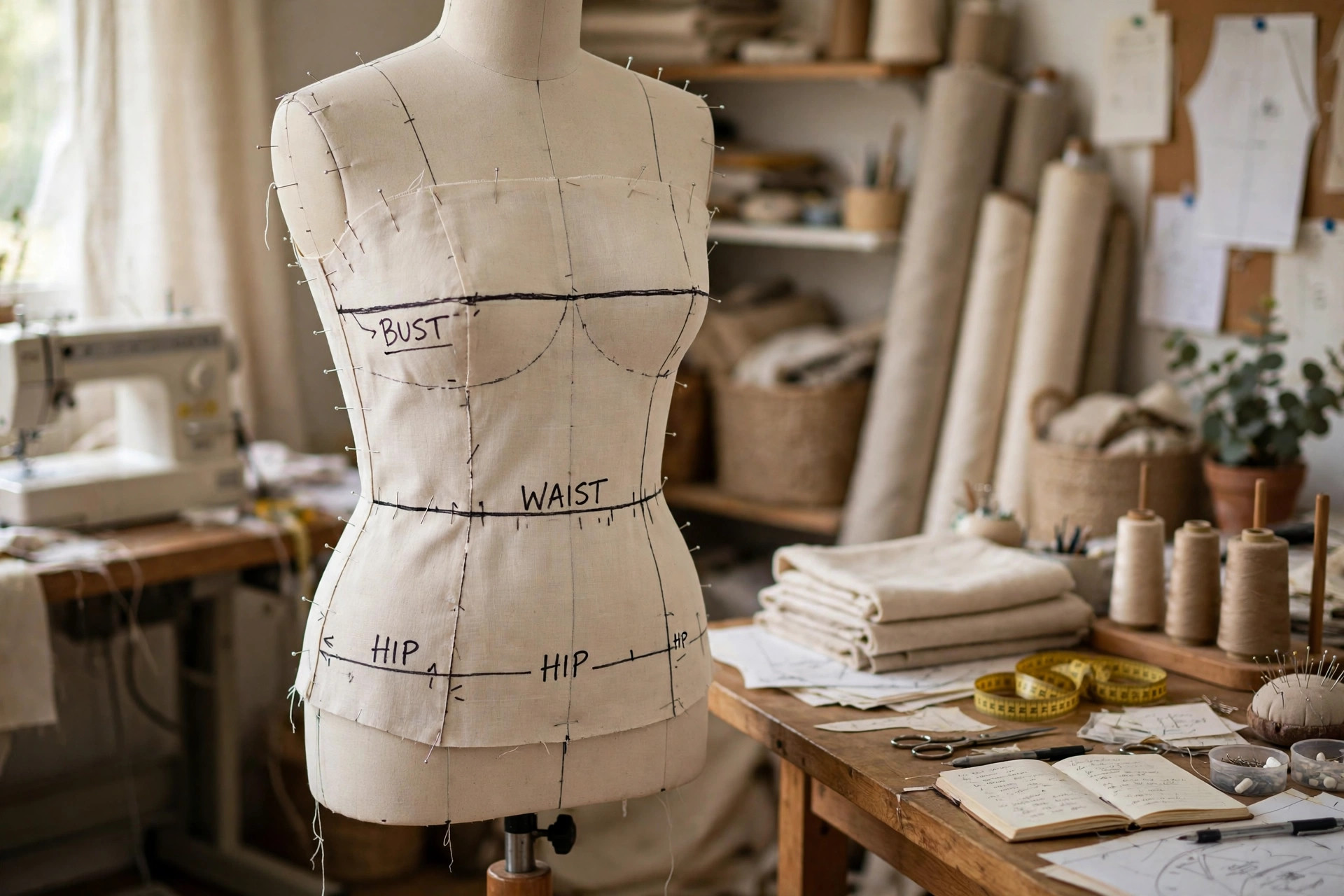
A fitting shell — also called a basic fitting dress, toile or muslin — is a plain, close-fitting test garment sewn from a basic block pattern in inexpensive fabric, with no styling details at all. Its only job is to reveal how the flat pattern meets a real body: where it pulls, sags, twists or sits perfectly. Corrections are pinned, drawn and transferred back to the paper until the shell fits cleanly; that corrected block then becomes the foundation for every design and the reference for adjustments such as a full bust or swayback correction.
What a Shell Includes
A dress shell combines a fitted bodice (front and back darts, set-in sleeves), a straight skirt and, for pants fitting, a basic trouser — each with only wearing ease, seam allowances marked, and key lines drawn on the fabric: centre front and back, bust, waist, hip and grain lines. It is sewn in muslin or gingham (whose checks expose off-grain distortion at a glance), with long stitches and open seam allowances so it can be let out, pinned and re-sewn through several fittings.
- Sewing — the Apparel Search sewing section
- Marked, not decorated — every line on a shell is information: balance marks, apex points and level lines at bust, waist and hip.
From Shell to Wardrobe
Once perfected, the shell's pattern — the sloper, corrected for one body — anchors all further work. Industry uses a fit shell on a standard fit model to lock a brand's sizing; home and bespoke makers fit a shell on the client. Adjustments diagnosed on the shell (forward shoulder, high round back, swayback) are recorded as standard alterations and applied to every pattern made from the block thereafter.
A shell fitting follows a set order: length and balance first, then circumference, then darts and details — because each earlier decision changes the later ones. The fitter works from the centre out and from the back to the front, pinning one correction at a time and re-checking the whole hang after each. When the shell finally sits clean — no drag lines, level hems, darts pointing at the apexes — it is taken apart, its corrected lines transferred to paper, and that paper, not the cloth, becomes the permanent record of the body's fit.
FAQs
- What is the difference between a fitting shell and a sloper?
- The sloper is the paper pattern; the fitting shell is that pattern sewn up in test fabric and fitted on the body. The fitted shell corrects the sloper.
- Why use gingham or muslin for a shell?
- Both are cheap and stable; gingham's woven check makes twisting and off-grain problems immediately visible, and muslin takes pencil and pin marks clearly.
- How much ease does a fitting shell have?
- Only wearing ease — enough to move and breathe. Design ease belongs to the styles developed later from the corrected block.
Detailed Guides: see Fitting Shell in the glossary A–Z listing of the Apparel Search fashion glossary for related terms.