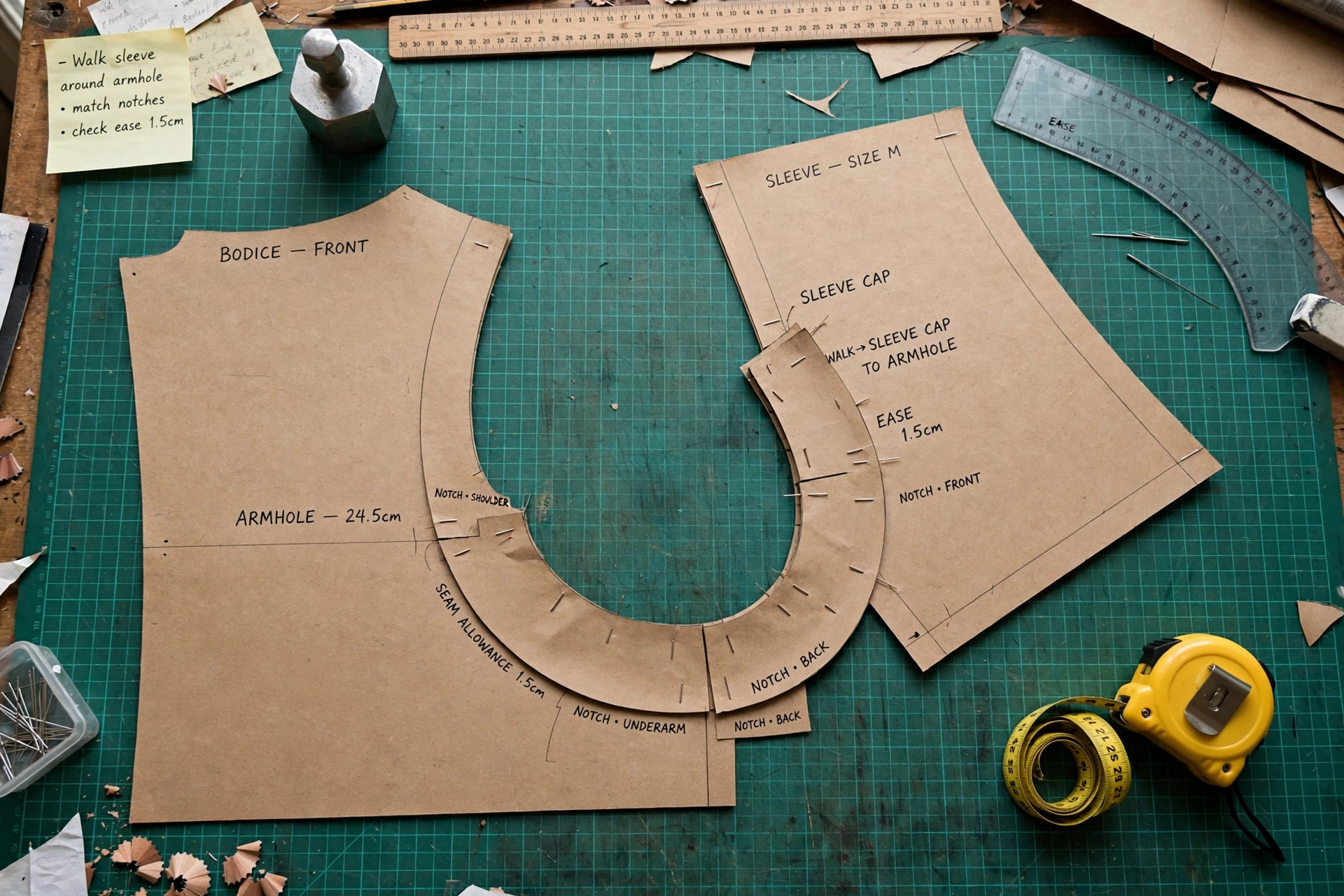
Walking the seams is the pattern check in which two pieces that will be sewn together are compared edge to edge: one piece is pivoted in small steps along the seam line of the other — literally walked around it — from notch to notch. The walk proves the seam lengths agree, shows exactly where any ease sits, and reveals whether the joined line flows smoothly. It is how a pattern maker guarantees a sleeve will fit its armhole and a collar its neckline before fabric is cut.
How a Seam Is Walked
Working on the stitching line, not the cutting edge, the maker aligns the first notch of both pieces and pivots the upper piece forward a short step at a time, marking each landing point, exactly as the sewing machine foot will travel. At every notch the marks must meet. Any difference is measured: a sleeve cap, for example, should carry a planned amount of ease over the armhole — commonly 1 to 1.5 inches (2.5–3.8 cm) on a tailored sleeve — spread evenly, never bunched.
- Sewing — the Apparel Search sewing section
- Must match exactly — side seams, waist seams, princess seams between their notches.
- Must differ deliberately — sleeve cap over armhole, collar fall, a slightly eased back shoulder — with the difference recorded and distributed.
What Walking Catches
Walking catches drafting slips, manipulation errors and grading mistakes while they are still pencil lines: a collar a centimetre short, a facing that twists, a junction where two seams meet at a peak instead of a smooth line. Combined with trueing and blending, it is the last quality gate before the pattern is allowed anywhere near fabric.
Walking is also how ease is designed rather than discovered. A shirt sleeve, for instance, is deliberately walked with slightly less cap ease than a jacket sleeve, because its fabric is softer and its armhole deeper; a raglan or kimono seam is walked to confirm the underarm curve flows. In production, walked patterns are re-verified after grading at the smallest and largest sizes, where rule errors concentrate. The habit is unglamorous and total: no seam in a professional pattern reaches the cutting table unwalked.
FAQs
- Do you walk the cutting line or the stitching line?
- The stitching line. Seam allowances can differ in width between pieces; only the stitching lines must agree in length.
- How much ease should a sleeve cap have?
- It depends on fabric and style — roughly 1 to 1.5 inches (2.5–3.8 cm) for a set-in tailored sleeve, less for shirts, none for a lined flat cap — but it must be planned and evenly spread.
- What happens if walked seams do not match?
- The pattern is corrected on paper: lines are re-blended, a notch moved, or a piece re-drafted. Sewing mismatched seams anyway forces puckers and twisted joins.
Detailed Guides: see Walking the Seams in the glossary A–Z listing of the Apparel Search fashion glossary for related terms.