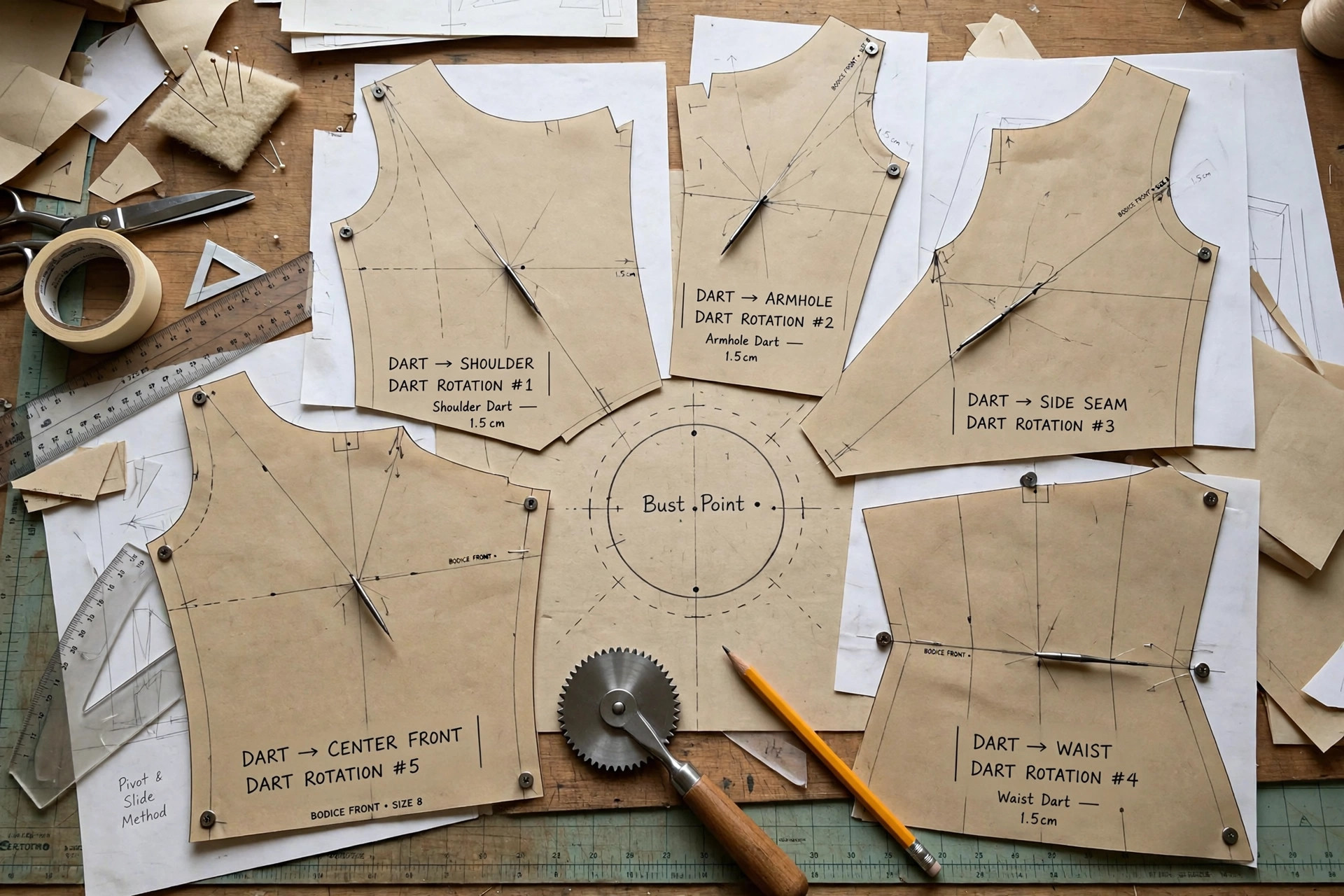
Dart manipulation is the flat-pattern technique of moving the shaping built into a basic block (sloper) from one place to another without changing the garment's fit. A dart can be rotated to a new position around the bust point, split into two smaller darts, or converted entirely into princess seams, gathers, pleats, tucks or a yoke line. The total amount of shaping stays the same — only its location and appearance change, which is how one fitted block becomes hundreds of different designs.
The Pivotal Bust Point
Almost all dart manipulation on a bodice turns on one idea: the pattern rotates around the bust point, the apex the dart points toward. Using the pivot method, the drafter pins the pattern at the bust point, traces a section, rotates it to close the old dart, and a new dart opens wherever the rotation ends. Using slash and spread, the pattern is cut and swung open instead. Both methods move the same wedge of fabric — the dart equivalent — to the new spot.
- Sewing — the Apparel Search sewing section
- Common moves — waist dart to shoulder, side-seam dart to armhole, French dart low on the side seam, darts combined into one large shoulder or neck dart.
- Conversions — darts become princess seams, ease, gathers at a yoke, or pleats when the new opening is left unsewn.
Rules That Keep the Fit Honest
A moved dart is usually shortened so its point ends about 1/2 to 1 inch (1.3–2.5 cm) before the bust point; sewing it all the way to the apex creates a pointed cone. The dart's legs must be equal in length, and after any move the seams are walked and trued so adjoining pieces still match. Manipulation changes style, never size — if the garment must also fit differently, that is a separate fitting adjustment.
Dart manipulation is taught as the core skill of flat pattern making because it proves a liberating idea: fit and fashion are separate decisions. The block guarantees the fit; manipulation supplies the fashion. A designer can sketch a bodice with a single dramatic shoulder dart, gathers spilling from a yoke, or seams that spiral around the body, and the pattern maker reaches every one of those looks by the same rotations of the same wedge — which is why sample rooms test manipulations on half-scale blocks first, checking the new style in minutes before committing to full-size paper.
FAQs
- Does moving a dart change the fit?
- No. Dart manipulation relocates the same amount of shaping, so the garment fits the same body — it just shapes it from a different place, or as seams or gathers instead of a dart.
- What is the dart equivalent?
- The wedge of fabric the dart removes. However the fullness is expressed — dart, princess seam, gathers, pleat — the wedge amount stays constant for the same fit.
- How far should a dart point stop from the bust point?
- Usually 1/2 to 1 inch (about 1.3 to 2.5 cm) short of the apex, so the fabric releases smoothly over the bust instead of ending in a point.
Detailed Guides: see Dart Manipulation in the glossary A–Z listing of the Apparel Search fashion glossary for related terms.