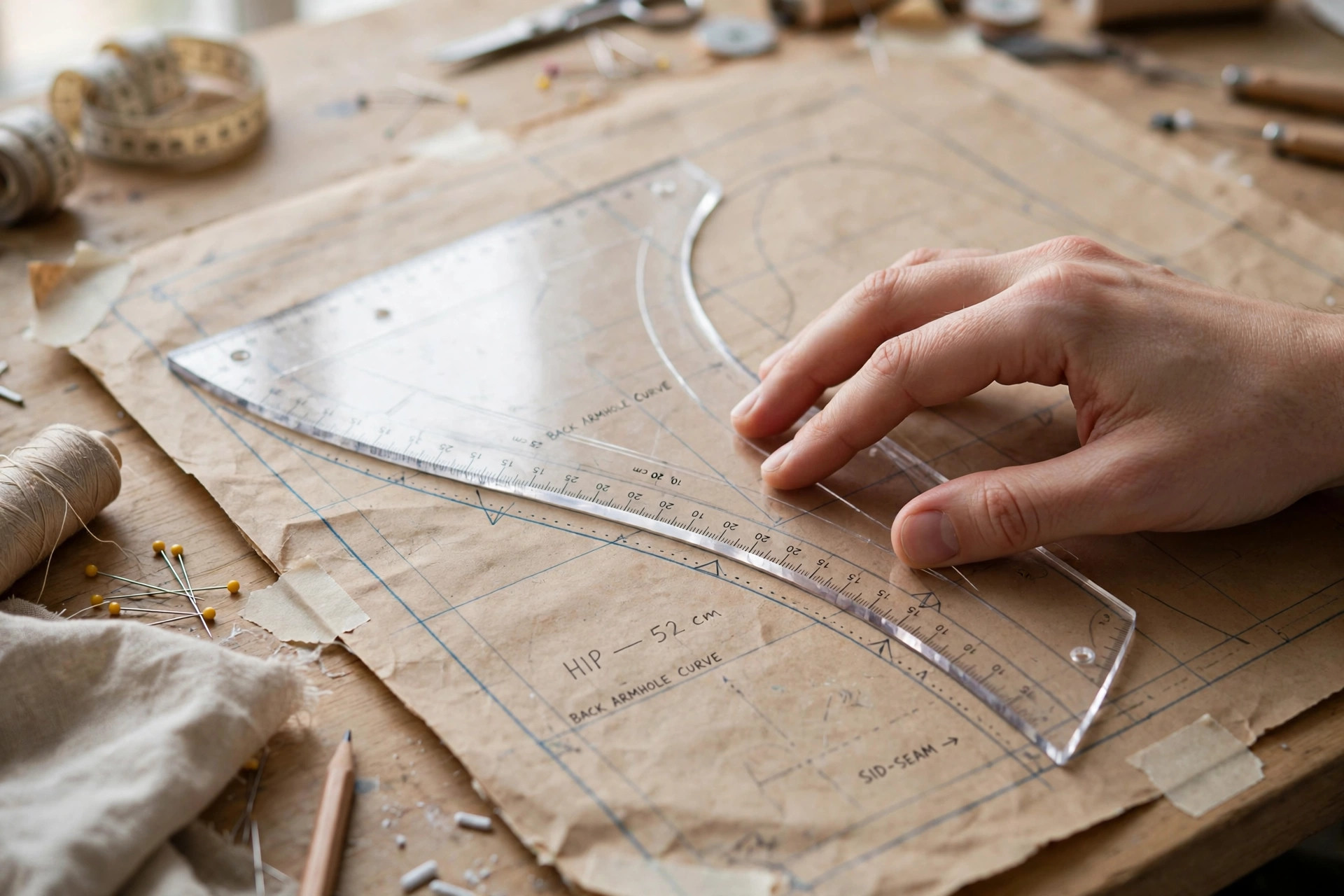
In pattern making, blending is the smoothing of a line — a curve, a seam, a dart leg or a graded outline — so it flows in one fair, continuous sweep with no bumps, corners or flat spots. After any pattern change, the drafter runs a curve ruler along the line, sights down it, and redraws it in a single corrected stroke. Blended lines sew into smooth garment curves; unblended lines show on the body as mysterious little peaks, dips and drag wrinkles.
Where Blending Matters Most
- Sewing — the Apparel Search sewing section
- Curves — necklines, armholes, sleeve caps, hip and crotch curves, where a millimetre of bump becomes a visible pucker.
- After alterations — a raised waist, moved dart or adjusted shoulder leaves steps in the adjoining seams until they are re-blended.
- Graded nests — each size in a graded set must echo the base curve; blending lines drawn through the size steps keep every size fair.
How It Is Done
The pattern maker marks the fixed points the line must pass through, then connects them with a French curve, hip curve or flexible ruler in the longest, smoothest stroke possible, shaving bumps rather than adding dips. On a graded nest, a blending line is drawn through corresponding points of all sizes at once. Blending is part of trueing — the overall check that a pattern is ready to cut — and of fitting work, where pencil corrections on a muslin are blended when transferred back to paper.
Blending is also where a pattern maker's handwriting shows. Two makers given the same marked points will draw slightly different fair curves, both correct, because blending is judgment about how a body — itself a compound curve — should be echoed in cloth. The test is always the same: sight along the line from its end, as a carpenter sights a plank. Any line that draws the eye to one spot has a bump there. On the body, that spot would become the pucker a customer notices without ever knowing its name. Good blending is invisible precisely because nothing catches the eye.
FAQs
- What is a blending line in grading?
- A line drawn through the same point on every size of a nested grade. If the blending line is smooth, the curve grows evenly through the sizes; a kink shows a grading error.
- Is blending the same as trueing?
- Blending smooths individual lines. Trueing is the complete check — darts, seams, lengths and notches — that includes blending as one step.
- Why do small pattern bumps matter?
- Fabric magnifies them. A tiny peak at the armhole or hip becomes a pucker or drag line on the body, and pressing cannot remove an error cut into the cloth.
Detailed Guides: see Blending in the glossary A–Z listing of the Apparel Search fashion glossary for related terms.