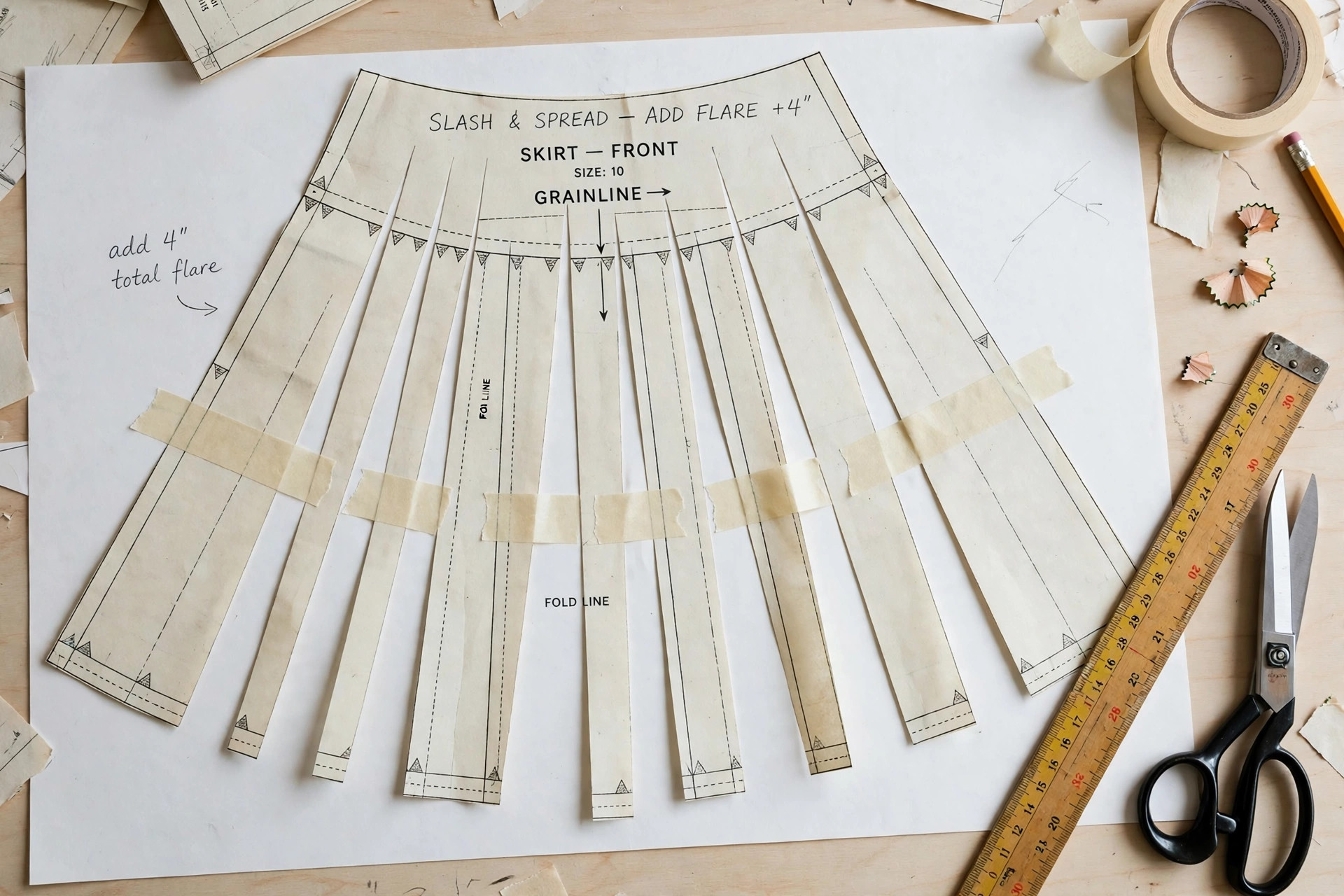
Slash and spread is a flat-pattern method in which a pattern piece is cut along marked lines and the sections are opened out — spread apart — to add length, width or fullness, then taped onto fresh paper and traced as a new piece. Spreading evenly adds flare, as in an A-line skirt; spreading at one edge only swings the piece, which is how dart fullness is relocated. It is the paper equivalent of letting out a seam, done before any fabric is cut.
How the Method Works
The drafter draws slash lines from the point where change is wanted to a hinge point, cuts almost — but not quite — through the hinge, and pivots the sections open by the measured amount. The gap is taped down, the new outline is traced, and the edges are blended and trued. For flare, several evenly spaced lines are spread by equal amounts; for fullness gathered into a seam, the spread is larger and the extra edge is later eased or gathered.
- Sewing — the Apparel Search sewing section
- Hinge point — the uncut pivot (often the bust point or hip level) that keeps the piece registered while it opens.
- Even spread — equal openings for smooth flare; uneven spread — more fullness at one side for asymmetric drape or a bust dart transfer.
Where It Is Used
Slash and spread creates flared and circular skirts, bell and puff sleeves, cowls and draped necklines, and the extra width that becomes pleats or gathers. It is also the standard way to add wearing room across a back or sleeve. The companion technique, slash and overlap (or slash and close), does the reverse — sections are overlapped to remove fullness, shorten a dart or take in width.
A few workshop rules keep the method accurate. Slash lines are drawn before any cutting, grain lines are marked on every section so the spread piece can be re-aligned, and openings are measured at the edge where the fullness will show, not at the hinge. The spread sections are taped to paper that extends well beyond the new outline, and the final tracing is done in one pass so no step creeps in. When a slash must pass through a dart, the dart is closed on paper first and the resulting shape slashed — otherwise the wedge is counted twice.
FAQs
- What is the difference between slash and spread and the pivot method?
- Both move the same fullness. Slash and spread cuts the paper and opens it; the pivot method rotates an uncut pattern around a pinned point and traces it in stages.
- What does slash and overlap do?
- The reverse of spread: sections are overlapped to remove width or length, for example closing a dart or reducing flare.
- Why leave a hinge instead of cutting the pattern fully apart?
- The small uncut hinge keeps the sections in correct relation while they open, so grain lines and adjoining edges stay registered and the new piece traces accurately.
Detailed Guides: see Slash and Spread in the glossary A–Z listing of the Apparel Search fashion glossary for related terms.