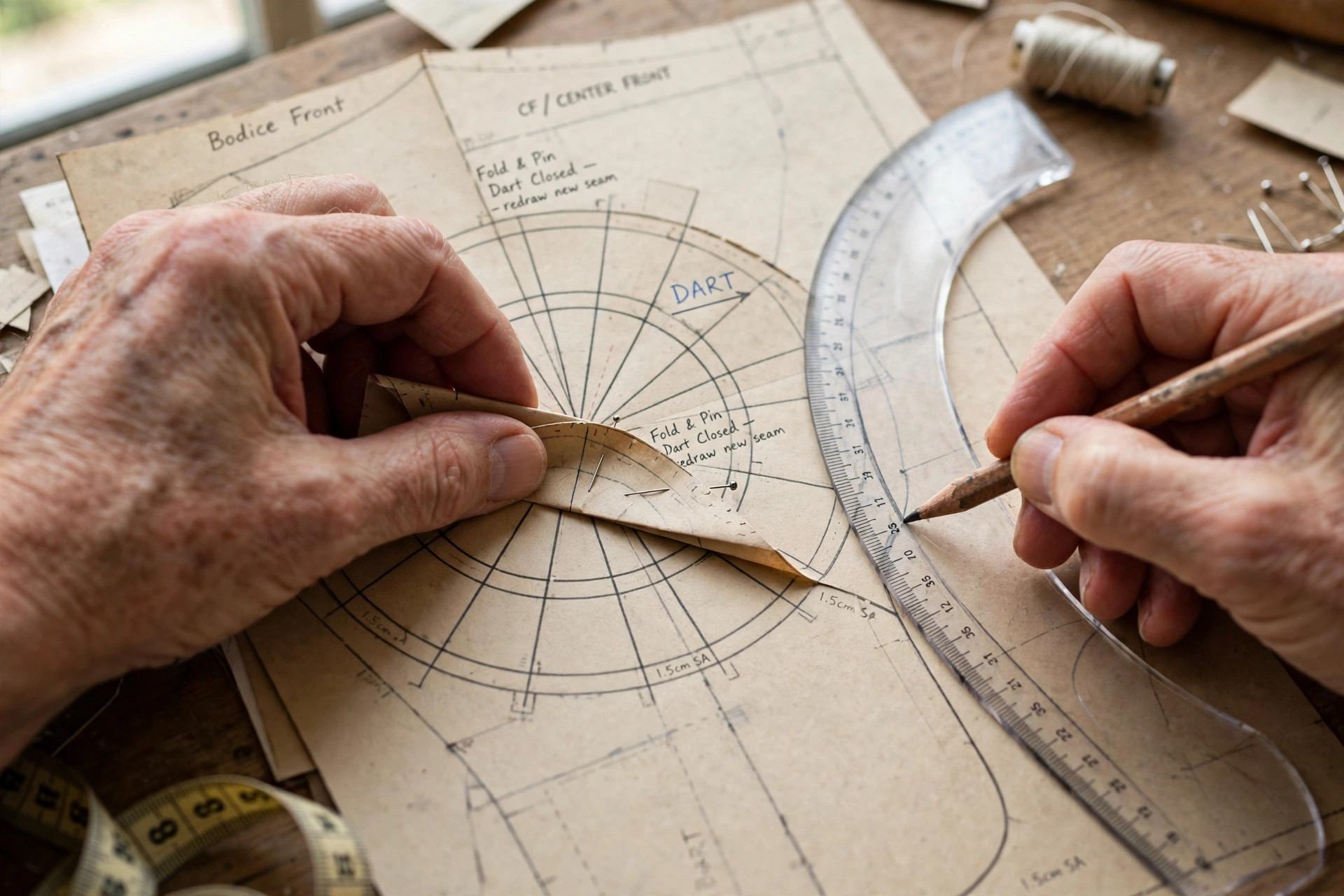
Trueing (also spelled truing) is the pattern maker's final check: every seam, dart and curve on a finished pattern is verified and corrected so the pieces sew together into smooth lines. Darts are folded closed and the seam above them re-drawn as one flowing curve; adjoining seams are walked against each other to confirm equal length; notches, grain lines and seam allowances are checked. A trued pattern is the difference between pieces that fight at the sewing machine and pieces that fall together.
What Gets Trued
- Sewing — the Apparel Search sewing section
- Darts — fold the dart closed in the direction it will be pressed, then re-draw the seam line across the fold; opened flat, the line shows the correction the leg needed.
- Seam junctions — where seams meet (armhole at the shoulder, waist at a princess line), the joined line must flow without a peak or dip.
- Curves — necklines, armholes and hip curves are smoothed with a French curve or hip curve until no flat spots or bumps remain.
- Lengths and notches — walked seams must match between notches; ease is distributed deliberately, never left as an accidental lump.
When Trueing Happens
Trueing is done every time a pattern changes: after drafting, after every dart manipulation or slash-and-spread move, after fitting corrections are transferred back to paper, and after grading, when each size is spot-checked. Skipping it does not save time — it moves the error into fabric, where a peaked armhole or mismatched seam is far more expensive to discover.
Experienced pattern makers true almost by touch: fingertips run along a curve feel a bump the eye misses, and a seam walked for the tenth time still gets checked again after any later change, however small. Trueing also has a paper discipline — corrections are drawn in a different colour, dated on revisions, and never erased from the master until the sample is approved, so a mistake can be traced back to the change that caused it. Production patterns are trued one final time after grading, size by size, before markers are made. A pattern that has not been trued is a draft, not yet a pattern.
FAQs
- Is trueing the same as blending?
- They are partners. Blending smooths a line or curve itself; trueing is the whole verification pass — darts, junctions, lengths, notches — of which blending is one part.
- Why fold the dart before checking the seam?
- A dart sewn shut changes the angle of the seam crossing it. Folding it as it will be sewn shows the true line the stitching must follow.
- Can a pattern be trued in CAD?
- Yes — pattern software has curve-smoothing and seam-walking checks — but the maker must still run them; the software will happily store an untrued pattern.
Detailed Guides: see Trueing in the glossary A–Z listing of the Apparel Search fashion glossary for related terms.