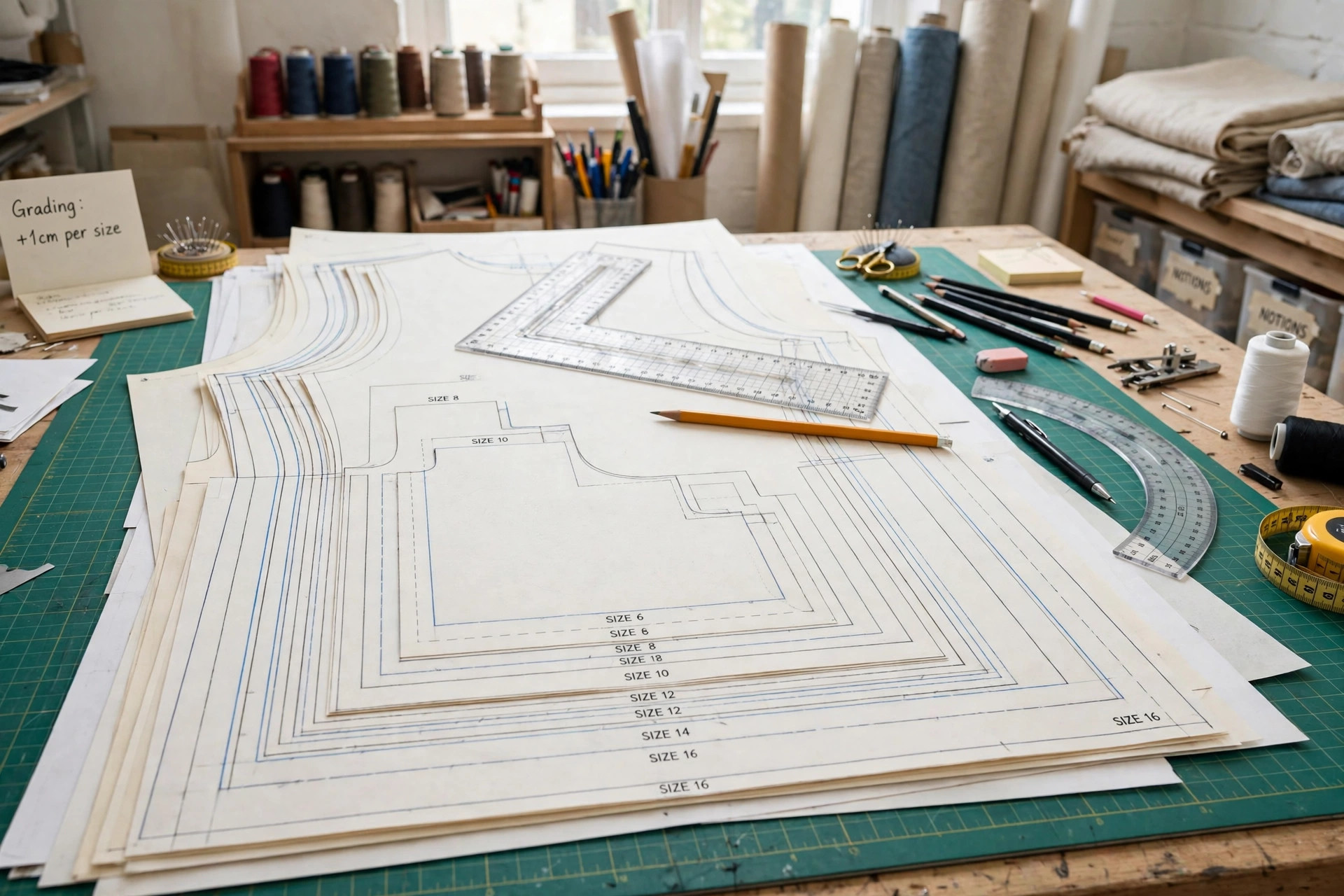
Pattern grading is the process of scaling an approved base-size pattern up and down to create the full size range for production. The pattern itself does not change shape or style — only its measurements move, by small fixed amounts called grade rules, applied at defined points such as the bust, waist, hip, shoulder and sleeve length. Grading is what turns one fitted sample into sizes 6 through 16 (or XS through XL) that all look like the same garment.
How Grading Works
Each pattern piece carries grade points, and each point has an X and Y movement for every size step. A typical women's grade adds about 1 inch (2.5 cm) of circumference at the bust, waist and hip between standard sizes, split among the pattern pieces, while length grades are much smaller. The drafter applies the rules piece by piece — by hand with a grading ruler and squared paper, or in CAD software where the rules are stored in a grade-rule library and applied automatically.
- Sewing — the Apparel Search sewing section
- Base size — the size that was fitted and approved; all grades grow or shrink from it.
- Grade rules — the recorded movements for each point and each size step.
- Nested grade — all sizes drawn on one sheet, fanned out from a common point, so errors between sizes are easy to spot.
Grading Is Not Fitting
Grading assumes bodies grow evenly by the amounts in the grade rules; it does not fix a fitting problem and it is never used to create the first pattern. A badly fitting base size grades into a badly fitting size range. Companies choose their own rules — a junior grade, a missy grade and a plus-size grade distribute the growth differently, especially above size 18, where standard rules often stop working and a separate base is drafted.
In a factory, grading is also a quality checkpoint. The grader compares every graded size against the base pattern and the size spec, because a rule mis-keyed by a few millimetres multiplies across thousands of garments. Buyers receive a nested grade or a measurement chart for approval before cutting begins. Whether the work is done with a grading machine moving a pattern under a stylus, by hand on the table, or in CAD, the principle is unchanged since the first graded paper patterns of the nineteenth century: grow the garment, never redraw it.
FAQs
- What is the difference between grading and drafting?
- Drafting creates the original pattern from measurements. Grading only scales that finished pattern into other sizes, following fixed rules, without redesigning it.
- How much does a pattern grow between sizes?
- Commonly about 1 inch around the bust, waist and hip per size in the middle of a women's range, with smaller length changes; exact amounts are each company's grade rules.
- What is a nested grade?
- A drawing showing every size of a pattern piece stacked on one sheet. The stepped outline reveals at a glance whether each size grew smoothly from the base.
Detailed Guides: see Pattern Grading in the glossary A–Z listing of the Apparel Search fashion glossary for related terms.