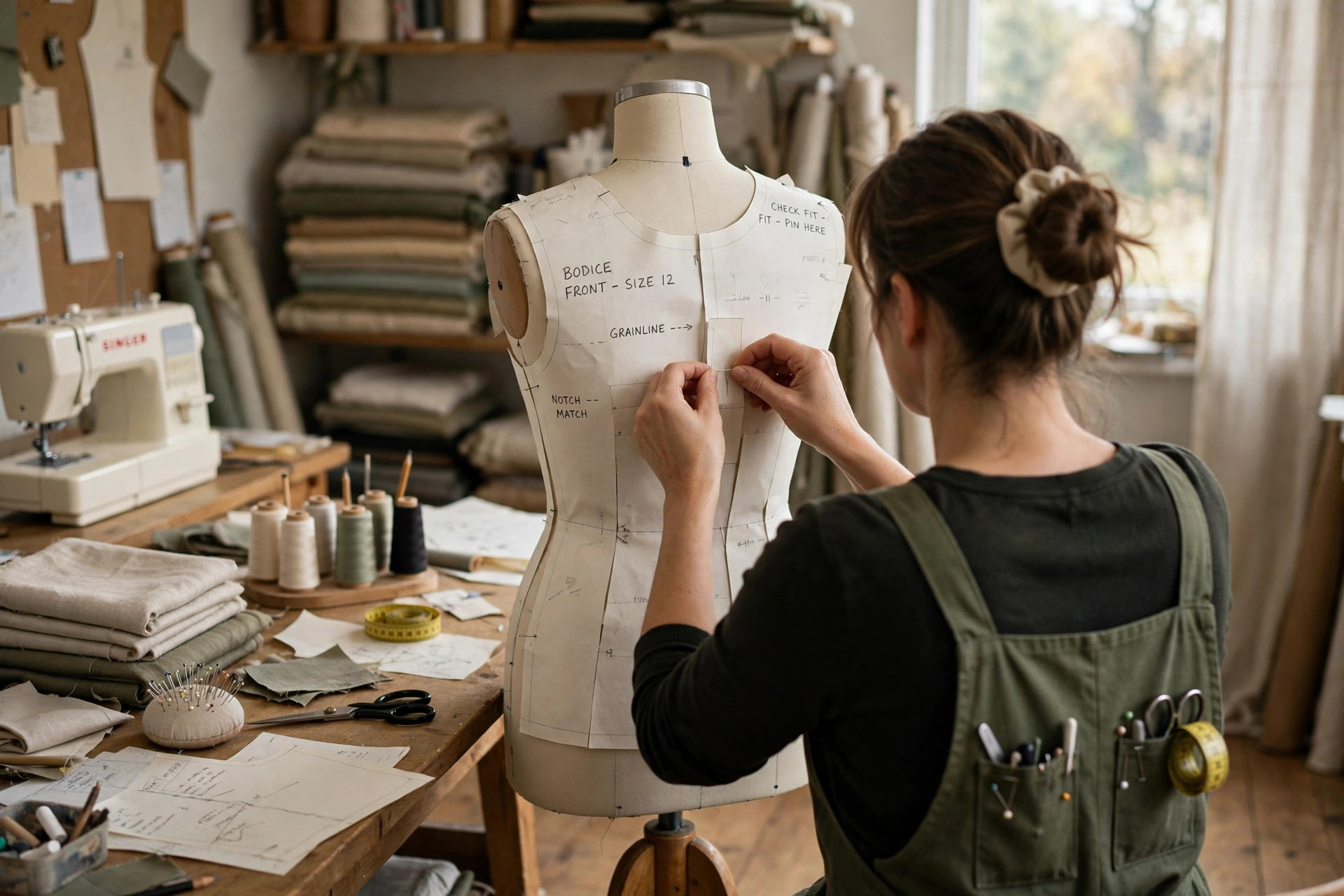
Tissue fitting is a fitting method in which the paper pattern pieces themselves — seam lines marked, darts pinned out — are assembled and tried directly on the body (or dress form) before any fabric is cut. Because paper shows exactly where a pattern is too tight, too loose, too short or off-balance, many corrections can be made by slashing, spreading, taping and redrawing the tissue itself. Popularised by fitting authors such as Palmer and Alto, it is a fast first pass that catches major problems before a fabric fitting shell is sewn.
How Tissue Fitting Is Done
Seam allowances are trimmed or folded to the stitching lines, centre fronts and backs are reinforced with tape so they do not tear, darts and seams are pinned as they would be sewn, and the tissue is tried on over fitting underwear, ideally with help to pin the back. The fitter smooths — never stretches — the tissue, checks that centre lines hang plumb and grain lines stay level, and marks changes with pencil and tape: a slash to release a pull, a taped wedge where length is missing.
- Sewing — the Apparel Search sewing section
- Best on — stable, simply shaped styles; tissue tears and lies on complex, bias or very draped designs, and it cannot show how a fabric's drape or stretch will behave.
Tissue Versus Muslin
Tissue fitting answers paper questions — size, length, balance, dart placement — in minutes and preserves the pattern as the record of the alteration. A sewn fitting shell (muslin) answers fabric questions — how seams sit, how cloth moves and wrinkles on the body. Many makers use both: tissue first to size the pattern, then one muslin to confirm. Tissue fitting cannot replace a muslin for precision tailoring, stretch fabrics or designs whose fit depends on drape.
Tissue fitting has its own small toolkit: a roll of translucent tape for slashing repairs, a fine marker that will not bleed through, and pins reserved for paper so fabric pins stay sharp. Patterns printed at home are joined and their seam lines inked before the fitting, and multi-size patterns are traced at the chosen size so the original survives. Fitters also mark the body's landmarks on the tissue — apex, waist, shoulder point — turning the flat sheet into a map that the later paper alterations can follow exactly.
FAQs
- Can paper really be fitted on a body?
- Yes, with care. Reinforced at stress points and handled without stretching, tissue follows the body's main contours closely enough to judge lengths, widths and balance.
- What alterations suit tissue fitting?
- Length changes, full and small bust adjustments, swayback and shoulder corrections, and dart moves — all can be slashed, taped and redrawn on the tissue itself.
- When should I sew a muslin instead?
- For stretch fabrics, bias cuts, complex seaming, tailored garments, or whenever how the fabric drapes and moves is part of the fit question.
Detailed Guides: see Tissue Fitting in the glossary A–Z listing of the Apparel Search fashion glossary for related terms.