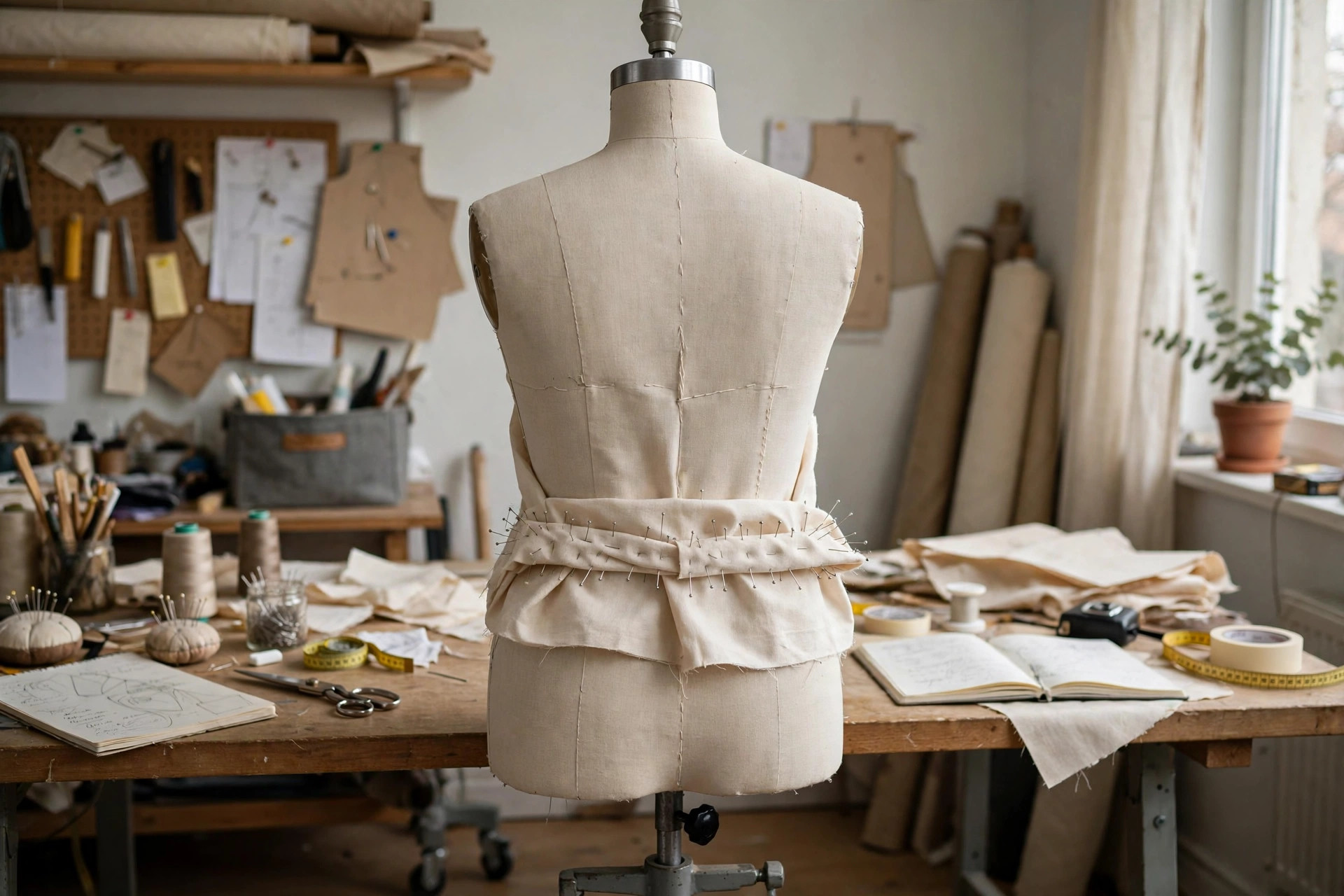
A swayback adjustment is a pattern alteration that removes excess length from the back of a garment for a wearer whose lower spine curves inward more than average — a sway (or hollow) back. The extra curve shortens the back surface between waist and hip, so an unadjusted garment has too much cloth there, which collapses into horizontal folds just below or above the back waist and makes skirts and trousers hike or drag. The adjustment takes a horizontal tuck out of the back pattern, tapering to nothing at the side seams.
Recognising a Sway Back
On a fitting shell, the tell-tale signs are soft horizontal wrinkles pooling across the small of the back, a back waist seam that sits below the natural waist while the front sits correctly, and — on trousers — wrinkles under the seat with a back waistband that dips. The wearer often also stands with the pelvis tilted forward. Pinching the excess into a horizontal fold at the centre back of the muslin, tapering to zero at the sides, measures the correction directly.
- Sewing — the Apparel Search sewing section
- Typical amounts — 1/4 to 3/4 inch (0.6–1.9 cm) removed at centre back is common; more suggests the real problem may be a posture or balance issue to diagnose first.
Making the Alteration
On paper, a horizontal line is slashed across the back at waist level and the upper section overlapped by the measured amount at centre back, pivoting at the side seam so side-seam length and hip shaping are unchanged; the centre-back seam is then re-blended. For trousers the same tuck is taken through the back crotch area with care to preserve crotch shape. Dresses with a waist seam can often be corrected in the seam allowance alone.
The adjustment interacts with trousers' crotch curve and with skirt balance, so it is best diagnosed on a complete shell rather than a bodice alone. Some apparent swaybacks are really a pattern whose back waist was drafted too long for a short-waisted wearer — the fold then sits straight and even rather than dipping at centre back — and the honest fix there is a general back-waist shortening. Recording which correction a body needs, with its amount, on the block itself saves rediscovering it at every future fitting.
FAQs
- Why do folds form at the back waist with a sway back?
- The inward spinal curve shortens the body's back surface. The pattern's extra length has nowhere to go, so it collapses into horizontal folds at the waist.
- Is a swayback adjustment the same as shortening the back waist?
- It is a shaped shortening: length is removed at centre back and tapered to nothing at the side seams, following the body's curve. A straight shortening would distort the side seams and hip line.
- Can trousers need a swayback adjustment?
- Yes — the same excess appears as folds under the back waistband and seat. The correction is smaller and must keep the crotch curve true.
Detailed Guides: see Swayback Adjustment in the glossary A–Z listing of the Apparel Search fashion glossary for related terms.