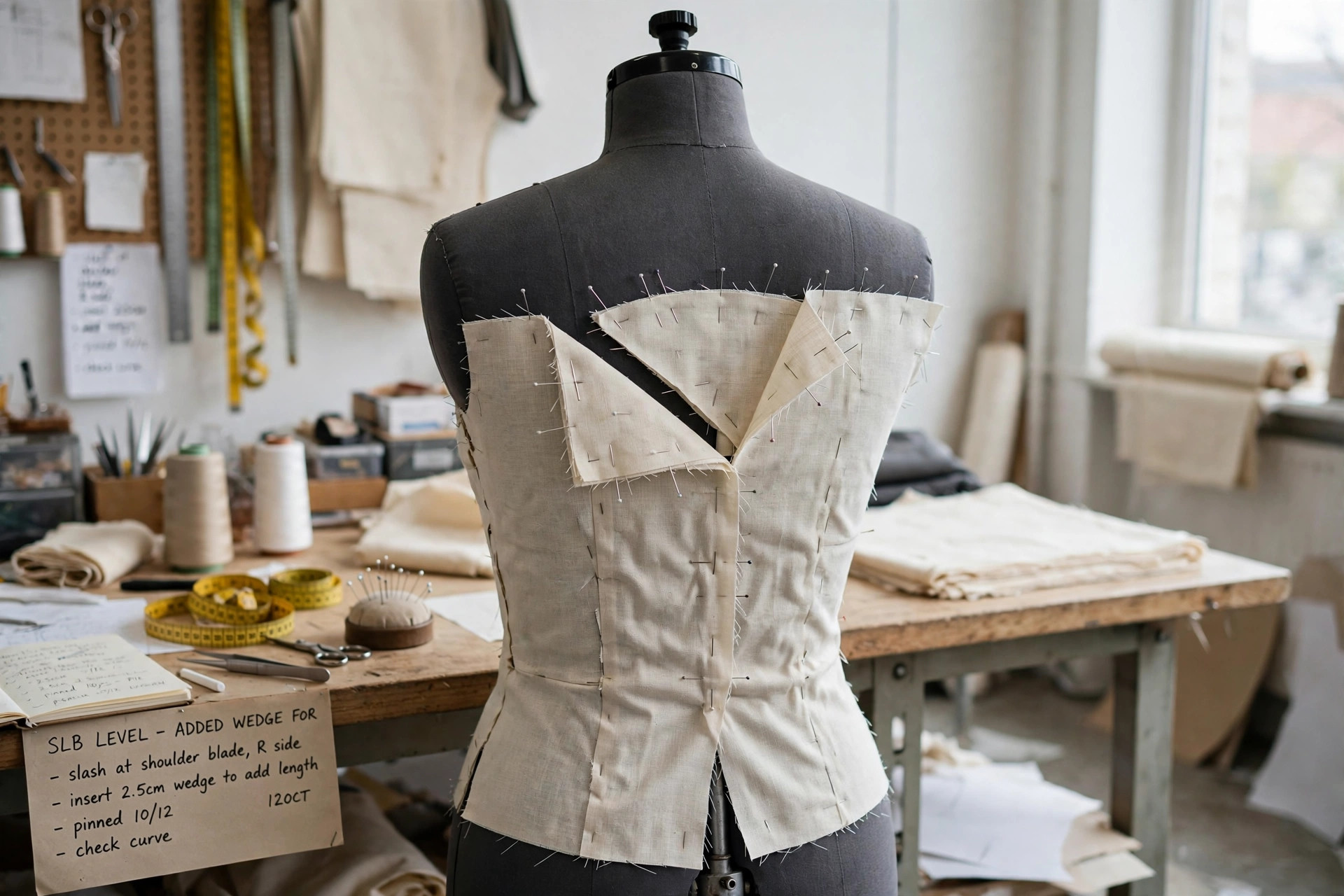
A high round back adjustment is a pattern alteration that gives a garment enough length — and a little shaping — over a rounded upper back. A curved thoracic spine and forward head need more fabric from neck to waist than a straight back does; without it, the back pulls short: the centre back rides up, back hems lift, front hems droop, collars stand away from the neck and strain lines run from the armholes. The alteration slashes the back pattern across the shoulder-blade level and spreads it, restoring the missing length exactly where the curve is.
Making the Alteration
The back is slashed horizontally at blade level and spread open at centre back by the measured shortage — commonly 1/4 to 1 inch (0.6–2.5 cm) — tapering to the armhole, then the centre-back line is re-blended. Larger corrections are shaped with a small neck or shoulder dart, or a centre-back seam that takes the curve's contour, since a very round back needs shape, not just length. The neckline is re-trued afterwards, and forward shoulders, which usually accompany the rounding, are adjusted on the same pattern.
- Sewing — the Apparel Search sewing section
- Measuring the shortage — on a fitting shell, let out or slash the back at blade level and let it drop until hems level and the collar settles; the opened wedge is the correction.
Why It Matters Beyond the Back
Because a garment hangs from the shoulders, a short back distorts everything else: fronts sag, side seams swing, sleeves rotate. Fitters therefore correct back length early in a fitting sequence — before judging bust, waist or sleeve problems that may vanish once the back is given its length. In bespoke tailoring the same correction is a standard figure variation built into the draft itself.
Clothing history is full of this correction: Victorian and Edwardian tailoring drafted for an erect, corseted carriage, and as posture relaxed through the twentieth century, standard blocks quietly absorbed a little more back length. Bespoke cutters still read the back before anything else, watching how a client stands when they forget they are being measured. For the home maker, the practical rule is to fit the back's length before the bust or waist are judged — a garment cannot be assessed while it is being pulled out of position from behind.
FAQs
- What are the signs of a high round back in a garment?
- Back hem lifting, front hem drooping, a collar standing away from the back neck, and strain lines from the upper back toward the armholes.
- How is it different from a forward shoulder adjustment?
- A high round back adds length (and sometimes a dart) over the curved upper back. A forward shoulder moves the shoulder seam forward. Rounded figures usually need both.
- Can the extra length just be added at the hem?
- No. The shortage is over the blades, between neck and waist. Adding at the hem lengthens the skirt but leaves the strain — and the lifted back waist — exactly as they were.
Detailed Guides: see High Round Back Adjustment in the glossary A–Z listing of the Apparel Search fashion glossary for related terms.