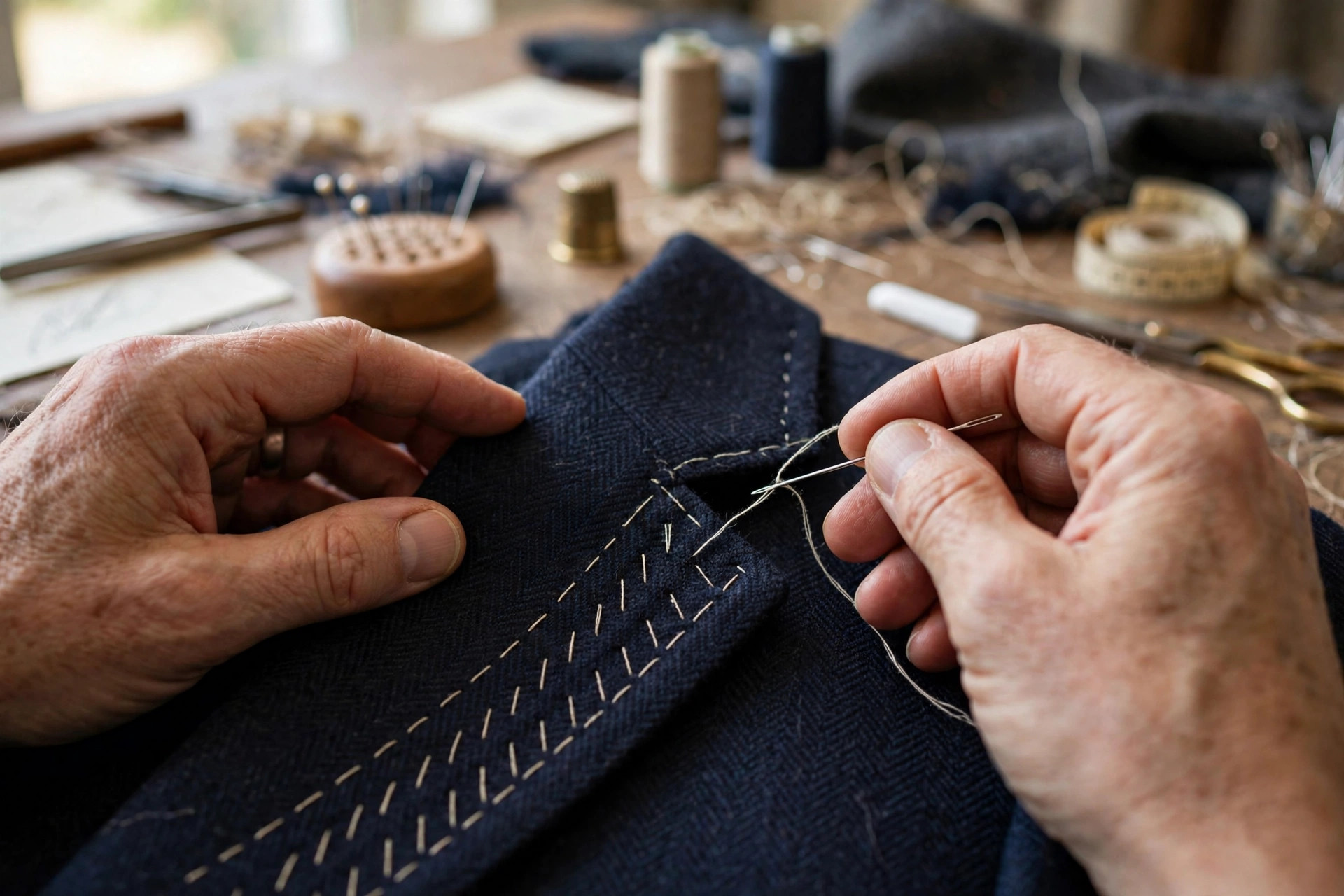
Couture hand stitches are the small family of hand stitches fine sewing relies on where a machine cannot go — or cannot go invisibly. Five do most of the work: the pad stitch, rows of diagonal stitches that shape a lapel's roll and marry hair canvas to cloth; the catch stitch, a crossed stitch that holds hems and facings with a little give; the fell stitch, a small slanted stitch securing a folded edge (a lining, an appliqué) flat to its ground; the herringbone stitch, a wide crossed stitch that catches a hem or facing while stretching with it; and the slip stitch, an almost invisible stitch closing folded edges together — linings, bindings and gaps left for turning.
The Five Stitches
- Sewing — the Apparel Search sewing section
- Pad stitch — worked in rows through canvas and cloth, each stitch a small diagonal bite; the rows build permanent curve into lapels and collars. Smaller, denser stitches near the roll line, looser below.
- Catch stitch — worked left to right (for right-handers) taking a tiny bite of the garment, then a bite of the hem edge, crossing threads into flat X's that hold securely yet flex — the classic hem stitch of quality skirts and trousers.
- Fell stitch — short slanted stitches over a folded edge, pinning it to the layer beneath; used to set linings at armholes and waist, attach appliqué and close waistband insides.
- Herringbone stitch — a larger, openly crossed stitch used where a hem or facing must give a little, and decoratively on flannel and craft work; it is the big cousin of the catch stitch.
- Slip stitch — the needle slips inside one fold, emerges, and takes a thread or two of the opposite fold: the two folded edges (lining to garment, binding ends, a turning gap) meet with the thread essentially hidden.
Why Couture Still Sews by Hand
Hand stitches do three things machines cannot: they shape in three dimensions (pad stitching literally sculpts), they flex with the body (a catch-stitched hem moves; a machine topstitched one can snap), and they disappear — a slip-stitched lining shows no machine line on a garment costing thousands. They are slower, which is exactly the couture trade: time spent where only the hand will do, machines used everywhere else without apology.
FAQs
- What is the difference between a catch stitch and a herringbone stitch?
- Both cross their threads. The catch stitch is small, flat and worked close for hems and facings; the herringbone is larger, more open and more decorative, used where some stretch or a visible craft effect is wanted.
- Why are pad stitches diagonal?
- Diagonal stitches worked in offset rows let the two layers shift minutely against each other, building a smooth permanent curve — the lapel roll — instead of a flat lock.
- When is a slip stitch used?
- Whenever two folded edges must be joined invisibly: closing a lining, finishing a binding, or sewing shut the gap left for turning a piece right side out.
Detailed Guides: see Couture Hand Stitches in the glossary A–Z listing of the Apparel Search fashion glossary for related terms.