Women's Socks on Amazon
Ankle, crew, knee and no-show lengths — plus dress patterns, athletic builds and sock fabrics
Socks are the hardest-working small garment in the drawer, and Amazon's women's sock range is organized by the two decisions that actually matter: how high the sock rises on the leg, and what it is made of. The lengths run from invisible no-show socks and footies up through ankle socks, crew socks and tube socks to knee socks, and the styles run from plain athletic socks to dress socks, argyle and cable knit patterns, rib socks, slouch socks and seamless constructions.
Beyond socks proper, the same department covers the wider hosiery family — stockings, panty hose and footies — plus seasonal and specialty builds such as ski socks, cashmere socks and novelty holiday socks for Christmas and Halloween. This guide explains the lengths, the named styles and the fibers, so a multipack bought online matches the shoes, the outfit and the weather it was bought for.
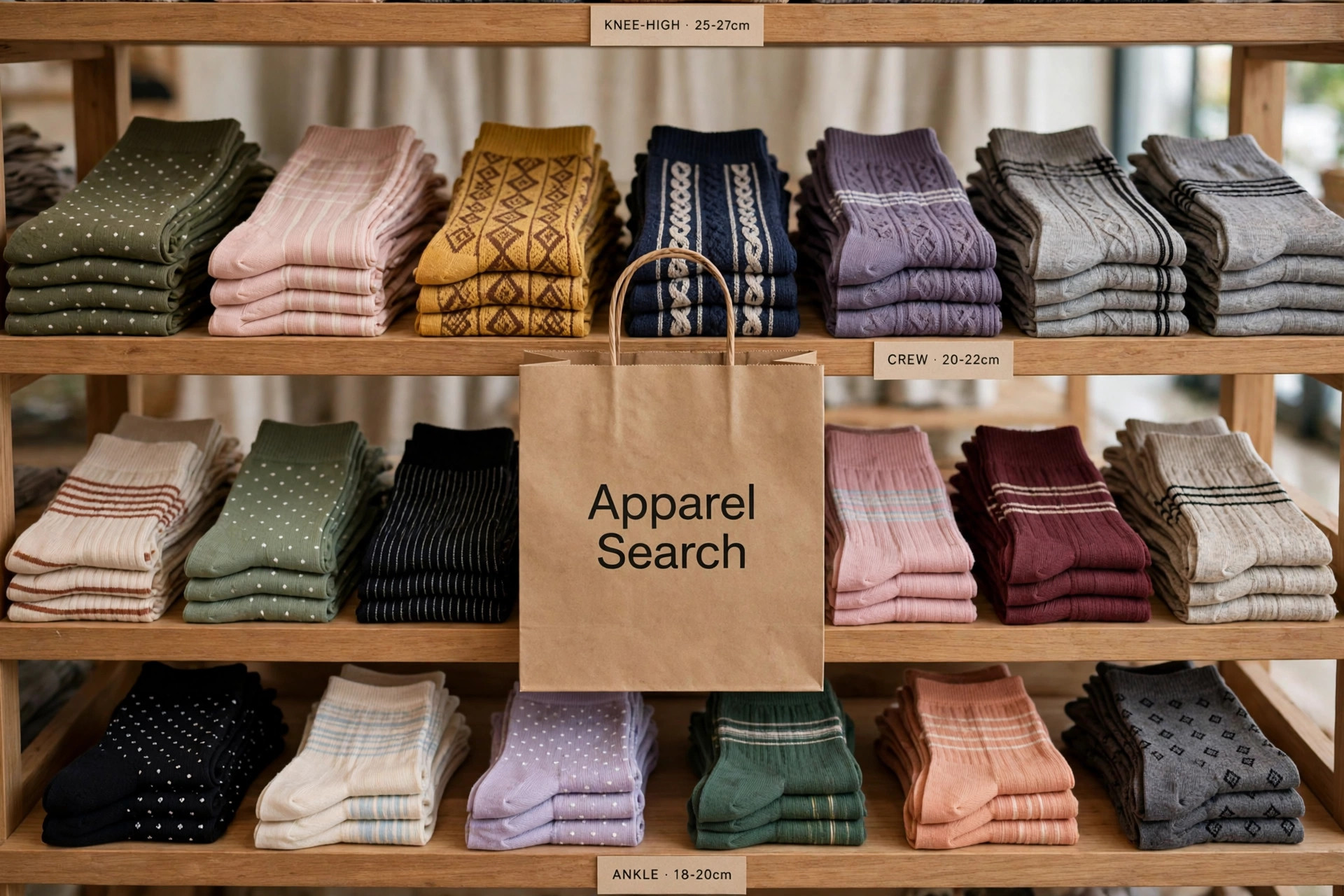
Socks are a small purchase that rewards a system, and the Apparel Search Amazon clothing guide gathers this length-and-fabric guide together with the hosiery, shoe and activewear departments that complete it.
Sock Lengths: No-Show, Ankle, Crew, Tube and Knee
No-show socks and footies sit below the shoe line, giving the bare-ankle look with a layer against the shoe's lining; silicone gripper heels are the detail that keeps them in place. Ankle socks rise just above the shoe collar and are the default for sneakers and walking shoes. Crew socks rise to mid-calf, the most versatile length, worn with everything from trainers to boots, while tube socks — knitted as a straight tube without a shaped heel — trade a precise fit for one-size simplicity in sport and casual wear.
Knee socks rise to just below the knee and serve two different wardrobes: as a warm layer under boots and with skirts in cold weather, and as part of school, team and uniform dress. Slouch socks are a deliberate style rather than a length — a longer, softer sock pushed down into folds around the ankle, usually in a loose rib knit. Choosing the length first, before color or pattern, narrows any sock department faster than any other filter.
Named Styles: Dress, Argyle, Cable Knit, Rib and Seamless
Dress socks are the fine-gauge end of the range: thinner, smoother knits in dark or dressy colors, made to sit flat inside loafers, heels and dress shoes without bunching. Argyle socks carry the classic diamond pattern with its fine overcheck lines, cable knit socks carry raised rope-like twists borrowed from sweater knitting, and rib socks use vertical ribbing that hugs the leg and holds the sock up — three patterns that read very differently in an outfit despite similar lengths.
Seamless socks close the toe without a raised seam ridge, which removes the pressure point that irritates feet inside close-fitting shoes — a construction detail worth seeking for sensitive feet and long days. Contrast heel socks pick out the heel (and often the toe) in a second color, a small design accent on an otherwise plain sock. Novelty socks carry prints and motifs, and the holiday branch of the family — Christmas socks, Halloween socks and other themed pairs — is bought as much as a small gift as as clothing.
Fibers and Specialty Socks: Cotton, Wool, Silk, Cashmere, Athletic and Ski
Fiber decides warmth, moisture behavior and lifespan. Cotton socks are soft, breathable and easy to wash, the everyday default, though cotton holds moisture once wet. Wool socks regulate temperature in both directions and stay comfortable when damp, which is why they dominate hiking and winter ranges. Silk socks are fine, smooth and warm for their weight, worn as dress socks and as liners, and cashmere socks are the soft luxury end — warm, delicate, and best kept for shoes with room and for rest rather than sport.
Athletic socks are engineered rather than knitted plain: cushioned soles, arch compression bands, mesh ventilation panels and moisture-wicking synthetic blends matched to running, training or court sports. Ski socks are tall, lightly padded on the shin and foot, and knitted to work inside a fitted boot without wrinkles. The hosiery neighbors complete the picture: stockings are individual leg coverings held up or attached at the top, panty hose join the legs to a brief in one sheer garment, and modern hosiery ranges from sheer dress weights to opaque winter tights-weight knits.
Common Questions
What is the difference between crew socks and tube socks?
Crew socks have a shaped heel and rise to mid-calf, so they stay positioned on the foot. Tube socks are knitted as a straight tube with no shaped heel, which makes them simple and one-size but less precisely fitted.
Why choose seamless socks?
A seamless toe closure removes the raised ridge that can rub inside close-fitting shoes. It is a comfort detail that matters most for sensitive feet, long days on your feet, and snug dress shoes.
Which sock fiber is warmest for winter?
Wool is the practical winter choice: it insulates, manages moisture and stays comfortable if it gets damp. Cashmere feels softer and is warm for its weight, but it is delicate and better suited to gentler wear.