Women's Suits on Amazon
Pantsuits, skirt suits, blazers and dress jackets — construction, fabrics and fit
A women's suit is a matched set with a job to do, and Amazon's range is built from four components: pantsuits, skirt suits, the blazer and the dress jacket. A pantsuit pairs a tailored jacket with matching trousers; a skirt suit pairs the same kind of jacket with a matching skirt; and blazers and dress jackets are sold as separates that build a suit look with trousers, skirts or dresses the buyer already owns.
Because a suit's value sits in its construction, this guide reads the garment rather than the label: lapels and closures, lining and shoulder structure, trouser and skirt shapes, and the suiting fabrics — wool, crepe, tweed and stretch blends — that decide drape and season. It also covers fit points and the separates strategy, since most real suit wardrobes grow jacket by jacket rather than arriving as a single set.
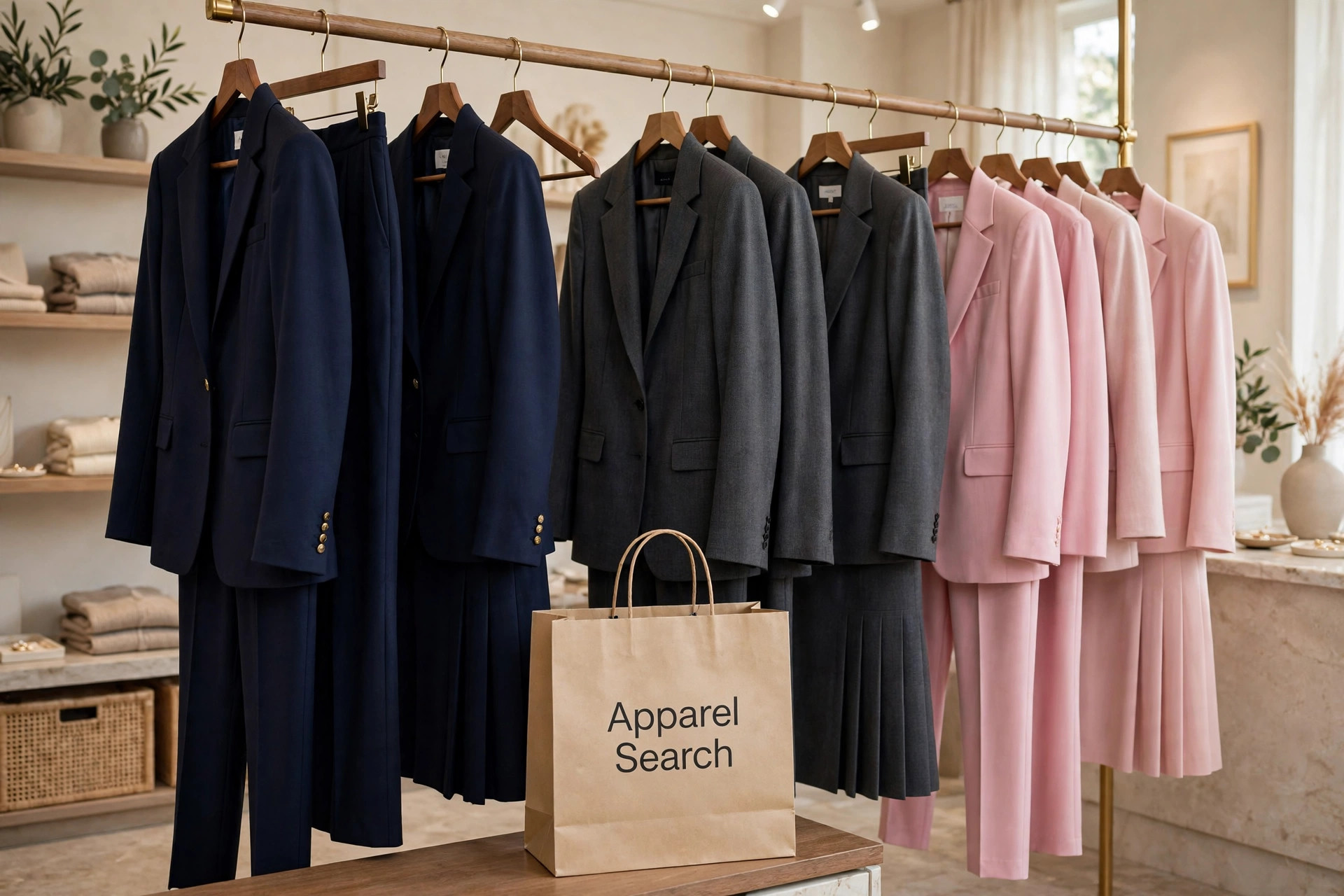
A suit is bought in pieces but worn as one decision, and the Apparel Search Amazon clothing guide connects this construction-and-fit guide to the tops, shoes and tailoring departments around it.
Pantsuits and Skirt Suits: The Two Matched Sets
The pantsuit is the modern default: a tailored jacket with matching trousers, usually in a straight, tapered or wide leg. Trouser rise, break and lining decide how formal the set reads — a lined, creased trouser with a clean break is boardroom dressy, while an unlined cropped trouser in the same cloth reads as a softer, more casual suit. Two-piece and three-piece versions differ by the addition of a waistcoat or a matching top layer.
The skirt suit pairs the jacket with a pencil, A-line or straight skirt in the identical fabric and dye lot — the matching is the point, since a jacket and skirt bought separately in near-identical navy rarely match under office light. Skirt length, vent placement for walking ease, and lining all deserve the same check as the jacket. Both set types also appear in coordinated colors beyond black and navy: soft neutrals, pastels for spring events, and deeper jewel tones for evening formality in crepe or satin-backed fabrics.
Blazers and Dress Jackets as Separates
A blazer worn as a separate is less formal than a matched suit jacket by design: patch pockets, contrast buttons and softer shoulders signal the difference. Single-breasted blazers with one or two buttons are the most versatile; double-breasted styles give a stronger, more structured line. Shawl, notch and peak lapels each change the formality, and an unlined or half-lined jacket drapes more casually than a fully lined, canvassed one.
Dress jackets occupy the occasion end: cropped jackets for dresses, bolero and shrug lengths, and longer tailored jackets that stand in for a suit over a sheath dress. Bought deliberately, separates extend a small suit wardrobe a long way — one well-fitting blazer in a neutral cloth works over suit trousers on Monday, a skirt midweek and dark denim on Friday, provided the fabric weights are compatible and the colors are true neutrals rather than near-matches.
Suiting Fabrics, Fit Points and Care
Wool and wool blends remain the benchmark suiting cloth: they breathe, resist creasing, and hold a tailored shape, with tropical weights for summer and flannel or tweed for winter. Polyester and viscose crepes give fluid drape and easy care at lower cost, stretch blends add elastane for movement in slim cuts, and linen suits summer at the price of easy wrinkling. On a product page, the fiber percentages and a note of the lining tell more about how a suit will wear than the photographs do.
Fit checkpoints are the same for any suit: the shoulder seam sits at the shoulder point, the jacket closes without pulling across the buttons, sleeves end at the wrist bone, and trousers or skirts sit smooth across the front. Jackets are the most commonly tailored garment in the wardrobe, and a suit that fits through the shoulders can usually be adjusted everywhere else. Care follows the cloth: most tailored suits are dry-clean or gently pressed rather than machine washed, and rotating two suits through a working week roughly doubles the life of each.
Common Questions
What is the difference between a pantsuit and a skirt suit?
Both are matched jacket-and-bottom sets cut from the same fabric. A pantsuit pairs the jacket with matching trousers; a skirt suit pairs it with a matching skirt. The identical cloth and dye lot are what make either read as one suit.
Can a blazer replace a suit jacket?
For business-casual and smart settings, yes — a well-fitting blazer over trousers or a skirt reads as tailored dressing. A matched suit remains the more formal choice for interviews, court and conservative offices.
Which suiting fabric wrinkles least?
Wool and wool-blend suitings resist creasing best among natural options and recover overnight on a hanger. Polyester crepe also resists wrinkles well. Linen wrinkles most readily and is chosen for summer ease rather than polish.