Women's Tops on Amazon
Blouses, shirts, tees and sweaters — necklines, sleeves and fabrics in depth
"Tops" is the wardrobe's umbrella word: it covers shirts, t-shirts, sweaters and sweatshirts, blouses and every sleeveless and sleeved upper-body garment in between. Amazon's women's tops range is organized by exactly those garment types, and the useful vocabulary is in the details — eyelet and peasant blouses, silk blouses and embroidered blouses, button-down shirts, oxfords and polos, crew neck, v-neck, band collar, turtleneck and mock turtleneck necklines.
This guide defines the category the practical way: the blouse family, the shirt family, the t-shirt and knit family, and the sweater layer, with sleeve lengths (short sleeve, long sleeve, three-quarter sleeve, sleeveless) and fabrics (silk, wool, cotton, flannel and leather) treated as the decisions they are. Solid tops, printed tees and striped blouses are the pattern side of the same choices — the pieces that combine with every bottom in the wardrobe.
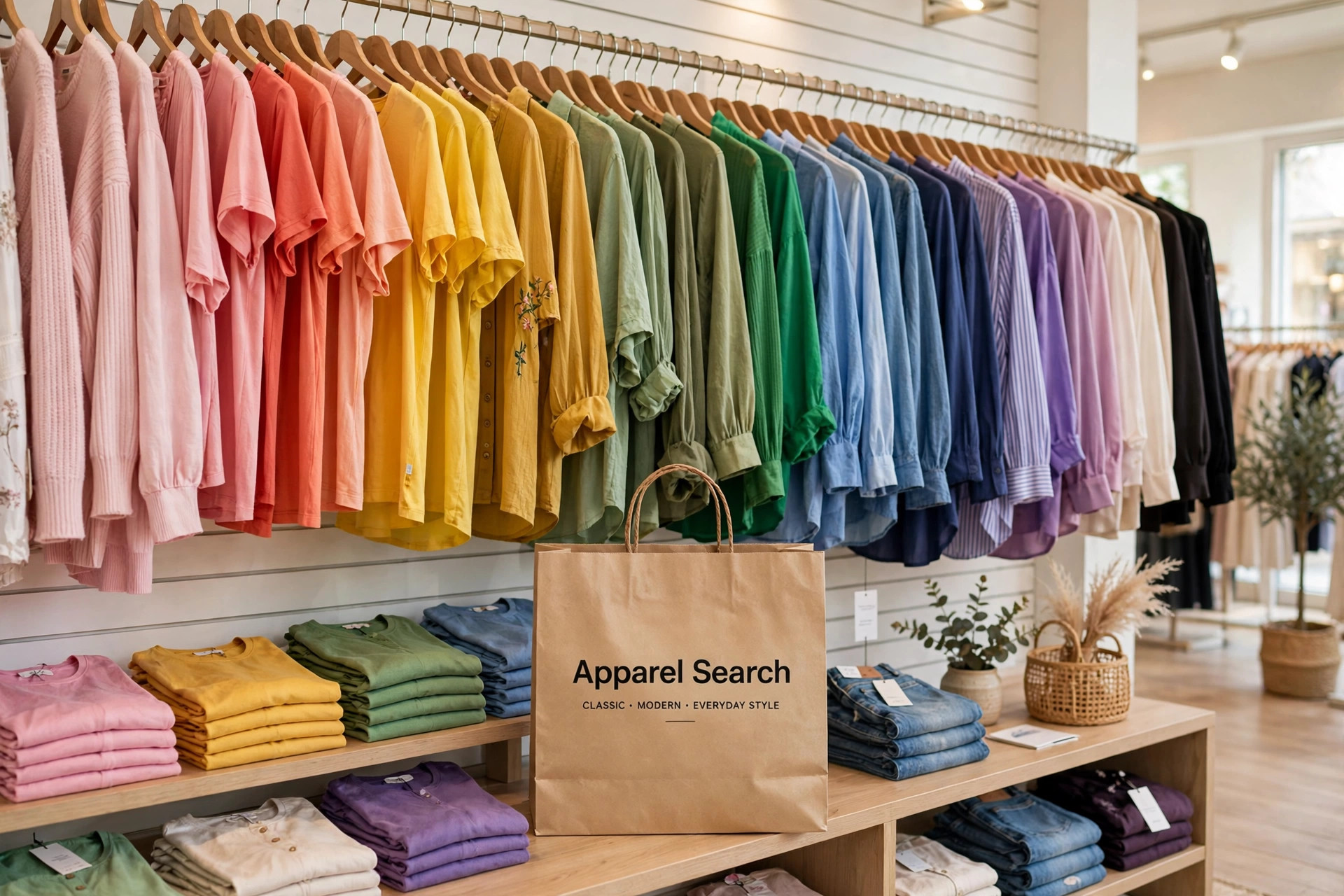
Tops do the talking in most outfits, so shop them by neckline and fabric — the Apparel Search Amazon clothing guide connects this construction guide to the jeans, suits and shirt-store directories that build around it.
Blouses: Eyelet, Peasant, Silk, Embroidered and Striped
A blouse is the softly constructed, usually woven top: it drapes rather than clings and fastens or pulls on without a shirt's formal structure. Eyelet blouses use embroidered cutwork — small holes finished with stitching — for a light, summery texture, while peasant tops gather at the neckline and sleeve with soft volume drawn from folk dress. Silk blouses are the dressiest branch, in a fabric that takes color deeply and works from office to evening, with the gentle washing silk requires.
Embroidered blouses carry stitched decoration at the yoke, cuff or front, and striped blouses use the oldest pattern in the shirtmaker's book to sharpen an outfit. Halter tops fasten behind the neck and leave the shoulders bare, and tube tops are strapless bands worn in warm weather and layered under jackets. Sleeve choice finishes the blouse decision: sleeveless for layering, short sleeves for summer, and the three-quarter sleeve — ending between elbow and wrist — as the length that flatters most arms and suits most seasons.
Shirts: Button-Down, Oxford, Polo and Flannel
A shirt, in the tailored sense, has a collar, a buttoned front and a structured cuff. Button-down shirts anchor the collar points with buttons — a detail borrowed from sport that became a wardrobe staple — while oxfords are named for their cloth, a basket-weave cotton that is durable, matte and slightly textured. Wrinkle-resistant shirts add a finish that keeps that structure through a working day and a suitcase, which is why they dominate travel and uniform ranges.
Polos are the knitted branch of the shirt family: a soft collar and short placket in a piqué knit, sitting between a t-shirt and a woven shirt in formality. Flannel shirts are brushed cotton or wool in plaids and solids, warm enough to work as a light overshirt. The collar vocabulary completes the family — the band collar stands without a fold-over leaf for a clean, minimal neckline — and a leather shirt, cut like a tailored shirt in a soft hide, stands at the statement end of the same family tree.
T-Shirts, Knit Tops, Sweaters and Sweatshirts
The t-shirt is the knitted foundation top: crew neck for the classic round collar, v-neck for an open line, in solid colors for layering and printed tees for graphics and statements. Cotton tees are the standard; the fabric weight, stated or visible in photographs, separates a substantial tee from a sheer one. Tank tops narrow the garment to straps for heat and layering, racerback tanks join the straps between the shoulders for sport, and athletic tops add moisture-wicking knits and mesh panels for training.
Sweaters and sweatshirts are the warm layer of the tops family. Sweaters knit wool, cotton, cashmere blends or synthetics into pullovers and cardigans, with turtleneck and mock turtleneck collars — the mock standing shorter, halfway up the neck — as the defining winter necklines. Sweatshirts trade knit structure for brushed fleece comfort. Together with the woven blouses and shirts, these knit tops are why the category word stays so broad: a top is chosen by fabric, neckline and sleeve first, and by season second.
Common Questions
What counts as a top?
Tops is the umbrella term for upper-body garments: blouses, shirts, t-shirts, knit tops, sweaters and sweatshirts. The category is organized by garment type, then refined by neckline, sleeve length and fabric.
What is the difference between a blouse and a shirt?
A blouse is softly constructed and drapes, usually without a formal collar and cuff structure. A shirt is tailored, with a collar, a buttoned front placket and structured cuffs, as in button-down and oxford styles.
What is a mock turtleneck?
A mock turtleneck collar rises only partway up the neck — about half the height of a full turtleneck — and does not fold over. It gives the covered look of a turtleneck with less bulk and warmth.