The Hook
The Most Imitated Outfit in Business

For thirteen years, the most powerful product launches on earth were presented by a man dressed like a stagehand: a black mock turtleneck, a pair of blue jeans, and a pair of gray sneakers. Steve Jobs wore that uniform in nearly every keynote from 1998 to his final one on 6 June 2011, and in doing so he invented something the business world had never quite had — a chief executive whose clothes were a logo. Mark Zuckerberg’s gray T-shirt and Jensen Huang’s leather jacket both descend from it. Yet the turtleneck’s own story is stranger than its imitators’: it began as a uniform for an entire company, was rejected by that company’s employees in a single meeting, and survived only because its designer — one of the greatest fashion minds of the twentieth century — agreed to make a private supply for an audience of one.
The Turtleneck File
- The Look
- A black long-sleeved mock turtleneck — the short, stand-up collar, not the full folded turtle — with Levi’s 501 blue jeans and gray New Balance sneakers.
- The Maker
- Issey Miyake, the Japanese designer who had created Sony’s factory uniforms and became Jobs’ friend.
- The Count
- “Like a hundred,” by Jobs’ own approximate words: “I have enough to last for the rest of my life.”
- The Years
- Nearly every keynote from 1998 (the iMac era) to his final Stevenote, WWDC, 6 June 2011.
- The Reported Price
- $175 — the price reported for Miyake’s turtleneck in coverage of the designer’s death in 2022.
- The Afterlife
- A NeXT-branded turtleneck from his closet sold at auction in 2016 for $2,880. No museum exhibits one — museums hold his jeans.
Origins
Sony’s Factory Floor, and the Uniform Apple Refused
The story comes from Walter Isaacson’s biography Steve Jobs (2011), and it begins not in California but in Japan. On a trip there in the early 1980s, Jobs asked Sony chairman Akio Morita why everyone in Sony’s factories wore a uniform. Morita explained that after the war, no one had any clothes, so companies like Sony had to give workers something to wear each day; over the years, the uniforms developed their own signature styles and became a way of bonding workers to the company. Jobs’ reaction was immediate and characteristic: “I decided that I wanted that type of bonding for Apple.”
Sony’s uniform had been designed by Issey Miyake — a rip-stop nylon jacket whose sleeves could unzip to convert it into a vest. Jobs called Miyake and asked him to design a vest for Apple. Then he presented the idea to his own company. In Isaacson’s telling, Jobs picks up the story himself: “I came back with some samples and told everyone it would great if we would all wear these vests. Oh man, did I get booed off the stage. Everybody hated the idea.” The Apple uniform died in that room.
“So I asked Issey to make me some of his black turtlenecks that I liked, and he made me like a hundred of them.”Steve Jobs, in Walter Isaacson’s biography
What survived was the friendship, and a private arrangement. Jobs befriended Miyake and, in Isaacson’s summary, “came to like the idea of having a uniform for himself, both because of its daily convenience (the rationale he claimed) and its ability to convey a signature style.” Jobs showed the biographer the stack of black turtlenecks in his closet and delivered the line that has anchored every account since: “That’s what I wear. I have enough to last for the rest of my life.” Note the number’s own hedge — “like a hundred” is Jobs’ approximate wording, not an inventory. Note, too, that the turtlenecks were not a product Jobs found and adopted; they were, in effect, bespoke — made for him by a designer he had first approached as a uniform supplier for thousands.
A Necessary Correction
It Wasn’t Really About “Decision Fatigue”
Ask the internet why Jobs wore the turtleneck and the most common answer is the one attached to Zuckerberg: to save his decision-making energy for things that matter. It is a tidy story, and it is mostly a later gloss. Isaacson — the source closest to Jobs, drawing on direct interviews — gives two stated motives, and decision fatigue is neither of them: daily convenience, and the ability to convey a signature style. Behind both stood the Sony lesson, which was not about efficiency at all but about identity: a uniform as a bond between a person (or a company) and the people watching.
The explicit decision-elimination framing belongs to Zuckerberg, who spelled it out in 2014 in the language of psychology theory — small decisions that “can make you tired.” The two men landed in similar places by different roads: Jobs dressing, from the start, partly for effect; Zuckerberg dressing, by his account, to avoid effects altogether. Fashion writers who treat the turtleneck as a pure productivity hack miss the half of the story its wearer admitted to: he knew exactly what it made him look like, and that was part of the point. A uniform adopted for signature is not anti-fashion. It is fashion, reduced to a single, perfect repetition.
Anatomy of the Uniform
Mock, Not Full: The Three Pieces
The turtleneck
The garment was a mock turtleneck — a short stand collar that rises partway up the neck, rather than the full folded-over turtle. The distinction is the design. As Vanessa Friedman wrote in the New York Times, the mock “did away with an extraneous fold at the neck, had the ease of a T-shirt and a sweatshirt but also the cool, minimal lines of a jacket.” In black, in a fine knit, long-sleeved, it read on stage as something between a sweater and a silhouette: no buttons, no lapels, no tie, nothing to date, nothing to clash with the slides behind him. Our men’s mock turtleneck shirts guide covers the style’s cuts and fabrics, and the mock turtleneck sweaters guide its heavier knits.
The jeans and the sneakers
Below the turtleneck, the uniform was deliberately ordinary: Levi’s 501 blue jeans — a style Jobs had worn for decades; the Levi Strauss & Co. Archives holds a pair of his 501s dated to about 1984, customized with suspender buttons inside the waistband — and gray New Balance sneakers from the 99x series. On the sneaker model, honesty is required: sources split between the 991 and the 992, both produced in the era, and Jobs wore the gray 99x line across the 2000s. Any article that names one model for the whole period is tidier than the evidence allows.
Put the three together and the uniform’s real trick becomes visible: one piece of genuine designer clothing, made for him by a master, framed by two pieces of mass-market American basics that any audience member could buy that afternoon. The turtleneck supplied the signature; the jeans and sneakers supplied the everyman alibi. It is the same algebra Huang’s jacket performs — statement piece up top, anonymity below — executed fifteen years earlier, at a fraction of the price, in knit instead of leather.
The Stevenote Years
1998 to 2011: The Uniform at Work
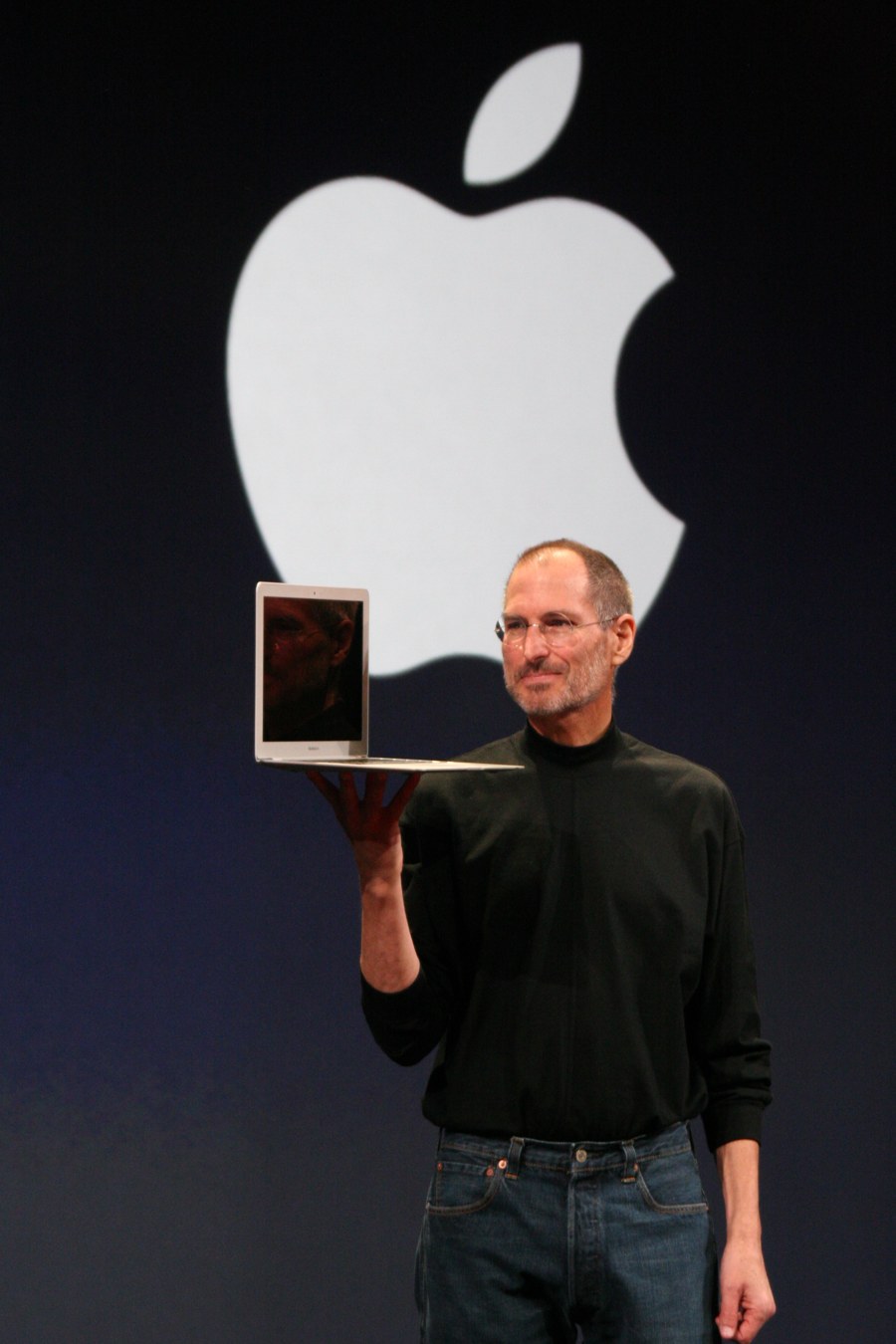
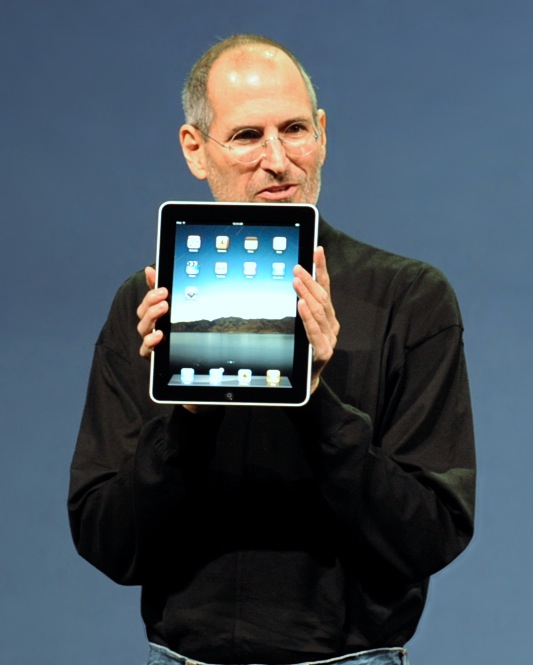
The uniform is in place by the late-1990s keynotes — the post-return, iMac-era presentations of 1998 — and it does not vary in kind for the rest of his career. The freely licensed photographs in this feature mark its stations: WWDC 2007, months after the iPhone’s introduction (above); MacWorld 2008, where he balanced the impossibly thin MacBook Air on one palm against a giant glowing Apple logo (below); and the original iPad launch in January 2010, holding the new device up to the audience in the same black top he had worn for a decade of revolutions.
The repetition was the message. Each keynote’s drama was supposed to be the product; the presenter’s clothes receded to a constant, so constant that the silhouette alone — black top, blue jeans, the close-cropped gray hair — became a pictogram. When the final Stevenote came, at WWDC on 6 June 2011, introducing iCloud, the uniform was there as it had been for thirteen years. Jobs resigned as Apple’s CEO that August and died on 5 October 2011. The turtleneck’s working life ended with his; what happened to it next is a story of auctions, swatches, and one impostor.
The Impostor Claim
The Turtleneck That Wasn’t: The St. Croix Story
Within days of Jobs’ death in October 2011, a rival origin story appeared. The owner of St. Croix — a Minnesota knitwear firm (Knitcraft) — claimed that Jobs had been buying two dozen of its turtlenecks a year, implying the iconic shirts were American-made St. Croix, not Miyake. For a news cycle, the claim traveled. Then it collapsed: it could not be squared with Jobs’ own on-the-record account to Isaacson — Miyake, the hundred, the closet stack — and the company backed away from the claim. The episode survives as a useful caution for uniform lore generally: when a garment becomes this famous, claims of manufacture attach themselves to it, and the wearer’s own words remain the strongest evidence. It is why this feature is careful, elsewhere, about the difference between a documented maker and a merely repeated one.
Afterlife
Auction Blocks, a One-Centimeter Relic, and the Museum That Isn’t
Jobs’ turtlenecks did not retire quietly. In September 2016, Julien’s Auctions offered a NeXT-branded black turtleneck from his closet — the NeXT logo on the front, and on the back the era’s slogans: “1980s: Personal Computing / 1990s: Interpersonal Computing.” With a starting bid of $500 against an estimate of $1,000–$3,000, it sold for $2,880 — a fraction of what Huang’s jacket would later make, but proof, five years after his death, that the garment had detached from the man and become a collectible in its own right.
The afterlife’s strangest artifact is smaller. Mini Museum sells a 1×1 centimeter swatch cut from a turtleneck Jobs wore at the 1991 PC Forum gathering in his NeXT years — the shirt bought at public auction by the specimen’s creator, Hans Fex, for a reported $8,000, and now distributed, a square centimeter at a time (the standalone specimen sells for $29), as a relic for collectors. A uniform so total that even its fragments have a market.
Miyake’s own house offered its homage in July 2017: the “Semi-Dull T,” a $270 shirt designed by Miyake protégé Yusuke Takahashi with a trimmer silhouette — with the company insisting, pointedly, that it was not a reissue of Jobs’ turtleneck. (Sources do not even agree on the original shirt’s own retirement date — some accounts say Miyake quietly retired the style in 2011, the year of Jobs’ death; others place the retirement in 2017 — and this feature declines to pick a winner the record cannot support.)
And then, the correction this subject most needs. It is natural to assume the world’s most famous turtleneck sits in a museum somewhere. It does not — or at least, no museum exhibit of a Jobs turtleneck is documented anywhere we could find. What museums exhibit is the other half of the uniform: the Levi Strauss & Co. Archives’ pair of his 501s (c.1984), shown with his Versace shirt and suspenders in “California Dreams” at the Bundeskunsthalle in Bonn (2019–2020) and in “Levi Strauss: A History of American Style” at the Contemporary Jewish Museum in San Francisco (2021). The jeans got the vitrines; the turtlenecks got the auction block and the specimen trade. Draw your own conclusion about which institutions move fastest.
The look’s folk afterlife needs no institution at all. The “Steve Jobs costume” — black mock turtleneck, jeans, sneakers, round glasses — became a standing Halloween shortcut within his lifetime (Gizmodo was already covering a fake “iWear” costume kit in 2010), and its darkest chapter was written by Elizabeth Holmes, who adopted the black turtleneck wholesale after the Jobs/Miyake story was explained to her, as borrowed credibility for Theranos. Friedman’s verdict on the copy is the sharpest sentence written about the uniform’s power: in Holmes’ case the turtleneck became “less a brilliant frame than a false front; a carefully calculated costume... a symbol of hubris rather than success.” The uniform, it turns out, does not transfer. It only certifies — or exposes.
The Analysis
“Geek Chic”: What the Fashion Press Saw
The measured verdict arrived from Vanessa Friedman of the New York Times, writing in August 2022 on Miyake’s death: “Even more than his Levi’s 501s and New Balance shoes, the turtleneck became synonymous with Mr. Jobs’s particular blend of genius and his focus,” and the uniform approach “helped make him the world’s most recognizable C.E.O.” Friedman also supplies the genealogy this series is built on: the uniform approach was Jobs’ first, “later adopted by adherents including Mark Zuckerberg and Barack Obama.”
At the other end of the timeline stands Robin Givhan of the Washington Post, writing at Jobs’ death in October 2011 — before the legend had fully set — and finding the clothes “neither disconcertingly flashy, nor self-consciously dowdy,” but “uniquely associated with him, indicative of the streamlined ease of his technical wizardry, but wholly accessible, uncomplicated and welcoming.” Her summary remains the best three-word review the uniform ever received: “the closest thing to geek chic... with just the tiniest hint of Steve McQueen cool in that mod black turtleneck.”
Honest balance requires the dissent, and it is a good one: GQ’s “15 Worst-Dressed Men of Silicon Valley” (August 2011, two months before his death) ranked Jobs number two, sneering at “the Svengali’s self-inflicted uniform (black turtleneck, dad jeans, Seinfeld kicks)” that “rival[ed] Superman’s in its homogeneity.” Both judgments describe the same fact — total, unvarying repetition — and differ only on whether repetition is a failure of imagination or its triumph. Fifteen years on, the culture has settled the argument: the turtleneck is reproduced in waxworks, Halloween kits, biopics and boardrooms, while the worst-dressed list is a footnote. Homogeneity, it turns out, is what a logo is.
Timeline
The Turtleneck in Dates
- Early 1980s
The Sony visit. In Japan, Jobs learns from Akio Morita why Sony’s workers wear Miyake-designed uniforms — and decides he wants “that type of bonding for Apple.”
- 1980s
Booed off the stage. Apple staff reject Miyake’s proposed Apple vest. Miyake instead makes Jobs his black turtlenecks — “like a hundred of them.” Jobs is already wearing Levi’s 501s (his archived pair dates to c.1984).
- 1998
The uniform crystallizes. Back at Apple, Jobs presents the iMac-era keynotes in the black mock turtleneck, 501s and gray New Balance — the dress code of the Stevenote for the next thirteen years.
- 2007–2010
The peak years. iPhone-era WWDC (2007), the MacBook Air reveal (2008), the iPad launch (2010) — the silhouette is now a pictogram, reproduced in every profile and parody.
- 6 June 2011
The final Stevenote. WWDC, iCloud — the last keynote in the uniform. Jobs resigns as CEO in August and dies on 5 October 2011.
- Oct 2011
The impostor claim. St. Croix asserts Jobs wore its turtlenecks; the claim collapses against his own Miyake account and is backed away from.
- 2016–2017
The collectibles. A NeXT turtleneck from his closet sells at Julien’s for $2,880 (2016); Issey Miyake releases the $270 “Semi-Dull T” homage — pointedly not a reissue (2017).
- 2019–2021
The museum piece is the jeans. His c.1984 Levi’s 501s are exhibited in Bonn and San Francisco. No museum exhibit of a turtleneck is documented.
- 2022
The verdict. On Miyake’s death, the New York Times’ Vanessa Friedman writes the uniform’s epitaph: synonymous with “genius and focus,” and the template his successors adopted.
The Shirt Itself
Getting the Look: A Mock, in Black, Forever
Jobs’ uniform is the most copyable in this series and the hardest to pull off, for the same reason: there is nowhere to hide. The formula is a black mock turtleneck in a fine, smooth knit — long sleeves, a short stand collar, no logos or hardware — worn with straight blue jeans in a classic five-pocket cut and plain gray sneakers. Fit does all the work the design declines to do: the knit should skim rather than cling, and the collar should stand clean. Our men’s mock turtleneck shirts guide is the direct route to the garment; the women’s turtlenecks guide covers the full turtleneck family; and the women’s black turtlenecks guide takes the same black-first approach in women’s cuts. The final ingredient is the one that cannot be bought: wear it until it stops being an outfit and starts being a signature — roughly a decade, by the only reliable measurement we have.
Signature Looks: The Tech Uniform Trio
Three tech founders turned a single garment into a personal logo. Jobs’ black turtleneck is the original of a trio of signature looks profiled in this series:
Questions
Common Questions
Who made Steve Jobs’ black turtlenecks?
Issey Miyake. In Walter Isaacson’s biography, Jobs recounts asking Miyake — who had designed Sony’s factory uniforms — for an Apple uniform; Apple staff rejected the idea, and Miyake instead made the black mock turtlenecks for Jobs himself. Jobs: “he made me like a hundred of them.”
How many black turtlenecks did Steve Jobs own?
By his own approximate count, “like a hundred.” Showing Isaacson the stack in his closet, Jobs said: “That’s what I wear. I have enough to last for the rest of my life.” The figure is his own round wording, not an inventory count.
Did Steve Jobs wear a turtleneck to save decisions?
That is the popular gloss, but it is not what Isaacson records. The biography gives Jobs’ reasons as daily convenience and the ability to convey a signature style, on top of the original Sony inspiration — he wanted Apple’s workers bonded to the company the way Sony’s uniforms bonded its workers. The explicit “decision fatigue” framing belongs to Mark Zuckerberg, who cited it in 2014.
What sneakers did Steve Jobs wear with the turtleneck?
Gray New Balance sneakers from the 99x series. Sources split between the 991 and the 992 — both were produced in the period and he wore the gray 99x line across the 2000s — so no single model number can honestly be given for the whole era.
Can you see a Steve Jobs turtleneck in a museum?
No museum exhibit of a Jobs turtleneck is documented. What museums hold and exhibit are his Levi’s 501 jeans — the Levi Strauss & Co. Archives pair (c.1984) has been shown in Bonn and San Francisco. His turtlenecks survive instead in the auction and specimen market: a NeXT-branded one from his closet sold at Julien’s in 2016 for $2,880, and a 1 cm swatch of a 1991 turtleneck is sold as a museum-style specimen.
Sources
Sources & Further Reading
- Walter Isaacson, Steve Jobs (2011) — the Sony visit, the booed-off-the-stage vest, and the “hundred” turtlenecks, as excerpted by NPR on Miyake’s death (2022): wkyufm.org; and in 2011 excerpt coverage: mactrast.com.
- Vanessa Friedman, “Why Steve Jobs chose this designer’s turtlenecks,” New York Times, 10 August 2022 — the mock’s design logic and the uniform’s genealogy.
- Robin Givhan, Washington Post, October 2011 — “geek chic,” written at Jobs’ death, as summarized at tgdaily.com.
- GQ, “15 Worst-Dressed Men of Silicon Valley,” August 2011 — the dissent, via macdailynews.com.
- The Smoking Gun, October 2011 — the St. Croix claim and its collapse: thesmokinggun.com.
- Gizmodo and Hypebeast, September 2016 — the Julien’s NeXT turtleneck sale ($2,880): gizmodo.com.
- Mini Museum — the 1×1 cm turtleneck specimen: shop.minimuseum.com; and Northern Virginia Magazine on the $8,000 auction shirt behind it: northernvirginiamag.com.
- MacRumors, June 2017 — Miyake’s “Semi-Dull T” homage ($270), “not a reissue”: macrumors.com.
- Levi Strauss & Co. — the archived 501s and their museum loans: levistrauss.com (Bonn) and levistrauss.com (San Francisco).
- Wikipedia, “Stevenote” — the uniform’s keynote span (1998–2011) and its standard description: wikipedia.org.
Where reporting conflicted — the New Balance model, and the date Miyake retired the shirt — this feature says so rather than picking a winner. Quotations are as reported by the outlets above; Jobs’ own words are as recorded by Isaacson.
Photo Credits
About the Photographs
Every photograph in this feature is a real, freely licensed image from Wikimedia Commons — no AI-generated or altered imagery is used. Credits, as required by the licences:
- WWDC 2007 (top of page): photo by Ben Stanfield, licensed under CC BY-SA 2.0 (resized for the web). Source: Wikimedia Commons.
- MacWorld 2008: photo by Matthew Yohe, licensed under CC BY 3.0 (resized for the web). Source: Wikimedia Commons.
- iPad launch, 2010: photo by matt buchanan, licensed under CC BY 2.0. Source: Wikimedia Commons.


More to Explore
Search Apparel Search