Fashion Optics
Apparel Search fashion summary — a short guide to fashion optics.
Optics is the scientific study of sight and the behaviour of light, including the transmission and deflection of other forms of radiation. Fashion optics takes that science in a stylish direction: it concerns eyewear — the things worn on the eyes, such as spectacles and contact lenses — chosen as much for how they look as for how they correct vision.
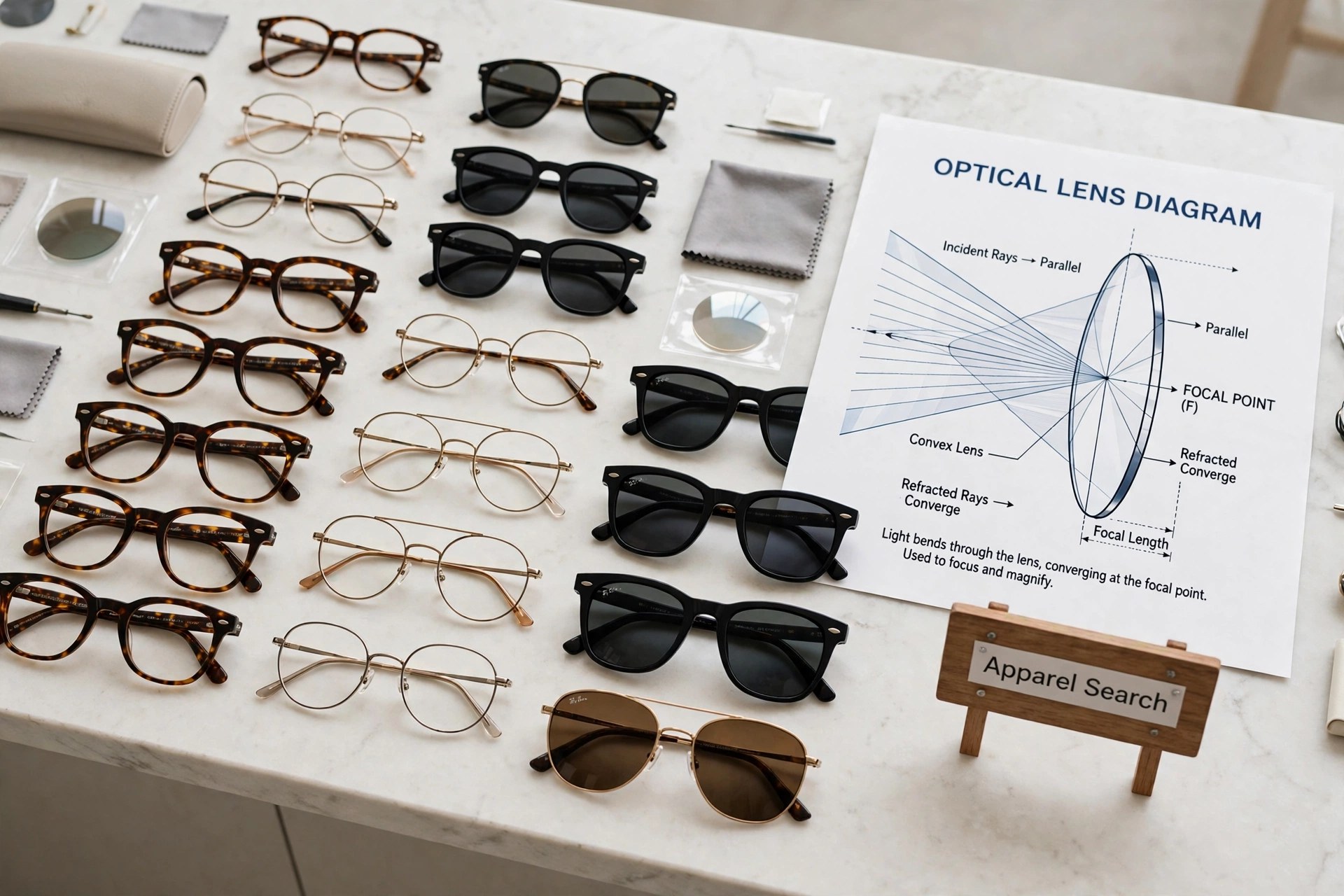
Fashion Optics — Explore & Resources
The Science Under the Frames
Every pair of glasses rests on the lens. A lens is a transmissive optical device that focuses or disperses a light beam by means of refraction; lenses are made from glass or plastic, ground and polished or moulded to the desired shape. Most are spherical lenses, whose two surfaces are parts of spheres — each surface convex, concave or planar — and the line joining the centres of those spheres is the axis of the lens, which typically passes through its physical centre.
That geometry is what makes vision correction possible: by bending light before it reaches the eye, a properly shaped lens compensates for the eye's own focusing errors. Prescription strength, lens material and coatings all follow from the same optical principles, whether the finished product is a plain medical appliance or a pair of designer frames.
Eyewear as Fashion
Fashion optics begins where pure correction ends. Frames turn a medical device into an accessory that sits at the centre of the face, so shape, colour and proportion matter as much as prescription: the same lens can sit in a wire aviator, a bold acetate rectangle or a rimless mount, and each choice changes the wearer's whole look. Sunglasses extend the principle — optical protection presented as style.
The neighbouring summaries divide the subject by product: the fashion glasses, fashion eyewear and fashion eyeglasses summaries linked from this page each cover the eyewear family from its own angle. Together with this page they make a practical point for shoppers: buy the optics from the science — correct prescription, proper fit, suitable lens material — and buy the fashion from the mirror, because a pair worn every day has to succeed at both.
Choosing Frames With the Science in Mind
A practical fitting joins the two halves of this subject. The optics set the constraints — lens size and shape affect how thick a strong prescription looks at the edge, and the frame must hold the lens at the correct distance and angle from the eye. Fashion then works inside those constraints, matching frame shape to face shape and colouring to wardrobe. Wearers who reverse the order, choosing frames the prescription cannot serve, end with glasses that fail as optics however well they succeed as an accessory.
Common Questions
What does fashion optics mean?
Optics is the science of sight and light; fashion optics is that science applied to stylish eyewear — spectacles and contact lenses chosen for appearance as well as vision correction.
What is a lens, in optical terms?
A transmissive device that focuses or disperses light by refraction. Most lenses are spherical, with convex, concave or planar surfaces, and are ground, polished or moulded from glass or plastic.
How do the glasses, eyewear and eyeglasses summaries differ from this page?
This page covers the underlying science and the eyewear idea as a whole; the linked summaries each treat a specific product family — glasses, eyewear and eyeglasses — in detail.