Infinite Scroll Tips for Fashion Websites
Endless pages, pogosticking, and how to keep a scrolling fashion site crawlable
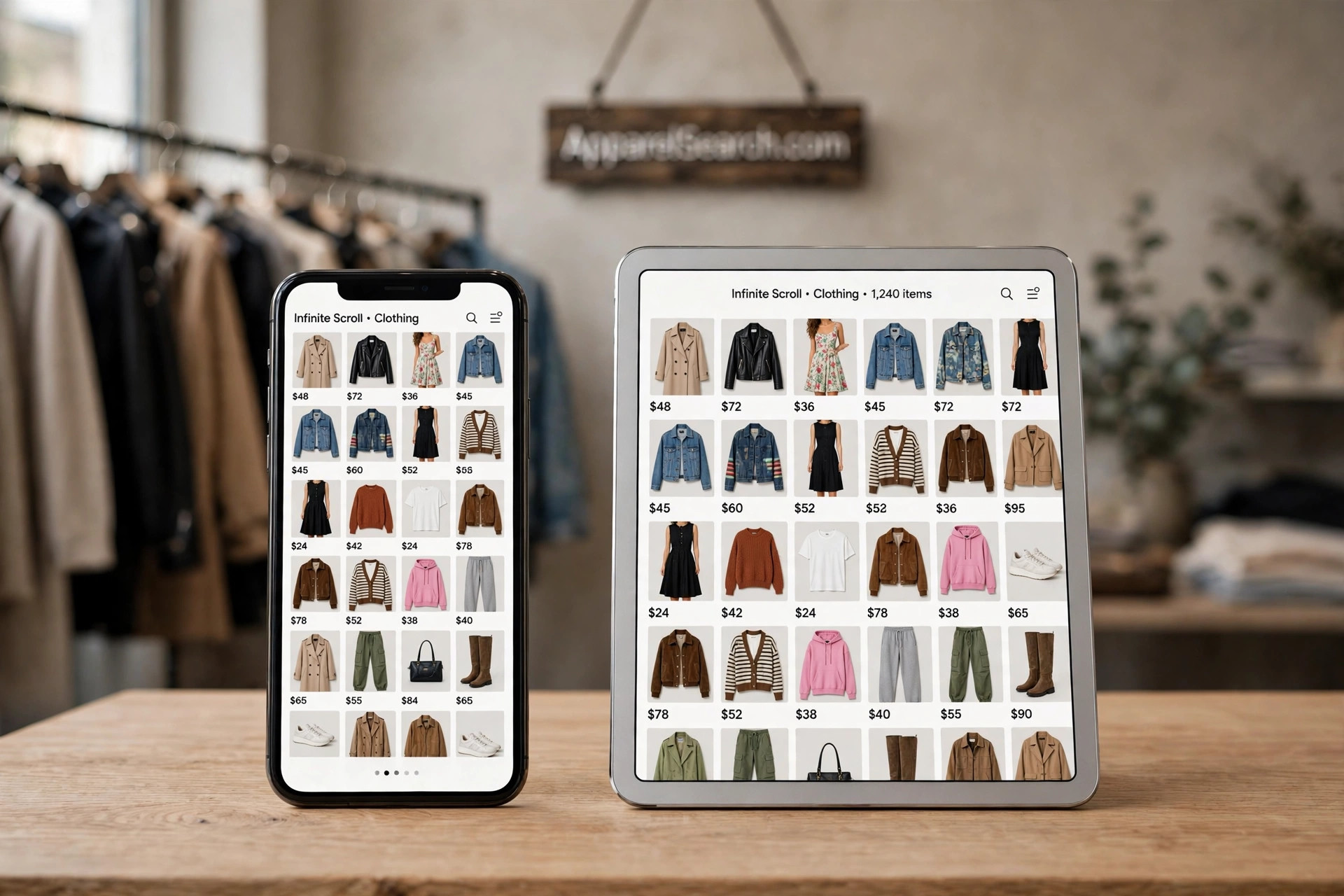
Are you familiar with infinite scroll on websites? Infinite scroll has been called autopagerize, unpaginate and endless pages, but essentially it is pre-fetching content from a subsequent page and adding it directly to the user's current page: as the user scrolls through content, more content is loaded automatically.
You can see it on the main page of some fashion blogs — scroll down and more articles are added automatically as you quest to reach the bottom of the list, with no need to click a "next page" button. On many sites you can eventually reach the bottom because the number of posts is limited; on a large site such as Pinterest you may scroll for an extremely long time before hitting bottom, if ever. Google has implemented infinite scrolling for image search results, though not for its general results.
SEO Guides on Apparel Search
Why Fashion Sites Like It
With the popularity of social media, massive amounts of data are consumed on a continuous basis; infinite scrolling offers an efficient way to browse that ocean of information without waiting for pages to preload or clicking a button to move to another page. The user enjoys a truly responsive experience. That is also the spirit of responsive web design — crafting sites to provide an optimal viewing experience, easy reading and navigation with a minimum of resizing, panning and scrolling, flowing nicely across devices from mobile phones to desktop monitors.
Fashion blogs and other image-intense websites are prime candidates for avoiding a scroll bar, and the Infinite Scroll pattern is built for exactly that kind of visual browsing. However, the system is not perfect for all sites. Infinite scrolling typically promotes a better experience for users, but along with the good comes a little bad — not so much for the website viewer as for the website owner.
The Search Engine Problem
If you are interested in search engine optimization, this method has drawbacks. The bottom line is that because the page is nearly never-ending, the search engines do not appear to pick up all the data on the page. Solutions were expected to come, but at the time of writing the method was not fully loved by search engines.
A good way to see the problem is to check the cache of a web page that uses infinite scroll: put "cache:" followed by the page's web address into the Google search box. Depending on when you read this, you could test the Apparel Search blog — blog.apparelsearch.com — the same way; the gap between what a visitor scrolling sees and what the cache holds is the indexing problem in miniature.
Pogosticking: Losing Your Place
Another problem is something called pogosticking. Infinite scrolling often causes your position on the page to be lost. Pogosticking happens when you click away from an infinitely scrolling list and, when you return by clicking "Back," are brought to the top of the previous page instead of to the point where you left off. This happens because the scroll position is lost when you navigate away from an infinitely scrolling page, forcing you to scroll back down each time.
When items are distributed across web pages, they are framed and indexed and have a start and end point; the information is presented clearly and orderly. If you select an item from a paginated list and are taken from that page, clicking "Back" will return you to that page, probably to the same scroll position, and your search continues right where it left off. Scroll the same list with infinite scrolling and you are left without that sense of control, because you are scrolling through a list that is conceptually infinite. As you can guess, this causes hardship for search engines as well as for visitors.
Making Infinite Scroll Search Engine Friendly
To make sure search engines can crawl individual items linked from an infinite scroll page, make sure that you or your content management system produces a paginated series — component pages — to go along with the infinite scroll. Search Engine Watch's Make Infinite Scrolling SEO Friendly walk through that approach.
Finally, keep the visitor in mind: do users always want a never-ending stream of data? As the Nielsen Norman Group cautions, infinite scrolling may not be appropriate for every fashion site. The technique will no doubt keep improving — but the decision to use it should be made with both the shopper and the search engine in view. Learn more about fashion industry SEO in the fashion terms section.
Common Questions
What is infinite scroll?
Infinite scroll — also called autopagerize, unpaginate or endless pages — pre-fetches content from a subsequent page and adds it directly to the user's current page. As the user scrolls, more content loads automatically, so there is no need to click a 'next page' button. Pinterest and Google Image Search are familiar examples.
Why can infinite scroll hurt SEO?
Because the page is nearly never-ending, search engines do not appear to pick up all the data on it. The safeguard is to make sure the site or its content management system also produces a paginated series of component pages alongside the infinite scroll, so search engines can crawl individual items one page at a time.
What is pogosticking in infinite scrolling?
Pogosticking happens when a visitor clicks away from an infinitely scrolling list and, on pressing Back, is returned to the top of the list instead of the point where they left off — the scroll position is lost. Paginated lists avoid this because each page is framed and indexed with a start and end point, and Back returns the visitor to the same page and position.