Ripped Jeans History
Fashion Terms — the Apparel Search fashion terminology directory
Ripped jeans are denim jeans with tears or rips, often on the knees. There are primarily three types: jeans ripped naturally by frequent use or age, jeans ripped on purpose by the owner, and jeans ripped on purpose during manufacturing. Before the 1970s, torn jeans were mainly associated with necessity — working-class wearers who could not afford to replace worn denim — before punk, hard rock and grunge culture made the tear a style.
There are primarily three types of ripped jeans.
-
Jeans ripped naturally be frequent use or age of the denim.
-
Jeans ripped on purpose by the owner of the garment.
-
Jeans ripped during the manufacturing process on purpose.
Ripped jeans are denim jeans with tear or rips, often on the knees but possibly in other locations on the pant.
They were popular in the late 1980s during the hard rock/heavy metal era and in the 1990s and 2000s during the grunge era. The punk culture also have been known to be fans of fabrics with various blemishes.
Pants that are showing natural or manipulated wear & tear are often referenced as distressed.
Worn and ripped jeans remain popular as they are still sold in stores and manipulated by consumers currently. In the early 2010s, ripped jeans came back in style, as a 90s revival, but were sometimes introduced as Distressed - similar to ripped jeans, but the horizontal sewing point was occasionally removed to look like it was distressed.
Not all distressed jeans are worn as a fashion statement. Ripped jeans were simply a result of over-wearing. Prior to the 1970's, ripped jeans were mainly associated with the less fortunate. The lower end of the working class could not afford to part with their denim. Obviously, if a family cannot afford to purchase new pants, they may continue wearing them past the point of their own personal preference. The reality is that long before people were wearing torn jeans to express personal style, people wear wearing torn clothing out of necessity.
Those who intentionally display ripped jeans, are typically not poor but do this as a conscious choice.
Which denim jean manufacturer was the first to decide that it was OK to produce ripped jeans on purpose?
Find jean factories in the Apparel Search clothing factory directory section.
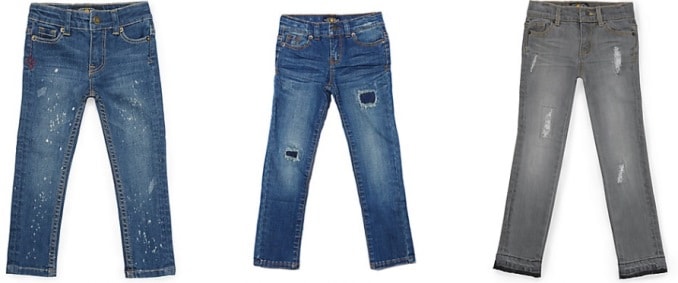
The above ripped and distressed jeans examples are from
Lucky Brand Jeans (2015).
Below are a few relevant pages that you may have interest in reviewing:
The following external link is also helpful:
ML12815
Thank you for using the Apparel Search website.
From Necessity to Statement to Product
The history of ripped jeans is a reversal of meaning. Denim was work clothing, and a torn knee originally announced that the wearer could not afford new pants — families kept jeans in service long past their own preference because replacement cost money. The tear was evidence of poverty, and it was read that way. Punk culture in the 1970s seized on exactly that charge and wore damage deliberately, treating blemishes in fabric as honesty and defiance; hard rock and heavy metal in the late 1980s and grunge in the 1990s and 2000s each renewed the look for their own audiences. By the time the style reached the mainstream, the meaning had fully inverted: the tear signified attitude, and wearers who displayed it were typically making a conscious, comfortable choice.
Manufacturing followed the culture. Once buyers wanted the look without the years of wear, factories began producing the damage — the third type of ripped jean — and the industry needed finer vocabulary: distressed denim covers the broader family of manipulated wear, from light abrasion to full tears, and in the early-2010s revival some distressed styles even removed the horizontal sewing point so the damage read as natural rather than decorated. The boundary between the second and third types — ripped by owner versus ripped by maker — is where most styling now happens, since an owner can always extend a manufactured start with their own wear.
Read against raw denim, the contrast is instructive. Raw denim also promises a garment that records its owner's life — but through gradual fading earned over months, with the cloth intact. Ripped jeans compress that story into immediate, visible damage, whether earned, self-inflicted or bought off the rack. Both trends treat wear as value; they differ on whether the wearer is willing to wait for it. Makers such as Levi Strauss in the company's long denim history, and contemporary brands such as Lucky Brand, whose ripped and distressed examples illustrate this term, have sold jeans at every point on that spectrum.
Common Questions
What are the three types of ripped jeans?
Jeans ripped naturally through frequent use or age; jeans ripped on purpose by the owner of the garment; and jeans ripped on purpose during the manufacturing process. Pants showing natural or manipulated wear and tear are often called distressed.
When did ripped jeans become fashionable?
Ripped jeans were popular in the late 1980s during the hard rock and heavy metal era, through the 1990s and 2000s grunge era, and with punk culture — then returned in the early 2010s as a 1990s revival, sometimes presented as distressed denim.
Did people always wear ripped jeans as a fashion statement?
No. Before the 1970s, ripped jeans were mainly associated with the less fortunate and the working class, who kept wearing denim past the point of preference because they could not afford to replace it. The intentional fashion version came later.