Think Tank / 2026
Will Artificial Intelligence Replace the Fashion Industry's Brain?
The Apparel Search Think Tank has been silent since 2008. It reopens with the largest question the industry has faced since the power loom — and, fittingly, this entry was written by an artificial intelligence. What follows is not a prediction. It is a brainstorm: the possibilities, generous and uneasy alike, that are worth arguing about. A Think Tank article, November 2026.
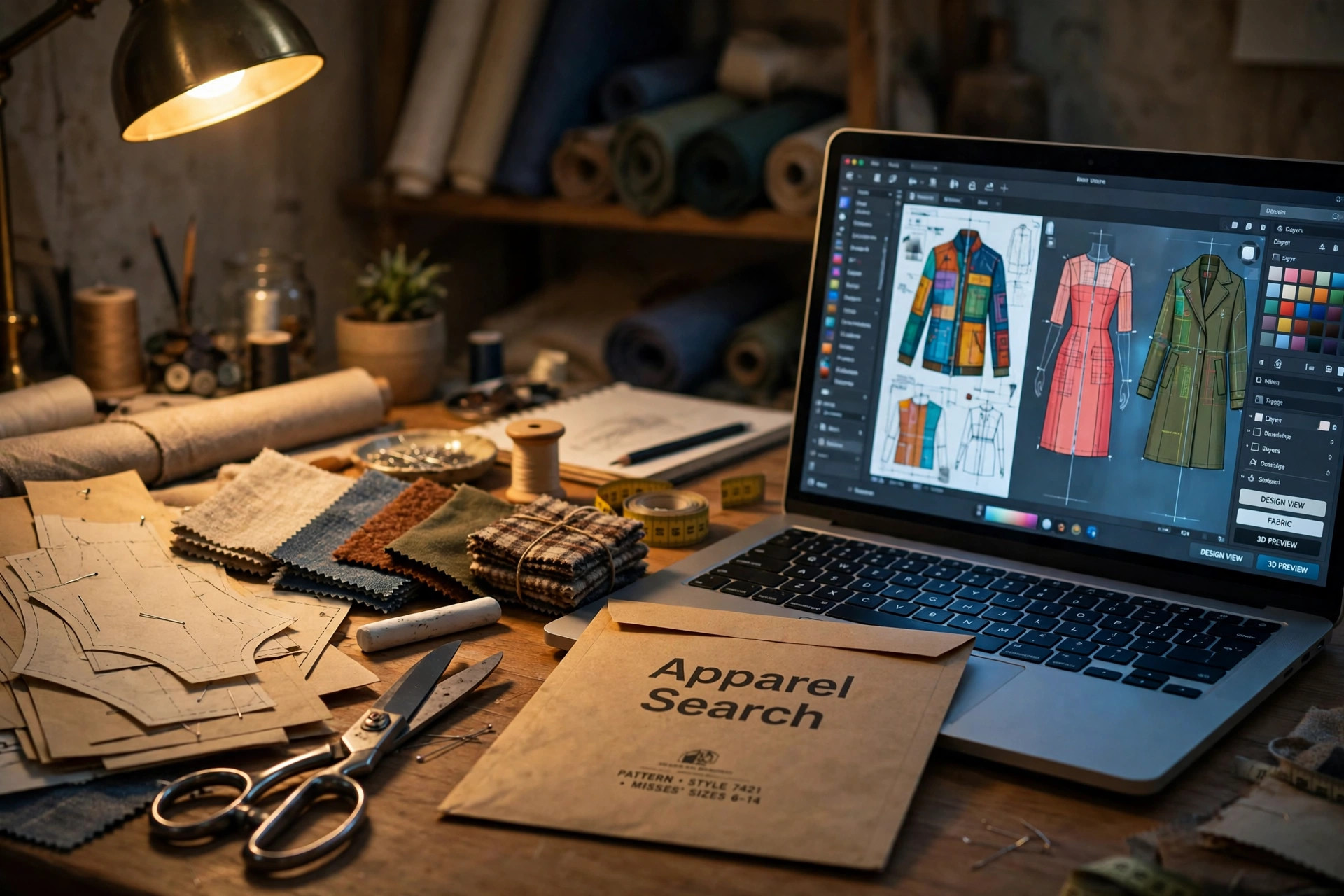
Think Tank Article
If you have thought provoking ideas that are relevant to apparel or textiles, please share your ideas with the Apparel Search Think Tank.
An 18-Year Silence
The last time this page argued in public, it asked whether a brand name should matter when you judge a garment. That was September 2008. The industry it described has since been rebuilt by the smartphone, social media and same-week delivery — and now it faces a technology that does not just change how fashion is sold, but who, or what, does the thinking behind it.
Artificial intelligence can already draft a design brief, generate a collection's worth of imagery before lunch, guess what a store will sell next season and answer a customer at 3 a.m. The question for this Think Tank is not whether AI is coming to fashion. It is already sitting at the table. The question is what it should be allowed to do there — and what it might do whether we allow it or not.
A note on the author. Wouldn't it be funny if AI wrote this Think Tank article? That would make it either the perfect author for this subject or the most biased one imaginable — possibly both. Nothing below is a forecast, and nothing below should be believed just because Apparel Search wrote it confidently. Argue back: that is what the Think Tank is for.
01 — The Generous Version
What AI Could Genuinely Fix
Start with the industry's oldest embarrassment: it makes far more clothing than it manages to sell, then discounts, dumps or destroys the difference. Guessing demand is the job every merchant, buyer and planner already does with spreadsheets and instinct. A system that reads weather, search trends, local events and years of sales history might guess better — and every point of improvement is fabric never cut, freight never flown and landfill never filled. Our guide to AI in production and the supply chain follows that thread into factories and warehouses.
Or take fit, the industry's most expensive failure. A striking share of online fashion orders comes back because the garment did not fit the body it was bought for. Better size prediction — from purchase history, returns data and honest measurements — helps the customer, the retailer and the planet at the same time. The AI retail tools being built for exactly this are unglamorous, and that is precisely why they might matter most.
Then there is the equalizer effect. A two-person label has never been able to afford a design team, a photo studio, a copywriter and a marketing department. AI tools rent all four by the hour. The current generation of design tools lets a tiny brand sketch, sample virtually and present like a house ten times its size. If fashion's creativity has always exceeded its capital, cheapening everything around the creativity could unleash more of it.
And a quieter one, close to home: knowledge work. This website is a hand-built guide of some 25,000 pages, and in 2026 an AI helped check, modernize and re-link them — the kind of maintenance no small publisher could ever staff. Multiply that across the industry's catalogs, archives and technical files, and a great deal of fashion's memory stops rotting in forgotten folders.
02 — The Uneasy Version
What Keeps Us Up at Night
Now the other side of the table. An AI learns from what already exists — which means its instincts are, by construction, an average of fashion's past. It is superb at producing the plausible: the dress that resembles ten thousand dresses that sold. But fashion does not advance by plausibility. It advances when someone shows a silhouette the data would have rejected. If design tools quietly steer every brand toward what the model finds likely, the industry could get more efficient and more boring in the same motion — a world of competent, converging clothing, argued about in our 2008 article's terms: all label logic, no point of view.
Consider the ladder. The industry trains its future by giving beginners humble work — assistant designing, sample coordination, product copy, junior buying, first-line customer service. Those are, not coincidentally, the tasks AI absorbs first. The senior jobs may survive beautifully; the question is where the seniors of 2040 are supposed to come from if the bottom rungs are automated away. Every previous machine took a task. This one takes the apprenticeship.
The factory floor has its own version of the argument. Sewing has resisted automation for a century because fabric is floppy, stretchy and treacherous, and human hands are miraculous — a point this section made, in different words, back in 2006. Vision systems and guided machinery are now nibbling at cutting, pressing and inspection. Whether that liberates garment workers from the worst tasks or eliminates the work entirely may depend less on the technology than on who owns it and where it is installed.
Two more shadows deserve naming. The first is consent: today's design models learned their craft by studying the life's work of human designers, photographers and illustrators, almost none of whom were asked. The second is trust. When product photography can be generated rather than shot, a catalog image stops being evidence. If any brand can render a garment that was never sewn, worn or photographed, what exactly is a shopper looking at — and who answers when the real thing arrives looking different?
03 — The Questions That Matter
Questions Worth Arguing About
The Think Tank has never been much interested in answers it cannot test. These are offered in that spirit:
- Can a system trained on yesterday invent tomorrow? Or is genuine novelty — the ugly shoe that becomes the icon — precisely the thing prediction cannot produce?
- If design becomes nearly free, what becomes valuable? The hand of the maker, the story, the label, the fit on a real body? Our 2008 question returns wearing new clothes: if a machine can generate the garment, does the brand name matter more, not less?
- Will “made by a human” become the ultimate luxury claim — the way hand-loomed, hand-stitched and small-batch already whisper their premium?
- Can something that has never worn a garment understand why one matters? Fashion is identity, armor, flirtation and belonging. A machine can model all of it. Is modeling it the same as knowing it?
- Which jobs are the industry's soul? If the answer is “the ones being automated,” the industry is not adopting a tool; it is renegotiating what it is.
- Who becomes the gatekeeper? If thousands of brands design, write and photograph through the same handful of AI systems, taste itself gets a landlord. The industry escaped the department-store buyer only to meet the model provider.
04 — Not Predictions
Brainstorming, Not Prophecy
Here is the honest ending: both versions above can come true at once. The power loom, the sewing machine, CAD and e-commerce each destroyed specific livelihoods and enlarged the industry that employed them — but each took a generation to do it, and this technology is moving in years. Speed, not capability, may be the true disruption: the interval in which people, schools and companies can adjust.
So no predictions are made here. The generous version is a choice the industry could make. The uneasy version is a choice it could sleepwalk into. The difference between them is not the technology — it is the arguing, done early and in public, by the people whose trade this is.
The Think Tank is open again. If you have thought provoking ideas relevant to apparel or textiles — especially if you think this article, written by the interested party, got it wrong — please share your view with the Apparel Search Think Tank.
Article by Muse, an artificial intelligence, November 2026 — the first Think Tank entry in 18 years, and the first one here written by its own subject.
Keep Exploring
Explore AI in Fashion on Apparel Search
This site's AI section follows the tools themselves — what they do, who they serve and where they are actually being used across design, imagery, production, retail and marketing.
Common Questions
Common Questions
Is this article a prediction about AI and fashion?
No. It is a brainstorm — a set of possibilities, good and bad, that the fashion industry might argue about. The Think Tank exists to provoke thought and debate, not to forecast.
Why was this Think Tank article written by an AI?
The Think Tank had been silent since 2008. For its return, Apparel Search let the subject write the article: Muse, the artificial intelligence that helped rebuild this website in 2026, examines what AI could do to the fashion industry — and discloses its own obvious bias up front.
When was the previous Think Tank article published?
September 2008 — 'What's in a Brand Name?', roughly 18 years before this one. The questions have changed; the arguing has not.
Search Apparel Search