Apparel Search · Fabric Construction Guide
Types of Looms: Shuttle, Projectile, Rapier, Air-Jet and Water-Jet
Every loom sheds and beats up the same way. What separates them is how the weft gets across — and that one choice sets the loom's speed, width, noise and the fabrics it weaves best.
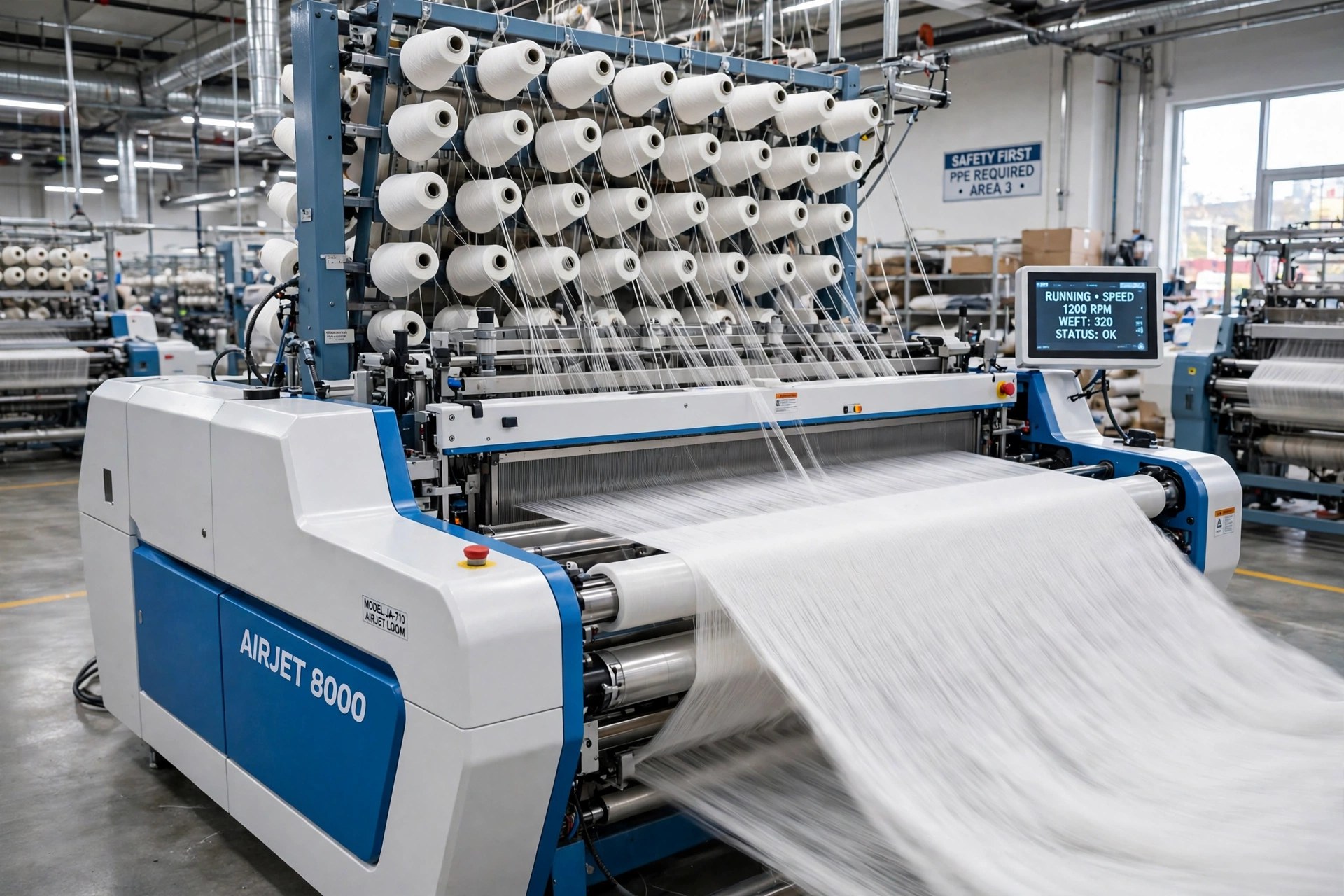
Strip a loom down to essentials and every type does the same three jobs described in How Weaving Works: open a shed, insert a pick, beat it up. The shedding machinery can be a simple cam, a dobby head or a jacquard machine on any of them. What actually defines a loom type — and what mills are buying when they choose one — is the weft insertion system: the mechanism that carries the filling yarn across the warp. This guide compares the five systems in commercial use, and it sits inside the Weaving & Woven Fabric Construction guide, where the structures these looms produce are covered in their own spokes.
Shuttle Looms
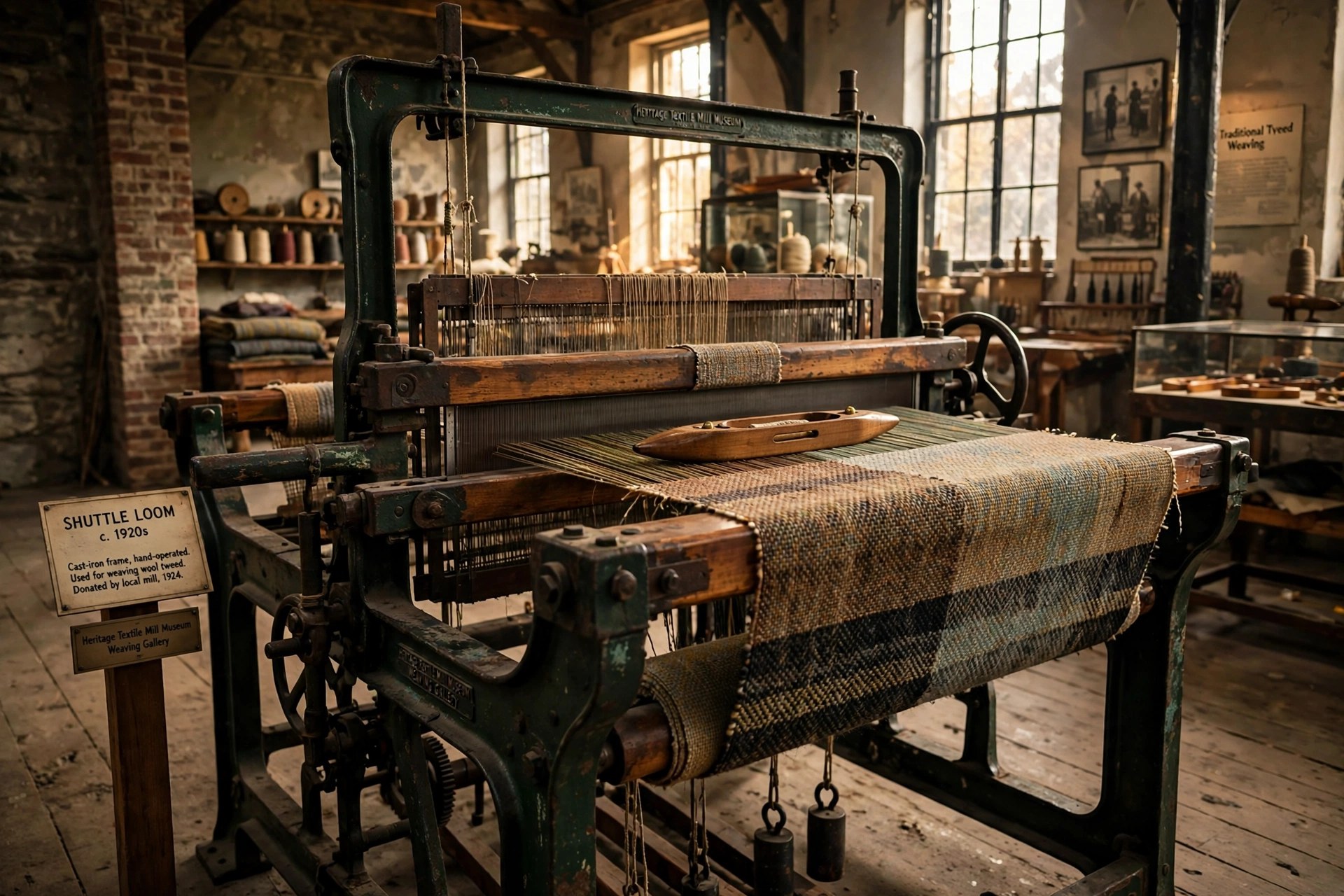
The oldest powered system: a boat-shaped wooden or composite shuttle, hollowed to hold a pirn of weft yarn, is thrown from a shuttle box at one side of the loom, through the shed, into the box at the other side, and thrown back on the next pick. Because the weft is continuous from pick to pick, shuttle looms form true woven selvedges — the edge prized in selvedge denim. The trade-offs are speed and noise: throwing a heavy shuttle limits insertion rates and makes shuttle sheds loud, and fabric width is constrained. Most commodity weaving has moved on, but shuttle looms survive where their edge and gentle yarn handling are the point — selvedge denim, some traditional and craft cloth, and fabrics whose weft is too delicate or irregular for jets.
Projectile Looms
A projectile loom replaces the shuttle with a small steel gripper projectile, only a few inches long, which clamps the weft end and is shot across the shed along a guide race; a fresh projectile is used for every pick and they circulate back on a conveyor. With far less mass flying through the shed, projectile looms run faster and much wider than shuttle looms — they are favorites for wide technical and home-furnishing fabrics and for weaving several fabric widths side by side — while handling yarn gently enough for a broad range of counts and fibers.
Rapier Looms
Rapier looms carry the weft on the tips of long thin bands or rods. In the common two-rapier system, a giver rapier enters the shed from one side carrying the pick, meets a taker rapier at the center, hands the yarn over, and both withdraw — a positive, controlled transfer that treats yarn kindly and handles an exceptional range of weft types, colors and counts, including fancy and delicate yarns. Rapiers are the versatile middle of the loom world: not the fastest system, but the one mills reach for when a fabric changes style often, runs multiple weft colors, or uses yarns that jets would damage.
Air-Jet Looms
An air-jet loom has no carrier at all: a main nozzle fires the weft yarn across the shed on a stream of compressed air, with relay nozzles along the reed keeping it on course. Removing the mechanical carrier makes air-jet the fastest mainstream insertion system, and it dominates high-volume plain fabrics — cotton shirting and sheeting, polyester cloth, glass and other industrial fabrics. Its limits are the mirror of its strengths: the air stream needs yarn with enough surface and strength to ride it, very heavy or hairy wefts travel poorly, and the compressed-air plant is a significant energy cost.
Water-Jet Looms
Water-jet looms substitute a fine jet of water for air. The water stream is more coherent, so insertion is fast, quiet and economical — but the fabric leaves the loom wet, which restricts the system to hydrophobic filament yarns that neither absorb the water nor weaken when wet: polyester, nylon and similar synthetics. For those fabrics — linings, taffeta-type cloth, lightweight filament goods — water-jet weaving is one of the cheapest ways to make cloth; for natural fibers it is simply unusable.
Reading a Loom Specification
Loom speed is quoted in picks per minute, and output depends on speed times fabric width — the trade often multiplies the two into a weft insertion rate. A narrow loom at 1,000 picks a minute may produce less cloth than a wide one at 600. When a mill says a fabric is “air-jet quality” or “shuttle woven,” it is really telling you about insertion system, edge type and the yarn range the cloth could use.
Handlooms and Frame Looms
Below the powered machinery sits the loom family that started everything: frame looms, rigid-heddle looms, table looms and floor looms worked by hand or treadle. Their insertion is a shuttle passed by hand — the same mechanics, at craft speed. Handloom weaving remains commercially real in heritage cloth, handwoven apparel fabrics and regional textile traditions, and it teaches the loom cycle more clearly than any diagram: every step this cluster describes is one a handweaver performs deliberately, pick by pick.
Common Questions
What is the fastest type of loom?
Air-jet looms are generally the fastest mainstream weaving machines, because nothing mechanical crosses the shed — the weft rides a stream of compressed air. Water-jet looms are comparably fast for synthetic filament fabrics. Actual cloth output also depends on fabric width and picks per inch, so a slower wide loom can out-produce a faster narrow one.
Why do shuttle looms make better selvedges?
A shuttle carries one continuous weft yarn that turns around the edge warp threads at each side, wrapping and locking the edge as part of the weaving itself. Shuttleless looms insert individual cut picks, so their edges are fringed and must be tucked, bound or fused afterward.
Which loom is best for delicate or fancy weft yarns?
Rapier looms. Their giver and taker rapiers grip the yarn and hand it over positively at the center of the shed, so insertion is controlled rather than ballistic or air-blown. Mills use rapiers for wide style variety, multiple weft colors and fragile or textured yarns that jets would strip or break.
Why can water-jet looms only weave synthetics?
The weft is carried by a jet of water and the fabric comes off the loom wet. Hydrophobic filaments such as polyester and nylon shed the water and keep their strength, while natural fibers absorb it, swell and weaken, and the cloth would need energy-intensive drying. The system is therefore reserved for filament synthetics.
Back to the Weaving & Woven Fabrics Guide
The Weaving & Woven Fabrics hub maps the whole construction story — how the loom cycle works, the structures looms produce, patterned weaving and the named fabrics that result.