Bekishe
Clothing Definitions — definitions of garments and clothing terms from Apparel Search
A bekishe is a long coat, usually made of patterned black silk, that Chassidim — members of Chassidic Jewish communities — are known for wearing on Shabbat and other Jewish holidays. This page explains the garment itself: its length, its characteristic patterned black silk, and its role as the formal outer garment of Chassidic dress for the Sabbath and festivals. As a coat worn for sacred and communal occasions rather than for everyday work, the bekishe belongs to the category of traditional dress whose meaning lies as much in the occasion and the community as in the cut of the cloth.
A Bekishe is a long coat, usually made of patterned black silk, that Chassidim are known for wearing on Shabbat and other Jewish holidays.
| The above article is licensed under the GNU Free Documentation License. From Wikipedia, the free encyclopedia (https://en.wikipedia.org/wiki/bekishe). 8/7/05 |
Photos
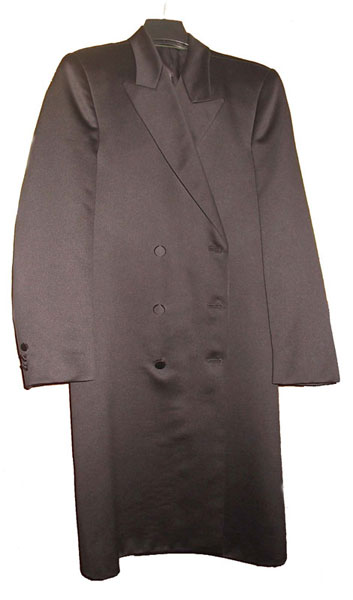
Dress for Shabbat and the Holidays
To understand the bekishe, start with the rhythm of the week it belongs to. In Chassidic life, Shabbat and the festivals are set apart from working days, and dress marks the boundary: the long black silk coat is put on for the Sabbath and for holidays, when the community gathers for prayer, meals and celebration. A garment reserved for those days acquires meaning from the reservation itself. The bekishe is therefore best understood not as everyday clothing but as ceremonial dress — the coat a Chassidic man wears when the occasion is sacred and communal, in the same way that other traditions keep a distinct best dress for worship and festivals.
The choice of material carries the same balance. Black is the established color of Chassidic men's dress, expressing modesty and uniformity within the community, and a single black standard also means that differences of wealth are muted in public worship. Within that discipline, silk — patterned silk, with the design woven into the cloth — supplies dignity. The coat is long, formal in line, and richer than weekday dress without departing from the community's code. Patterned black silk is the compromise the tradition settled on: festive, but festive inside the rules.
The Bekishe Among Chassidic Garments
The bekishe is the outer layer of a coordinated way of dressing, worn over the rest of the Shabbat outfit as a coat is worn — for arrival, for prayer and for the public parts of the day. As with other traditional garments, details of style can vary between communities and families, and those details are read by members as part of identity, even where an outside observer sees only a long black coat. For anyone describing, selling or studying the garment, the respectful essentials are the ones that define it: a long coat, usually of patterned black silk, worn by Chassidim on Shabbat and other Jewish holidays. Care follows from the fabric: silk holiday garments are kept for their occasions, stored carefully, and cleaned gently, because a coat worn only on Sabbaths and festivals is expected to serve for many years.
How the Bekishe Is Made and Kept
As a long coat, the bekishe is cut for a dignified, unhurried line: full length, room to wear over the garments beneath, and a front that closes the coat smoothly for prayer and for the walk to and from synagogue. The patterned silk is the signature material — black on black patterning that catches the light as the wearer moves, so that the coat reads as plainly black at a distance and richly worked up close. That woven pattern, rather than applied decoration, is what keeps the garment inside the community's standards of modest dress while still marking the day as a festival. Because it is worn weekly on Shabbat and again through the cycle of holidays, a bekishe is bought as a long-term garment, often the most significant single item of a man's wardrobe.
Ownership follows the occasion rhythm. The bekishe is not rotated like everyday clothing; it is taken out for Shabbat and the holidays and returned to storage between them, which is why a well-kept coat can serve for years and why its condition itself becomes part of the respect shown to the day. For a reader outside the community, the essential point is the one the definition gives: this is the long, patterned black silk coat by which Chassidic men dress for the Sabbath and the festivals, a garment in which community identity, religious observance and formal dignity are carried in a single piece of clothing.
Common Questions
What is a bekishe?
A bekishe is a long coat, usually made of patterned black silk. It is the garment Chassidim are known for wearing as their formal outer dress, most characteristically on Shabbat and on Jewish holidays.
When is a bekishe worn?
The bekishe is worn on Shabbat — the Jewish Sabbath — and on other Jewish holidays. It is occasion dress within the Chassidic community, marking the day as set apart from the ordinary working week.
What is a bekishe made of?
A bekishe is usually made of patterned black silk. The pattern is worked into the black fabric itself, so the coat keeps the community's sober black dress code while the silk and its pattern give it the richness appropriate to a holiday garment.