Cardigan Sweater
Clothing Definitions — definitions of garments and clothing terms from Apparel Search
Search Apparel Search
At a Glance
Definition: A cardigan is a knitted sweater that opens fully down the front and fastens with buttons, a zip or toggles, named after the 7th Earl of Cardigan.
Also known as: Cardi (informal shortening)
Category: Clothing Definitions
Word Origin
The cardigan is named for James Thomas Brudenell, 7th Earl of Cardigan, the British commander associated with the Charge of the Light Brigade at Balaclava in the Crimean War. Knitted, front-fastening waistcoats worn by officers of his era became attached to his name, and cardigan passed from the man to the garment — one of the few articles of clothing named after a soldier.
A cardigan is a type of sweater that opens down the front and fastens with buttons. That single feature — the full front opening — is what separates it from every pullover: a cardigan can be put on and taken off like a jacket, worn open, worn closed, or shrugged off the shoulders, which makes it the most flexible layering piece in knitwear. This page explains how cardigans are constructed, the necklines and fits in use, and how a military waistcoat became a universal garment.
What Makes a Cardigan a Cardigan
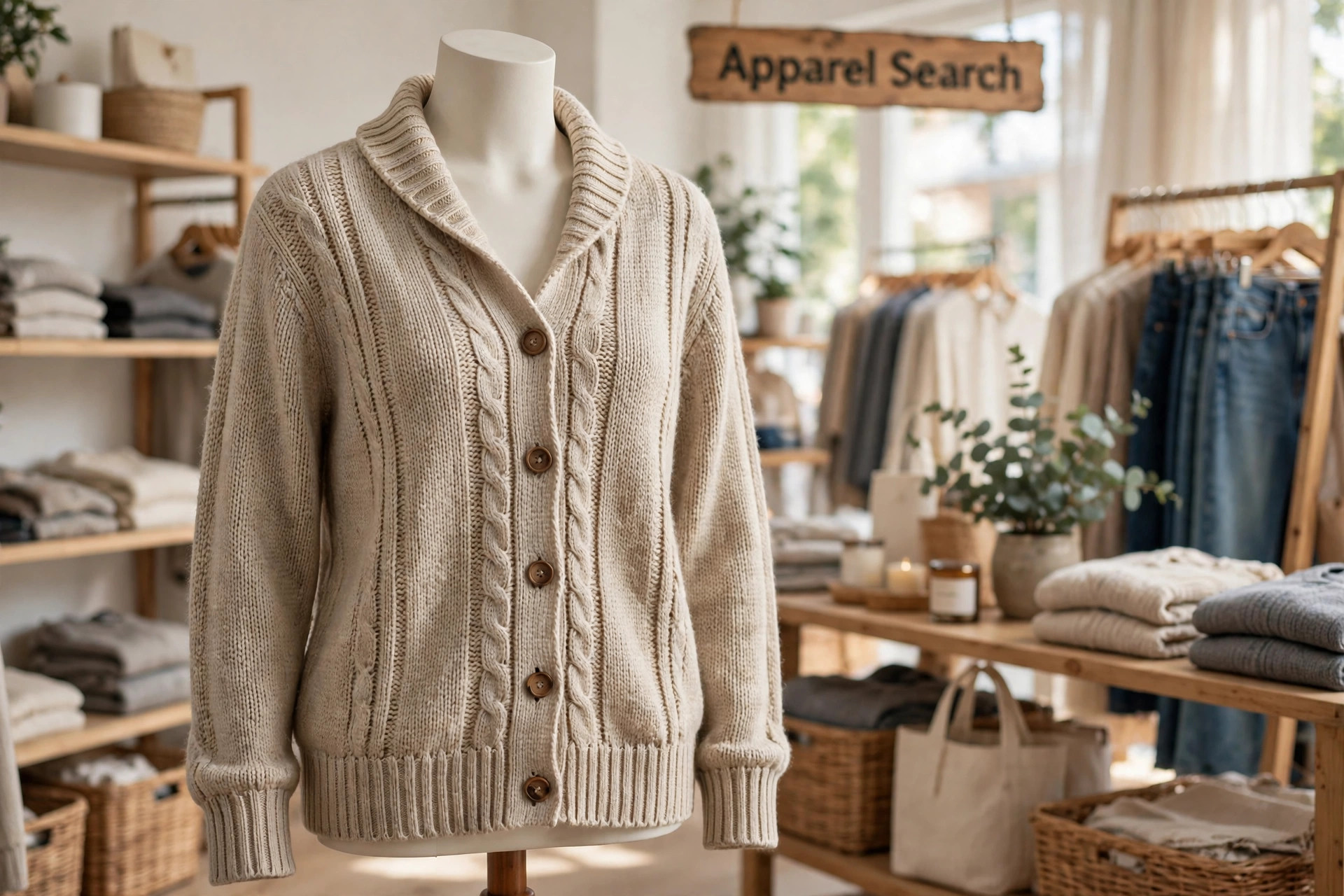
The defining feature is the open front. A cardigan is a knitted garment cut so the two front panels meet at the centre and fasten — classically with buttons, but also with a zip, toggles, hooks or a belt. A more open modern version has no fastening at all and is designed to hang open, but it keeps the cardigan's cut: two distinct fronts rather than a closed tube of knitting. By contrast, a pullover has no opening and must be pulled over the head, which is exactly the inconvenience the cardigan was designed to avoid.
Because it opens, the cardigan is usually knitted with a reinforced front band. The button band carries the strain of fastening and unfastening, so it is worked with enough body — often in a tighter rib or a doubled strip — to lie flat without rippling or gaping. Buttons should be firmly sewn, and a well-made cardigan supplies a spare. Pockets, when present, are set low on the fronts where hands naturally fall; ribbed cuffs and a ribbed hem keep the sleeves and body from bagging out with wear.
From Military Waistcoat to Wardrobe Staple
The cardigan is modelled on the knitted wool waistcoat that British officers wore in the Crimean War era. The fame of James Brudenell, 7th Earl of Cardigan, after the war attached his name first to that waistcoat and then to the front-buttoning knitted garment that developed from it. What began as a practical extra layer under a uniform — warm, close-fitting, and easy to remove without disturbing anything worn over it — proved just as useful in civilian dress.
Through the twentieth century the cardigan settled into wardrobes of every kind. Plain cardigans are worn over shirts and inside suit jackets as a less formal alternative to the waistcoat or vest, with the added benefit of steadying a necktie when the jacket comes off. The same garment appears as a fine-gauge layering piece, a school and uniform sweater, and a heavy belted knit worn in place of a light jacket. Its versatility across casual and formal settings, and across seasons, is why it never quite leaves fashion for long.
Necklines, Fastenings and Fits
The classic cardigan neckline is the V-neck, cut to frame a shirt collar, blouse or tie beneath it. Crew-neck cardigans button higher and read as more casual and sporty; shawl-collar versions, with a rolled collar that widens toward the chest, are warmer and usually knitted heavier, often belted. Women's cardigans add scoop and ballet necklines, cropped lengths that sit at the waist, and long duster lengths that fall below the knee. The neckline decides what the cardigan layers over most naturally, so it is the first choice to make when buying one.
Fit runs from fine-gauge, hip-length layering pieces to chunky knits with real weight. Sleeves may be set in at the shoulder for a tailored line or worked raglan for ease of movement. Machine knitting produces most cardigans today, in wool, cotton, cashmere blends and synthetics, but hand-knitted cardigans follow the same construction logic — the pattern is centuries of small refinements to a front-opening knit, not a different garment. For more styles and current examples, see cardigans in our fashion influence section and the wider survey of sweaters.
Wearing and Caring for a Cardigan
Worn open over a dress, buttoned up as a top in its own right, or layered under a coat as the middle layer, the cardigan earns its place by adjusting to temperature and formality through the day — buttons exist to be used selectively, and a cardigan fastened only at the middle buttons has been a recognised styling choice for generations. It is also the standard answer to over-air-conditioned offices and cool evenings, precisely because it goes on and off without disturbing hair, makeup or the clothing underneath. Our cardigan fashion blog collects styling coverage, and a common reader question — are cardigans always sweaters? — is answered in our questions section.
Care follows the knit. Wool cardigans should be folded rather than hung: a hung knit stretches under its own weight, especially at the shoulders, and gradually loses its shape. Gentle washing and drying flat keep the fit, and the button band and button stitching deserve a periodic check, since a loose button on the band is the most common cardigan repair. Treated that way, a good cardigan is a long-service garment — which is fitting for a style that has already lasted more than a century and a half.
Not to Be Confused With
A cardigan opens down the front; a pullover sweater (a jumper in British usage) has no opening and goes on over the head. The distinction is the opening, not the knit: both are sweaters, but only the front-opening style is a cardigan. A garment that merely ties closed, with no buttons, zip or other fastening, is closer to a robe than to a cardigan.
Common Questions
What is a cardigan?
A cardigan is a knitted sweater that opens fully down the front and fastens with buttons, a zip or toggles. The open front distinguishes it from a pullover sweater, which has no opening and goes on over the head.
Who was the cardigan named after?
The cardigan was named after James Thomas Brudenell, 7th Earl of Cardigan, a British military commander of the Crimean War period. Knitted front-fastening waistcoats worn by his officers became associated with his name, and cardigan became the general word for the garment.
What necklines do cardigans have?
The classic cardigan has a V-neck that suits wear over a shirt and tie or blouse; crew-neck and shawl-collar versions are also standard, and women's cardigans add scoop and ballet necklines. The neckline decides what the cardigan layers over most naturally.