Babydoll
Clothing Definitions — definitions of garments and clothing terms from Apparel Search
Search Apparel Search
At a Glance
Definition: A babydoll is a short nightgown or negligee worn as nightwear, often trimmed with lace, ruffles, bows and ribbons, sometimes on spaghetti straps, and sometimes made of sheer nylon, chiffon or silk.
Also known as: Baby doll; baby-doll
Category: Clothing Definitions
Word Origin
The name is said to have been popularised by the 1956 film Baby Doll, starring Carroll Baker in the title role, which marked the beginning of the style's enduring popularity for adults. The garment itself may be older than the name: lace-trimmed shortie bed-jackets and bed-capes of the 1930s and 1940s are a plausible earlier lineage for the same short, trimmed form.
A babydoll is a short nightgown or negligee intended as nightwear. The garment is often trimmed with lace, ruffles, bows and ribbons, optionally with spaghetti straps, and is sometimes made of sheer or translucent fabric such as nylon, chiffon or silk. It is now classified as a form of lingerie, and most lingerie retailers treat babydolls as a department of their own. This page explains the garment's construction and trims, the daywear babydoll dress of similar style, and how the form developed from the lace-trimmed bed-jackets of the 1930s and 1940s.
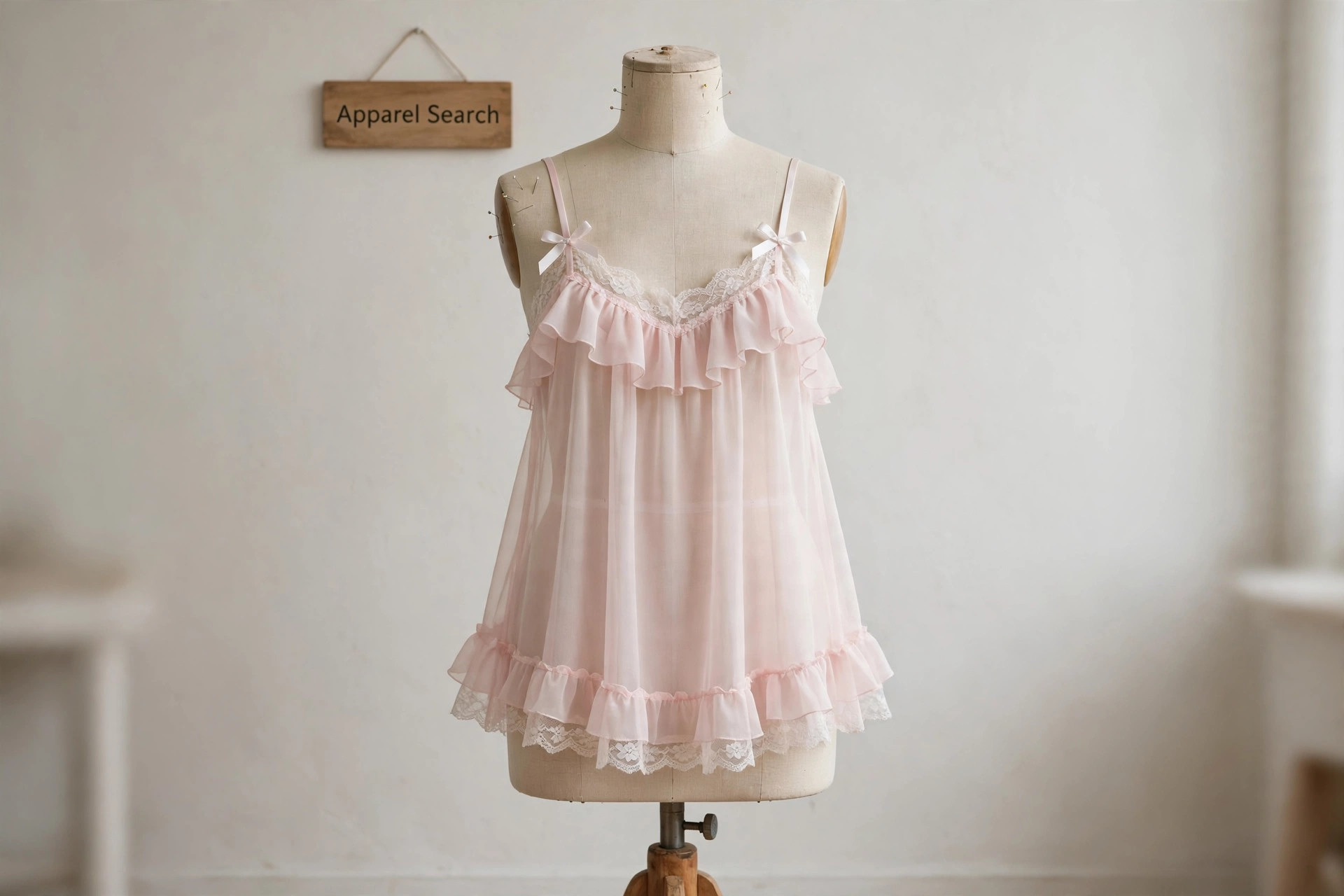
A Short Nightgown, Trimmed
The defining facts of a babydoll are its length and its trim. The gown is short — well above the knee — and is usually cut loose from a fitted or empire-line bodice, so the fabric falls straight from the bust rather than following the waist. That loose, high-waisted cut is what gives the style its name: it resembles, in miniature, the dresses put on infant dolls, and the shortness of the original infant garment is also why the adult version is so brief.
Decoration does most of the work of identifying the style. Lace edging at the neckline and hem, ruffles, bows and ribbons are standard, and the gown is commonly held up by thin spaghetti straps rather than sleeves. The fabrics are the light, fine fabrics of nightwear: nylon and chiffon where a sheer or translucent effect is wanted, silk in more expensive versions. Because the gown is so short, it is often sold as a set with matching panties, which are visible beneath the hem when the set is worn.
Construction follows from the fabrics. A sheer nylon or chiffon babydoll is cut in few pieces, with the shaping done by a seam under the bust rather than by darts or a waist seam, and the trim — lace, ruffles, ribbon — is applied at the edges where the fine fabric needs a finish in any case. Silk versions are cut the same way but finished more carefully, which is the main difference between the boutique and budget ends of the same style. Sizes are correspondingly simple: the loose fall from the bust means the garment fits a range of figures with little alteration, one reason the style suited boutique retailing so well.
The 1956 Film and the Name
The name is said to have been popularised by the 1956 film Baby Doll, starring Carroll Baker in the title role, which essentially marked the beginning of the enduring popularity of the style for adults. The timing mattered as much as the film: at the same time, new synthetic fabrics and boutique retailing made the form both affordable and easy to purchase. A sheer nylon babydoll could be produced cheaply, sold in a small boutique rather than a department store, and replaced often — the conditions under which a named style becomes a standard retail category.
There may, however, be an alternative origin for the style itself. If the lineage of lace-trimmed shortie bed-jackets and bed-capes of the 1930s and 1940s is considered, the babydoll looks less like an invention of the 1950s than like a shortening and lightening of garments that were already worn in bed — the film supplying the name for a form that already existed in embryo.
Babydoll Dresses and Collectable Nightwear
The name has spread beyond nightwear. Short daywear dresses of a similar style — loose from a high waist, short, and lightly trimmed — are sometimes called babydoll dresses. The name itself is written three ways: as one word, babydoll, as two words, baby doll, and hyphenated, baby-doll; all three spellings refer to the same garment.
Modern babydolls vary considerably from the styles of the 1960s and 1970s, in cut, fabric and finish, and are available in a sufficiently wide variety of styles that many lingerie retailers consider them a distinct department rather than a variant of the nightgown. The earlier generations have become collectable in their own right: baby doll negligees from the 1950s to the early 1980s are now sought as vintage items, which is one measure of how completely the style passed from a film title into a permanent category of lingerie. Within these definitions the babydoll sits in the fetish clothing group because of that lingerie classification, alongside the other nightwear and costume terms defined there.
The daywear babydoll dress takes the same elements — high waist, short length, loose fall, light trim — and rebuilds them in dress fabrics at dress lengths just above the knee. It is the nightgown's cut, not its fabrics, that transfers. That a single named style can exist as nightwear, as lingerie and as a day dress is unusual, and it is why the babydoll keeps a definition of its own rather than being folded into the nightgown page: the name, the film and the cut belong to all three uses at once.
Not to Be Confused With
Close neighbours, told apart by length and intent. A babydoll is one specific style: a very short nightgown, usually with an empire line, lace and ribbon trim, and often a matching pair of panties. A negligee is the wider category — any loose, decorative nightdress or dressing-gown set in a fine fabric, at any length. Every babydoll is a kind of negligee; most negligees are not babydolls. Styles of the same short length that are not cut as babydolls are generally sold simply as shortie nightgowns.
Common Questions
What is a babydoll nightgown?
A babydoll is a short nightgown or negligee intended as nightwear, often trimmed with lace, ruffles, bows and ribbons, optionally with spaghetti straps, and sometimes made of sheer nylon, chiffon or silk.
Where did the babydoll name come from?
The name is said to have been popularised by the 1956 film Baby Doll, starring Carroll Baker in the title role, which marked the beginning of the enduring popularity of the style.
What is a babydoll dress?
Short daywear dresses of a similar style to the nightgown are sometimes called babydoll dresses. The name is also written as two words, baby doll, or hyphenated, baby-doll.