1820's Fashion History presented by Apparel Search
Fashion Industry Fashion History Color Trend Forecasting Artist Guide Merchandising Fashion Industry News Definition List Fashion Museums and Exhibits
|
|
During the first half of the 1820s, there were slight gradual modifications of Regency styles, with the position of the waistline trending successively lower than the high waistline of the Regency (just below the breasts), and also further development of the trends of the late 1810s towards giving skirts a somewhat conical silhouette (as opposed to earlier more clinging and free-flowing styles), and in having various types of decoration (sometimes large and ornate) applied horizontally around the dress near the hem. However, there was still no radical break with the Empire/regency aesthetic.
During the second half of the 1820s, this neo-classical aesthetic was decisively repudiated, preparing the way for the main fashion features of the next ten to fifteen years (large sleeves, somewhat strict corseting of the natural waist, full skirts, elaborate large-circumference hats, and visual emphasis on wide sloping shoulders). Around 1826, fabrics with large bold checkerboard or plaid patterns were seen on various fashion plates (another contrast with the previous fashion period, which had favored small delicate pastel prints). A bustle was sometimes also worn.
This illustration gives examples of late 1820s fashions; the rightmost outfit, with its skimpier sleeves, non-whitish color scheme, and slightly lower neckline, is the evening dress.
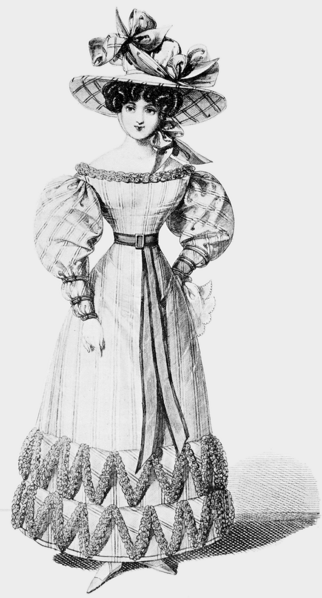
Image: 1826 fashion plate from Wiener Moden, Vienna. Shows how the cutting-edge high styles of the mid-1820's took a sharp turn from the legacy of the classically-influenced "Empire"/"Regency" styles of the late 1790's to early 1820's, preparing the way for the main fashion features of the next ten to fifteen years (large sleeves, somewhat strict corseting of the natural waist, full skirts, large-circumference hats, and visual emphasis on wide sloping shoulders).
| The above article is licensed under the GNU Free Documentation License. From Wikipedia, the free encyclopedia https://en.wikipedia.org/wiki/1820s_in_fashion 1/13/06 |
Learn about another era in fashion:
1980's Fashion History (terms section)
Designer Definition (from U.S Department of Labor)

|
|