Farthingale
Clothing Definitions — definitions of garments and clothing terms from Apparel Search
Farthingale is a term applied to any of several structures used under Western European women's clothing in the late fifteenth and sixteenth centuries to support the skirts into the desired shape. The Spanish form was a hoop skirt stiffened with osiers, rope, bent or, from about 1580, whalebone, and its name comes from the Spanish verdugo, green wood. This page explains the Spanish, French roll and wheel farthingales, how Catherine of Aragon carried the fashion to England in 1501, and why the farthingale is the ancestor of panniers and the crinoline.
|
|
Farthingale is a term applied to any of several structures used under Western European women's clothing in the late fifteenth and sixteenth centuries to support the skirts into the desired shape.
Spanish farthingale
The Spanish farthingale was a hoop skirt stiffened with osiers (willow cuttings), rope, bent, or (from about 1580) whalebone. The name comes from Spanish verdugo 'green wood'.
The earliest primary sources indicate that Princess Isabel of Portugal brought verdugadas with 14 hoops each with her to Spain on her marriage in the 1470s. The Spanish princess Catherine of Aragon brought the fashion into England on her marriage to Prince Arthur, eldest son of Henry VII in 1501.
Spanish farthingales were an essential element of Tudor fashion in England, and remained a fixture of conservative Spanish court fashion into the early seventeenth century (see Portrait of Queen Margaret of Austria, 1609).
French farthingale
The French farthingale is properly a crescent- or sausage-shaped pad stiffened with bent or whalebone and tied around the waist under the skirts; the resulting silhouette is broad and rounded over the hips with the skirt hanging freely in folds.
This type of French farthingale seems to be the item called a roll in Elizabeth I's wardobe accounts. It is the origin of the bumroll worn by Elizabethan recreationists.
The term French farthingale is also used for the wheel or drum farthingale, a stiffened circular support for the drum-shaped silhouette worn in England the 1590s.
The farthingale is the ancestor of eighteenth century panniers and of the nineteenth century crinoline.
Fashion History
| The above article is licensed under the GNU Free Documentation License. From Wikipedia, the free encyclopedia (https://en.wikipedia.org/wiki/farthingale). 1/6/06 |
Photos
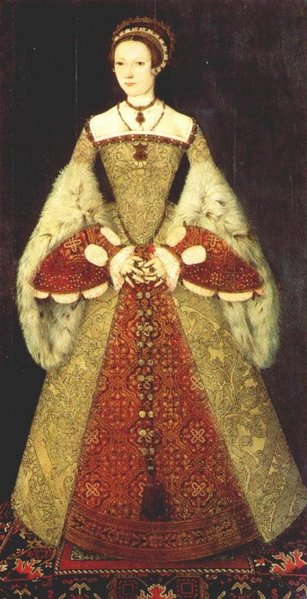
Spanish Hoops, French Rolls and the Wheel
The Spanish farthingale shaped the skirt into a cone. Hoops of increasing size, sewn into a skirt-like support, held the outer skirt away from the legs in a smooth A-line that became essential to Tudor fashion in England after Catherine of Aragon brought the fashion with her on her marriage to Prince Arthur in 1501. The earliest sources describe verdugadas with fourteen hoops each, brought to Spain by Princess Isabel of Portugal in the 1470s. Conservative Spanish court fashion kept the form into the early seventeenth century, long after it had changed elsewhere.
The French farthingale was properly a different device: a crescent- or sausage-shaped pad stiffened with bent or whalebone and tied around the waist under the skirts, giving a silhouette broad and rounded over the hips with the skirt hanging freely in folds — the item called a roll in Elizabeth I's wardrobe accounts, and the origin of the bumroll. The name French farthingale is also used for the wheel or drum farthingale, a stiffened circular support for the flat, drum-shaped silhouette worn in England in the 1590s. Each version solved the same problem — holding heavy skirt fabric in a fashionable shape without weight on the waist alone — with the materials at hand: willow, rope, bent and whalebone.
Common Questions
What is a farthingale?
A farthingale is any of several structures used under Western European women's clothing in the late fifteenth and sixteenth centuries to support the skirts into the desired shape.
What stiffened a Spanish farthingale?
The Spanish farthingale was a hoop skirt stiffened with osiers — willow cuttings — rope, bent, or, from about 1580, whalebone. Its name comes from the Spanish word verdugo, meaning green wood.
What did the farthingale lead to?
The farthingale is the ancestor of the eighteenth-century panniers and of the nineteenth-century crinoline, the later skirt supports that shaped fashionable silhouettes in the same way.