About Textile Fibers
The map of the fiber world: where every fiber on this site comes from, how the families differ, and how mills choose among them.
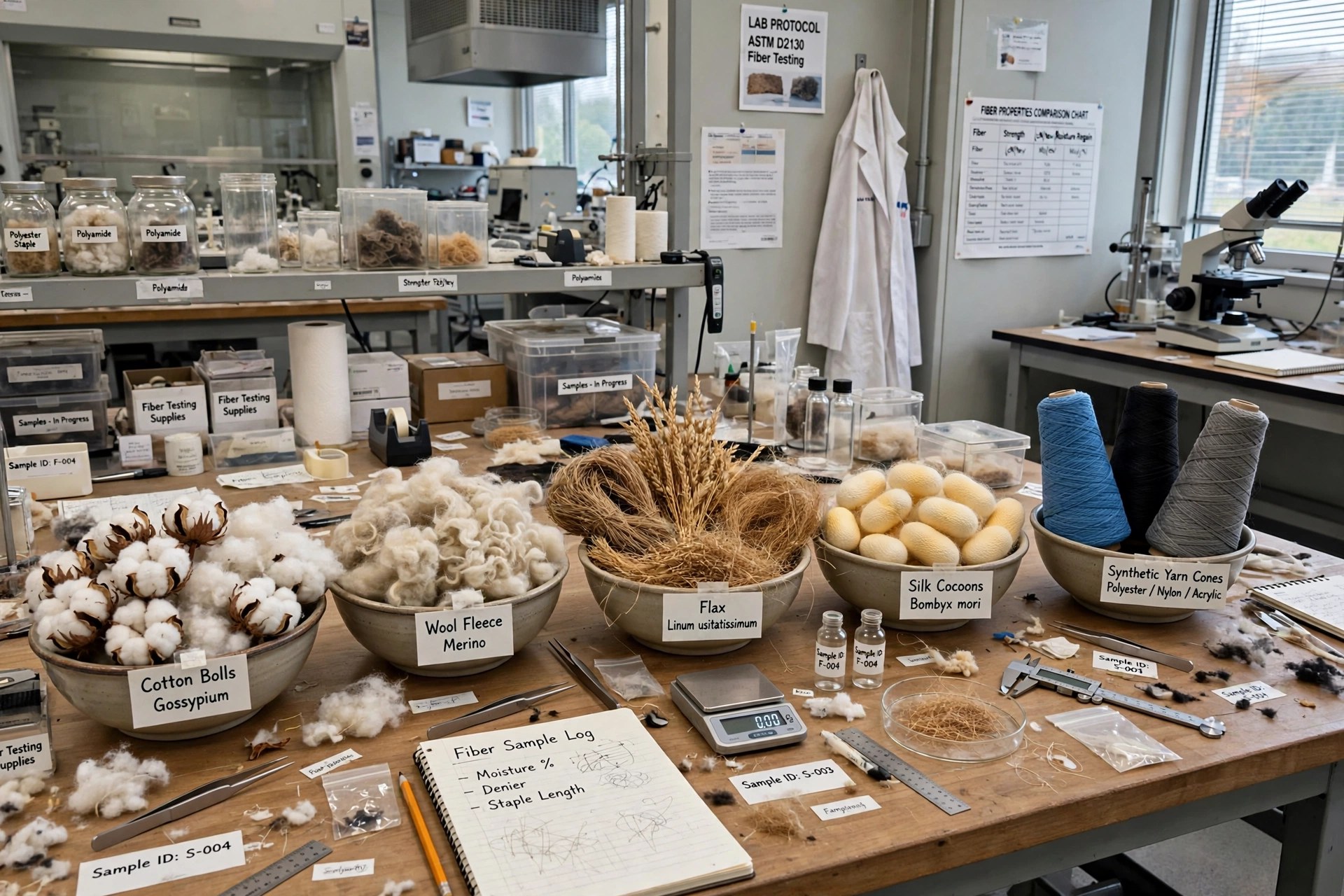
Every fabric begins as a fiber, and the fiber decides most of what the fabric can ever do — its warmth, absorbency, strength, luster, care and cost. Textile fibers sort into a simple map. Natural fibers grow in plants and on animals: cotton, flax, hemp and other plant fibers; wool, alpaca, cashmere, mohair, silk and other animal fibers. Manufactured fibers are made in plants of the industrial kind: regenerated fibers built from natural cellulose, and fully synthetic fibers built from chemical feedstocks.
This page is the hub for the fiber guides on this site. Each fiber in the directory below has its own page covering where it comes from, how it is processed, what it does well and where it fails. Use this overview to place a fiber in its family first — family explains most behavior — then read the individual guide for grades, blends and sourcing questions.
Fiber Guides in This Directory
Natural Fibers: Plant and Animal
Plant fibers are cellulose. Cotton grows as a short staple around the seeds of the cotton plant and spins easily into soft, absorbent yarn. The bast fibers — flax for linen, and hemp — run the length of their plant stems, and deliver longer, stronger, crisper fiber at the cost of retting and separation work. Animal fibers are protein. Wool and the specialty hair fibers insulate, absorb vapor and resist odor because of their scaled, crimped structure, while silk arrives as a continuous filament with unmatched luster.
Natural fibers share agricultural realities: weather, pests, harvest size and grading all move their price and quality from season to season — the bumper crop page in this directory explains how a single harvest swings fiber supply. They also share a reputation advantage with many consumers, which is earned in comfort and breathability more than in durability, where the best synthetics often win.
Manufactured Fibers: Regenerated and Synthetic
Regenerated fibers start from natural cellulose — usually wood pulp — that is dissolved and re-formed as fiber. The viscose process made rayon, the first manufactured fiber; modified versions produced modal; and the closed-loop solvent process produced lyocell. These fibers behave like refined plant fibers: absorbent, draping, comfortable, with wet strength that improves as you move from standard viscose toward lyocell.
Fully synthetic fibers — polyester, nylon and the elastane family sold generically as spandex and under brands such as Lycra — are polymerized from chemical feedstocks and melt- or solution-spun to exact specifications. Their strengths are strength itself: tenacity, abrasion resistance, wrinkle resistance, fast drying and lot-to-lot consistency. Their weaknesses are low absorbency, heat sensitivity in some types, and the microfiber shedding that laundering releases, which the industry is actively engineering against.
Staple, Filament and Choosing a Fiber
Form matters as much as chemistry. Staple fibers are short lengths that must be spun into yarn, giving softer, warmer, more matte fabrics. Filaments are continuous strands, used as smooth yarns directly or cut into staple. The same chemistry in filament and staple form makes visibly different cloth, which is why specifications name both the fiber and its form.
Choosing a fiber is a matching exercise: list the conditions the product will meet — skin contact, water, abrasion, heat, sunlight, laundering, flame rules, cost ceiling — and the fiber family that survives those conditions with the hand and look wanted. Most commercial fabrics are blends precisely because no single fiber wins every row of that list, and the fiber guides in this directory are written to make those trade-offs plain, fiber by fiber.
More to Explore
Common Questions
What are the main families of textile fibers?
Natural fibers from plants and animals, regenerated fibers made from natural cellulose such as rayon, modal and lyocell, and fully synthetic fibers made from chemical feedstocks such as polyester, nylon and spandex.
What is the difference between staple fiber and filament?
Staple fibers are short lengths that are spun into yarn, giving softer and warmer fabrics. Filaments are continuous strands that can be used as yarn directly or cut into staple, and they make smoother, more lustrous cloth.
Why are so many fabrics blends of several fibers?
Each fiber wins on some properties and loses on others, so blending combines strengths — cotton comfort with polyester durability, or wool warmth with nylon abrasion resistance — in one fabric at a workable price.